Back
BackElectric Fields from Point Charges and Coulomb's Law: Study Notes
Study Guide - Smart Notes
 Tailored notes based on your materials, expanded with key definitions, examples, and context.
Electric Fields from Point Charges and Coulomb's Law
Introduction
This section explores the fundamental concepts of electric fields generated by point charges, the calculation of forces between charges, and the analogies between gravitational and electric fields. The principle of superposition and the visualization of electric fields using field lines are also discussed.
Gravitational and Electric Field Analogy
Fundamental Equations
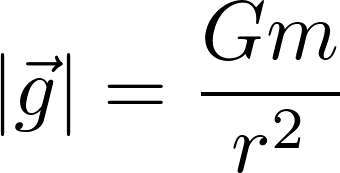
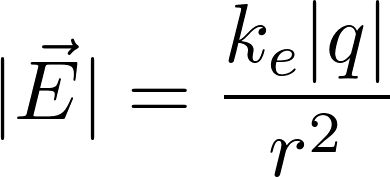
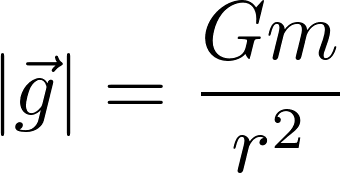
Both gravitational and electric fields follow inverse-square laws, and their equations are structurally similar. The direction of the field depends on the nature of the source (mass or charge).
Gravitational Field: Created by a point mass or outside a uniform sphere/shell of mass. Direction is toward the center.
Electric Field: Created by a point charge or outside a uniform sphere/shell of charge. Direction is away from positive charges and toward negative charges.
Key Equations:
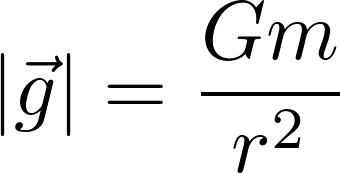
Gravitational field:
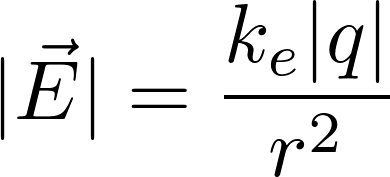
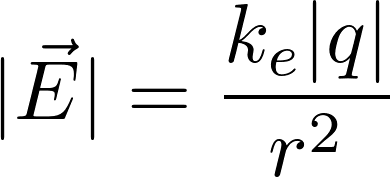
Electric field:
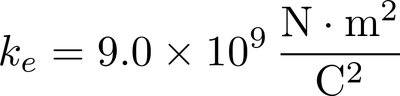
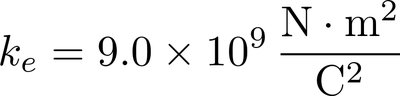
Electric constant:
Additional info: The analogy helps in understanding the behavior of fields and forces in both gravity and electricity, especially in the context of point sources.
Superposition Principle
Adding Fields from Multiple Point Charges
When multiple point charges are present, the net electric field at any point is the vector sum of the fields produced by each charge independently. This principle is crucial for solving problems involving more than one charge.
Fields must be added as vectors.
Fields from separate sources do not interfere with each other.
Each charge creates its own field, unaffected by the presence of others.
Example: If two charges of equal magnitude are placed equidistant from a point, the direction of the net field depends on the vector sum of their individual fields.
Coulomb's Law
Force Between Point Charges
Coulomb's Law describes the magnitude and direction of the force between two point charges. The force is attractive if the charges are of opposite signs and repulsive if they are of the same sign.
Magnitude:
Direction: Opposites attract, like charges repel.
Advice: Draw a diagram to determine the direction of forces.

Example: If a third charge is placed between two charges, the net force can be zero at a specific location depending on the magnitudes and signs of the charges.
Electric Field Lines
Visualizing Electric Fields
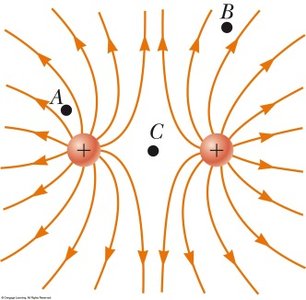
Electric field lines provide a graphical representation of the electric field in space. They help visualize the direction and strength of the field.
The electric field at a point is tangent to the field line passing through that point.
The density of lines indicates the strength of the field (more lines = stronger field).
Field lines can only end on charges or at infinity.
Field lines cannot cross.
Warnings:
Field lines should be pictured in 3D.
There is a field vector at every point in space, even between the field lines.
Field lines are not necessarily the trajectory that charged particles will follow.
Field lines are useful for visualization but not for quantitative problem solving.
Example: Denser lines near a charge indicate a stronger field, which results in a greater force and acceleration on a test charge placed there.
Uniform Electric Field
Applications and Characteristics
A uniform electric field has constant magnitude and direction, typically produced by two large plates of charge (capacitor). It is used in many electronic applications.
Formed by two large plates of charge, not point charges.
Applications: capacitors, keyboard keys, camera flash.
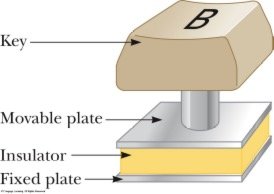
Example: The force on an electron in a uniform electric field is given by , where for an electron, so .
Summary
Key Takeaways
Gravitational and electric force laws are structurally similar.
Fields from point charges/masses and forces between them follow inverse-square laws.
The principle of superposition allows independent treatment of each charge.
Field lines are useful for visualization but must be interpreted carefully.