 Back
BackElectric Fields: Models, Symmetry, and Charge Distributions
Study Guide - Smart Notes
 Tailored notes based on your materials, expanded with key definitions, examples, and context.
Electric Fields and Charge Distributions
Introduction to Electric Fields
Electric fields are fundamental to understanding the interactions between charged particles. The field concept allows us to describe the influence of charges in space and forms the basis for analyzing forces, energy, and motion in electricity and magnetism.
Electric Field (\(\vec{E}\)): A vector field representing the force per unit charge exerted on a test charge at any point in space.
Charge Model: Charges can be positive or negative, and their interactions are governed by Coulomb's Law.
Field Model: The electric field mediates the force between charges, and its strength and direction are determined by the configuration of the source charges.

Electric Field from Point Charges
The electric field produced by a collection of point charges is calculated using the principle of superposition. Each charge contributes to the total field at a point, and the vector sum gives the resultant field.
Coulomb's Law: The electric field from a point charge \(q\) at distance \(r\) is given by:
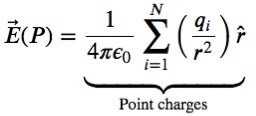
Superposition Principle: For multiple charges, sum the individual fields:

Electric Field from Continuous Charge Distributions
For objects with distributed charge, the field is calculated by integrating over the charge distribution. The type of distribution (line, surface, or volume) determines the integration method.
Line Charge: Charge per unit length \(\lambda\).
Surface Charge: Charge per unit area \(\sigma\).
Volume Charge: Charge per unit volume \(\rho\).
General Formula:

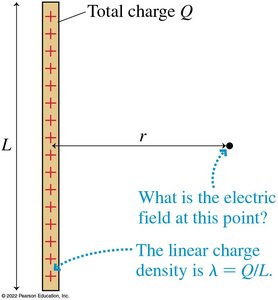
Example: For a rod of length \(L\) and linear charge density \(\lambda\):
Symmetry in Electric Field Calculations
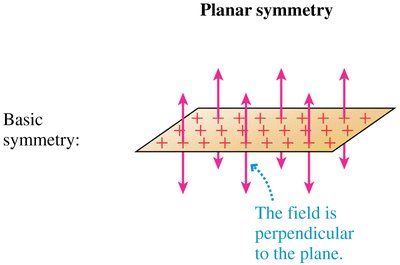
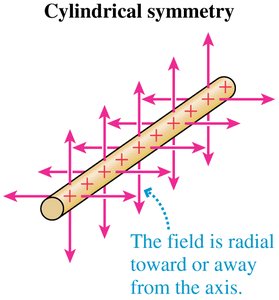
Symmetry simplifies electric field calculations by allowing us to predict the direction and magnitude of the field without full integration. The field must reflect the symmetries of the charge distribution.
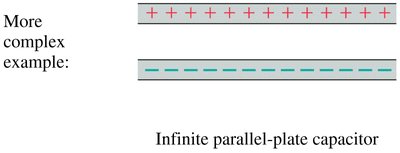
Planar Symmetry: Field is perpendicular to the plane.
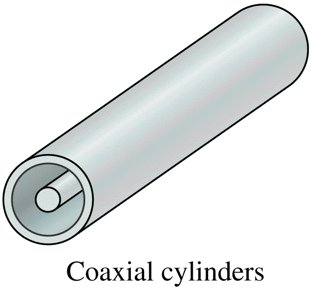
Cylindrical Symmetry: Field is radial from the axis.
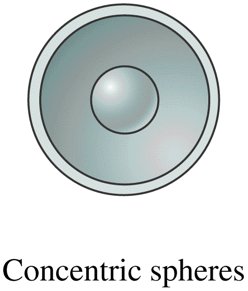
Spherical Symmetry: Field is radial from the center.
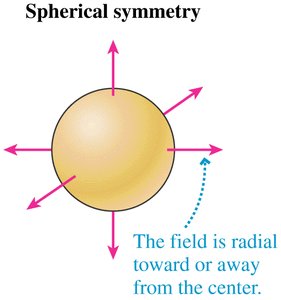
Complex Symmetry: Examples include parallel-plate capacitors, coaxial cylinders, and concentric spheres.
Electric Field of Special Charge Distributions
Different charge distributions produce characteristic electric fields. The field's dependence on distance and direction is determined by the geometry and symmetry of the distribution.
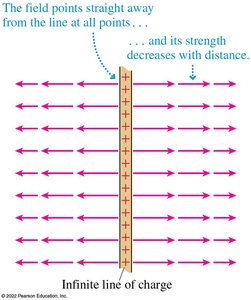
Infinite Line of Charge: Field points radially outward and decreases with distance.
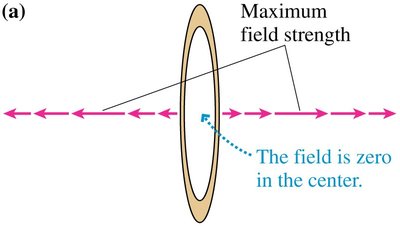
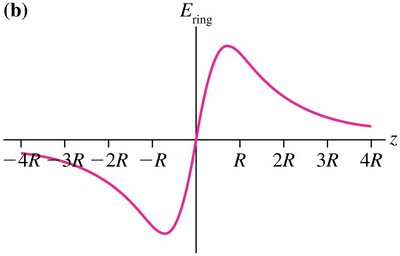
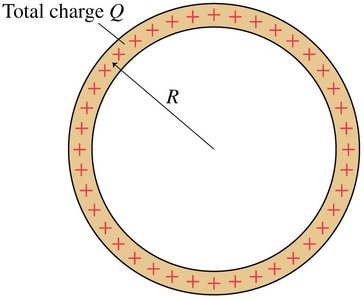
Charged Ring: Field is zero at the center, maximum on the axis, and decreases with distance.
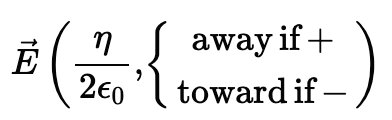
Infinite Charged Plane: Field is constant and perpendicular to the plane.

Summary Table: Comparison of line, ring, and disk charge distributions.

Electric Dipoles
An electric dipole consists of two equal and opposite charges separated by a distance. The dipole moment \(p = qd\) characterizes its strength. The field of a dipole falls off as the inverse cube of the distance.
Dipole Field:
Summary of Electric Field Models
Electric field models are essential for predicting the behavior of charges in various configurations. The choice of model depends on the geometry and symmetry of the charge distribution.
Key Equations:
(Point charge) (Line charge) (Surface charge) (Volume charge)
Applications: Used in calculating fields for capacitors, conductors, and molecular dipoles.
Additional info: These notes cover the foundational concepts for Chapter 23 (Electric Fields) and are directly relevant to college-level physics courses on electricity and magnetism.
