 Back
BackElectric Fields: Point Charges, Continuous Distributions, and Applications Ch 23
Study Guide - Smart Notes
 Tailored notes based on your materials, expanded with key definitions, examples, and context.
Electric Fields and Their Sources
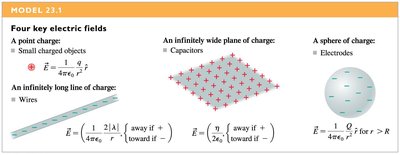
Point Charges and the Electric Field
The electric field is a fundamental concept in electromagnetism, describing the force per unit charge exerted by a charged object. For a point charge, the electric field at a distance r from the charge is given by Coulomb's law:
Definition: The electric field \( \vec{E} \) due to a point charge Q is:
Variables: Q is the charge, r is the distance from the charge, \( \hat{r} \) is the unit vector pointing away from the charge, and \( \epsilon_0 \) is the permittivity of free space.
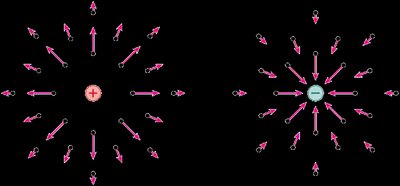
Direction: The field points away from positive charges and toward negative charges.
Example: The field around a proton (positive charge) radiates outward, while for an electron (negative charge) it points inward.
Superposition Principle
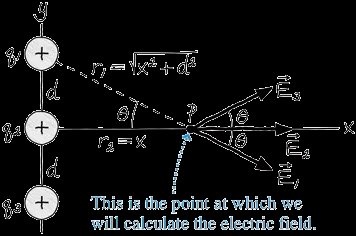
When multiple charges are present, the total electric field at any point is the vector sum of the fields produced by each charge:
Superposition:
Application: Used to calculate the field at a point due to several point charges.
Example: Three equal point charges arranged along a line; the field at a given point is found by summing the contributions from each charge.
Electric Dipoles and Multipoles
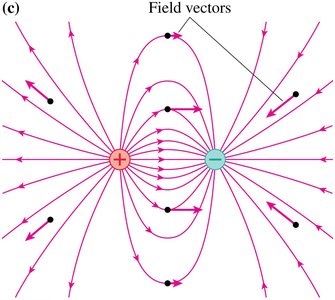
Electric Dipole
An electric dipole consists of two equal and opposite charges separated by a distance. The dipole moment \( \vec{p} \) is defined as:
Dipole Moment: , where q is the charge and \( \vec{d} \) is the separation vector.
Field on Axis:
Field in Bisecting Plane:
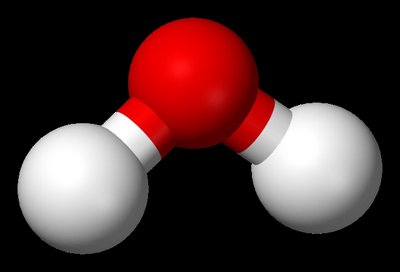
Example: Water molecule acts as a dipole due to its charge distribution.


Continuous Charge Distributions
Line of Charge
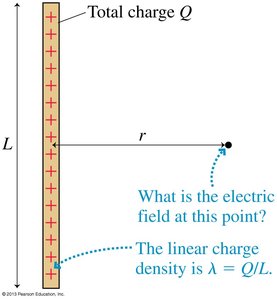
For a uniformly charged rod, the electric field at a point is calculated by integrating the contributions from each infinitesimal segment:
Linear Charge Density: , where Q is total charge and L is length.
Field Calculation: Divide the rod into small elements, sum their fields, and integrate.
Ring of Charge
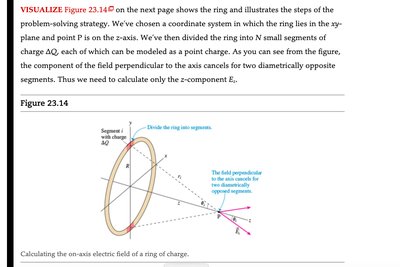
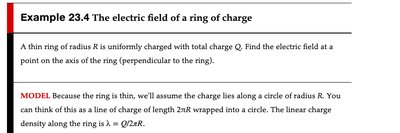
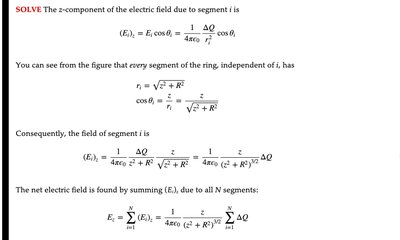
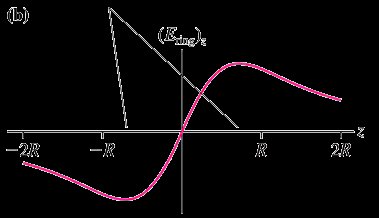
A ring of charge produces an electric field along its axis. The field is calculated by summing the z-components from each segment:
Field at Point on Axis:
Linear Charge Density:
Example: Field is zero at the center (z=0) due to symmetry.
Disk and Plane of Charge
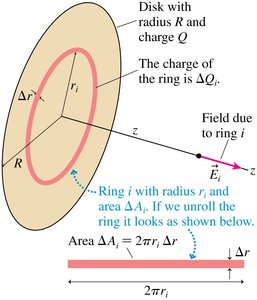
A disk of charge can be considered as a collection of concentric rings. For an infinite plane, the electric field is uniform and independent of distance:
Surface Charge Density: , where A is area.
Field of Infinite Plane: (away from plane if charge +, toward if -)

Applications: Capacitors and Spherical Distributions
Parallel-Plate Capacitor
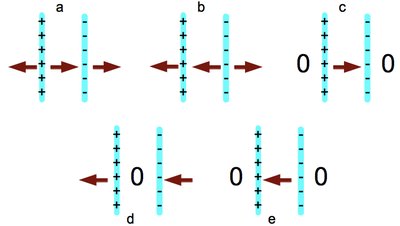
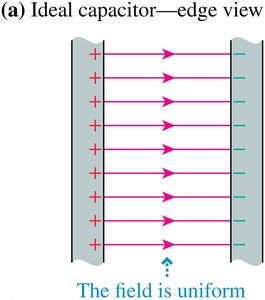
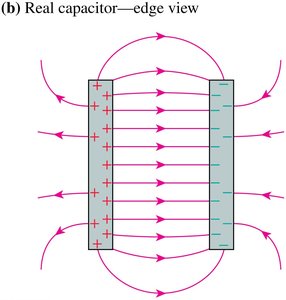
A parallel-plate capacitor consists of two large plates with equal and opposite charges. The electric field between the plates is nearly uniform:
Field Inside: (from positive to negative plate)
Field Outside: Zero (ideally)
Key Point: The field is constant and independent of position between the plates.


Spherical Charge Distributions
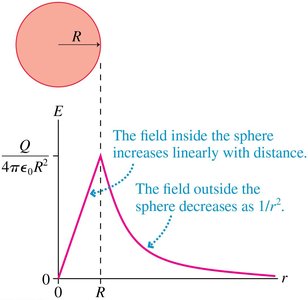
For a sphere with uniform charge, the electric field outside behaves as if all charge were concentrated at the center. Inside, the field depends on the charge distribution:
Field Outside: for
Field Inside: Increases linearly with distance from center.
Hollow Shell: Field inside is zero.
Summary Table: Key Electric Field Formulas
Source | Electric Field Formula | Notes |
|---|---|---|
Point Charge | Radial, away/toward charge | |
Infinite Line | Perpendicular to line | |
Infinite Plane | Uniform, independent of distance | |
Sphere (outside) | Same as point charge |
Additional info:
For continuous charge distributions, the field is calculated by integrating over the distribution.
Capacitors are essential in electronics for storing energy and creating uniform fields.
Dipoles are important in molecular physics and chemistry, especially for polar molecules like water.
