 Back
BackElectric Forces and Electric Fields: Study Notes
Study Guide - Smart Notes
 Tailored notes based on your materials, expanded with key definitions, examples, and context.
Electric Charge and Static Electricity
Definition and Properties of Electric Charge
Electric charge is a fundamental property of matter responsible for all electric phenomena. It is symbolized by q or Q and comes in discrete quantities, with the elementary charge given by . Protons carry a charge of , while electrons carry . Objects are electrically charged if they have an unequal number of protons and electrons.
Protons are held in atomic nuclei and cannot move.
Electrons are mobile and responsible for most electric phenomena.
Any amount of charge is a multiple of the elementary charge.
Static Electricity Experiment
When materials such as wool and plastic are rubbed together, electrons transfer from one material to another, resulting in one object becoming negatively charged and the other positively charged. Plastic typically has a high electron affinity, so electrons move from wool to plastic.
Objects initially neutral (equal numbers of + and - charges).
After rubbing, plastic gains electrons (negative), wool loses electrons (positive).
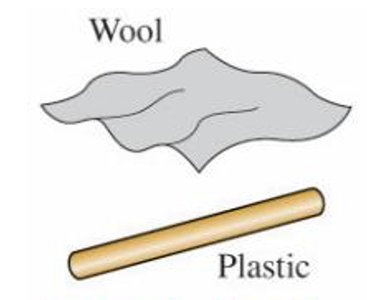
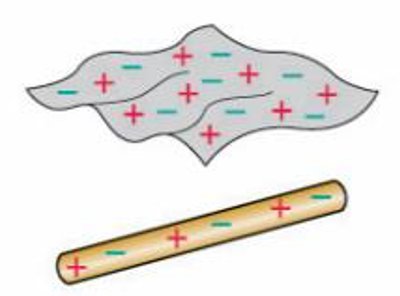
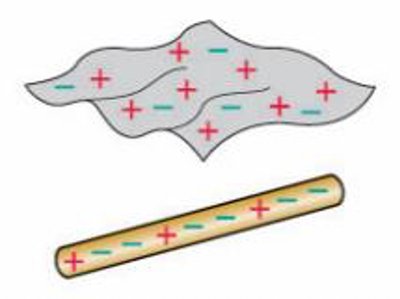
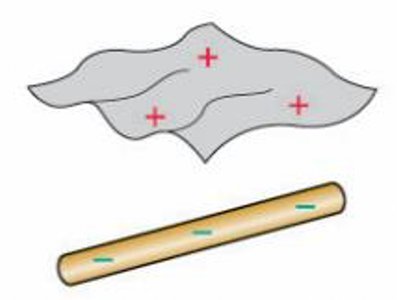
Example: A honeybee picks up a small positive charge while flying, attracting pollen grains to its body.

Conductors, Insulators, and Charge Polarization
Conductors
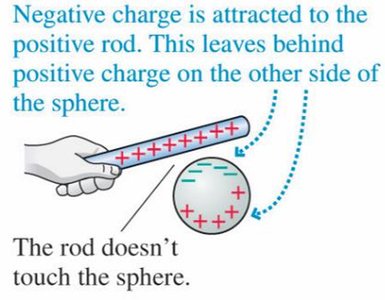
Conductors allow free movement of electric charge, typically electrons. Most metals are conductors. When a charged object is brought near a conductor, it polarizes the conductor, redistributing charges within it.
Free electrons move in response to external charges.
Charge polarization occurs without direct contact.
Insulators and Induced Dipoles
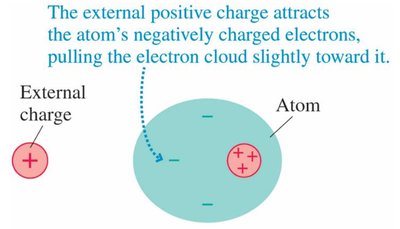
Insulators prevent free motion of electrons. When a charged object is brought near an insulator, it distorts the electron clouds of nearby atoms, creating induced electric dipoles.
Atoms become polarized, but electrons do not move freely.
Induced dipoles interact with external charges.
Charge Polarization and Electric Force Interactions
Electrically neutral objects, when charge polarized, can interact with other objects via electric forces. This explains phenomena such as pollen sticking to a charged bee.
Example: Neutral pollen grains become polarized and stick to a positively charged honeybee.

Coulomb's Law and Electric Force
Coulomb's Law
The electric force between two point charges is described by Coulomb's Law:
Magnitude:
is the electrostatic constant:
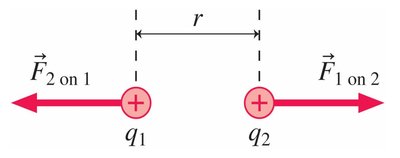
Forces are vectors: opposite charges attract, like charges repel.
Direction and Vector Notation
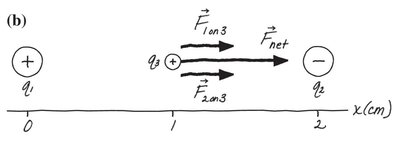
Forces between charges are equal in magnitude but opposite in direction. The notation and is used to specify which charge exerts the force.
Examples of Electric Force Calculations
Example 1: Two +10 nC charges are 2.0 cm apart. A +1.0 nC charge sits midway between them. The net force on the middle charge is zero because the forces from each side cancel.
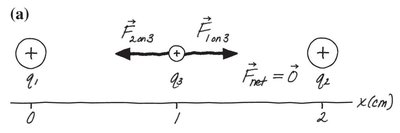
Example 2: If one of the side charges is negative, the forces on the middle charge add, resulting in a net force in one direction.
Trigonometry in Electric Force Calculations
Right Triangle Relationships
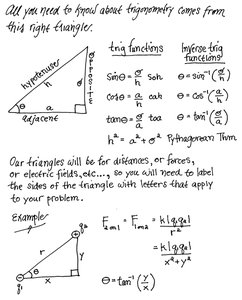
Trigonometry is essential for resolving forces in two dimensions. The basic relationships are:
Adding Forces in Two Dimensions
Vector Addition of Forces
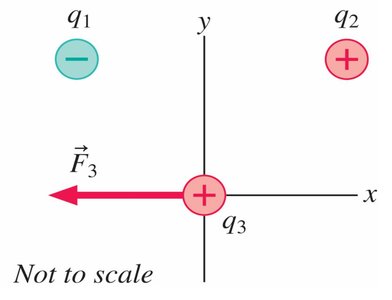
When multiple charges are present, the net force is found by adding the x- and y-components of each individual force. This is often visualized using vector diagrams.
Compute each force's magnitude using Coulomb's Law.
Resolve each force into x and y components using trigonometry.
Add components to find the net force.
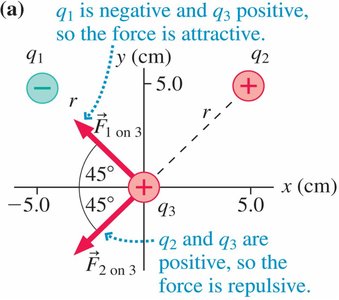
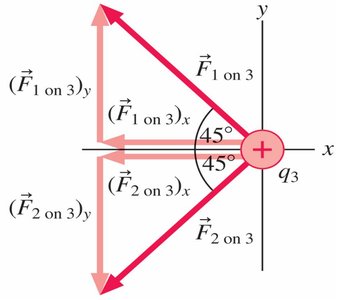
The net force on the central charge is pointing in the -x direction.
Summary Table: Types of Materials and Charge Behavior
Material Type | Charge Mobility | Polarization Mechanism |
|---|---|---|
Conductor | Free electrons move | Redistribution of electrons |
Insulator | Electrons do not move freely | Distortion of electron clouds (induced dipoles) |
Additional info: Table inferred for clarity based on academic context.
