 Back
BackElectric Potential and Potential Energy: Concepts, Calculations, and Applications
Study Guide - Smart Notes
 Tailored notes based on your materials, expanded with key definitions, examples, and context.
Electric Potential
Definition and Basic Properties
Electric potential is a fundamental concept in electrostatics, representing the electric potential energy per unit charge at a specific point in space. It is a scalar quantity and can be positive, zero, or negative depending on the configuration of charges.
Symbol: V
Unit: Volt (V), where 1 V = 1 J/C
Formula:
Nature: Scalar quantity
Potential Difference and Work
The potential difference between two points A and B is related to the work done by the electric field in moving a test charge between these points.
Formula:
Work:
Calculating Electric Potential
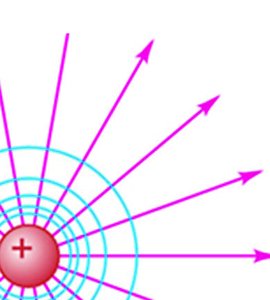
Potential Due to a Point Charge
The electric potential at a distance r from a point charge q is given by:
Formula: , where
Example: For nC and cm,
Potential Due to Multiple Point Charges
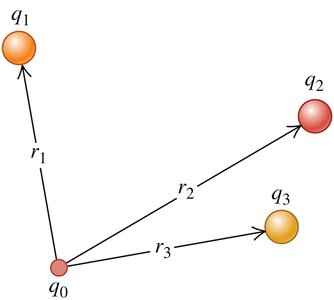
When several point charges are present, the total potential at a point is the algebraic sum of the potentials due to each charge.
Formula:
Example: For nC, nC, cm, cm,
Potential Due to a Continuous Charge Distribution (Thin Rod)
For a thin rod with uniform charge density, the potential at a point is calculated using integration.
Charge density:
Formula:
For :
Equipotential Surfaces and Electric Field Lines
Equipotential Surfaces for Point Charges
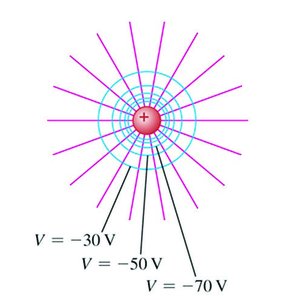
Equipotential surfaces are regions where the electric potential is constant. For a single point charge, these surfaces are concentric spheres centered on the charge.
Electric field lines: Perpendicular to equipotential surfaces
Potential values: Decrease with distance from the charge
Equipotential Surfaces for Dipoles and Multiple Charges
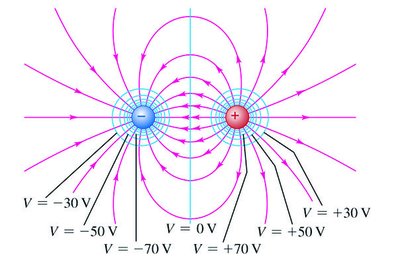
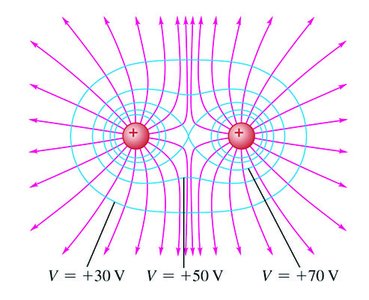
For a dipole or two equal positive charges, the equipotential surfaces and field lines become more complex, reflecting the superposition of potentials.
Dipole: Surfaces are distorted, with zero potential at the midpoint
Two equal positive charges: Surfaces are symmetric, with higher potential near the charges
Potential of a Dipole
Calculation and Example
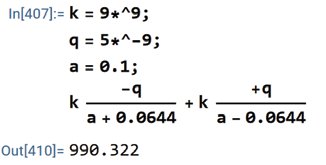
The potential at a point along the axis of a dipole (two equal and opposite charges separated by distance 2a) is given by:
Formula:
Example: For nC, m, m,
Relationship Between Electric Field and Potential
Gradient and Direction
The electric field is related to the spatial rate of change of the electric potential. It points in the direction of greatest decrease of potential.
Formula:
Component form:
Units: V/m = N/C
Potential Energy in Electric Fields
Potential Energy of a System of Charges
The potential energy of a test charge in the presence of multiple source charges is given by:
Formula:
Conservation of Energy
In electrostatics, the total mechanical energy (kinetic plus potential) is conserved:
Formula:
Application: Used to solve problems involving motion in electric fields
Special Cases and Properties
Equipotential Surfaces and Conductors
Points on the surface of a conductor are at the same potential, forming an equipotential surface. The electric field inside a conductor is zero.
Equipotential surface: for any points A and B on the surface
Conservative field: The work done moving a charge between two points on the same equipotential surface is zero
Summary Table: Electric Potential Formulas
Configuration | Formula for V | Notes |
|---|---|---|
Point charge | r = distance from charge | |
Multiple point charges | Sum over all charges | |
Thin rod (uniform charge) | λ = charge density, L = length, a = distance | |
Dipole (on axis) | a = half separation |
Examples and Applications
Example: Potential of a Line of Charge
For a line of charge with uniform density, the potential difference between two points is:
Formula:
Example: Conservation of Energy in Electric Fields
When a charge moves in an electric field, its kinetic and potential energies change according to:
Formula:
Application: Used to find unknown positions or velocities
Example: Potential Energy with Multiple Sources
The potential energy of a test charge in the presence of several source charges is:
Formula:
Additional info: Some formulas and explanations have been expanded for clarity and completeness, including the general relationship between electric field and potential, and the summary table of formulas for different charge configurations.
