 Back
BackElectric Potential and Potential Energy in Electrostatics
Study Guide - Smart Notes
 Tailored notes based on your materials, expanded with key definitions, examples, and context.
Electric Potential and Potential Energy
Potential Energy of a Test Charge
The potential energy of a test charge in an electric field is a fundamental concept in electrostatics. It describes the energy a charge possesses due to its position in an electric field, and is closely related to the work done by the field when the charge moves.
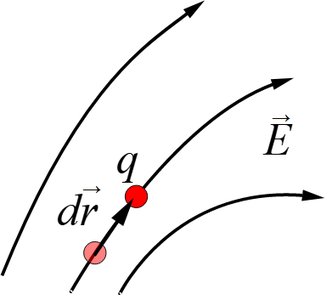
Work Done by the Field: The work done by the electric field to move a charge q from point A to point B is given by: This work is path-independent, ensuring energy conservation.
Potential Energy Expression: The potential energy at position r is:
Path Independence: The work done does not depend on the path taken between points A and B.
Electric Potential
Electric potential is defined as the potential energy per unit charge. It is a scalar quantity that simplifies calculations involving electric fields and energy.
Definition:
Units: Volts (V), where
Electron-Volt: The energy change of an elementary charge undergoing a potential difference of 1 V:
Relationship Between Electric Potential and Electric Field
The electric field is related to the spatial variation of the electric potential. The field points in the direction of decreasing potential.
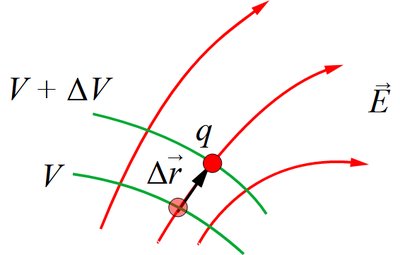
Potential Change: When a charge moves by , the potential changes by:
Component Form: , ,
Gradient Operator:
General Relation:
Equipotential Surfaces
Properties and Representation
Equipotential surfaces are imaginary surfaces where the electric potential is constant. They are useful for visualizing electric fields and understanding their properties.
Definition: Surfaces where
Graphic Representation: Equipotential surfaces can be drawn to represent the electric field visually.
Potential Difference: Neighboring equipotential surfaces differ by a constant step .
Field Strength: The denser the equipotential surfaces, the stronger the electric field.
Field Orientation: The electric field is always perpendicular to equipotential surfaces and cannot be tangential.
Electric Potential of Point Charges and Charge Distributions
Point Charge
The electric potential due to a point charge is a classic result in electrostatics. It forms the basis for understanding more complex charge distributions.
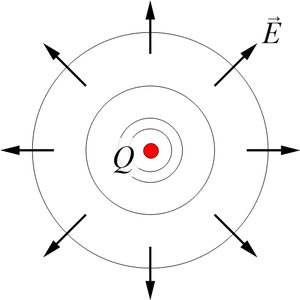
Electric Field of a Point Charge: , where
Equipotential Surfaces: Concentric spheres centered at the charge.
Potential at Distance r:
Generalization: For a charge at :
Multiple Charges:
Continuous Distribution:
Exercises and Problems
Exercise 1: Equipotential Surfaces as Parallel Planes
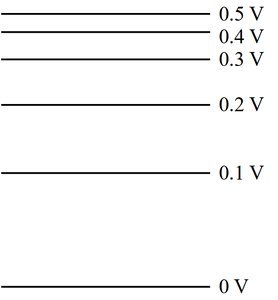
Is it possible to have an electric field whose equipotential surfaces are parallel planes with increasing density in a particular direction?
Analysis: Parallel equipotential planes correspond to a uniform electric field. If their density increases in a direction, the field strength increases in that direction, implying a non-uniform field.
Conclusion: Yes, it is possible if the field is non-uniform and the potential changes more rapidly in the direction of increasing plane density.
Exercise 2: Electric Field from a Given Potential
Given , where and is a constant, find the electric field .
Solution: The electric field is the negative gradient of the potential:
Calculation: Therefore,
Problem 3: Argon Ion Acceleration in a Mass Spectrometer
An Argon ion (m = 40 a.m.u., 1 a.m.u. = kg) is accelerated from rest by a uniform electric field of 10 kV/m between two grids separated by d = 10 cm. Find the velocity of the ion when it leaves the acceleration region.
Solution Steps:
Calculate the force:
Work done:
Set work equal to kinetic energy:
Solve for :
Example Calculation: For a singly charged Argon ion ( C), V/m, m, kg:
Problem 4: Terminal Velocities of Released Point Charges
Two point-like charges C and C are initially at rest, separated by d = 10 cm. Their masses are g and g. Find their terminal velocities after release.
Solution Steps:
Initial potential energy:
After release, all potential energy converts to kinetic energy:
Momentum conservation:
Solve the system for and .
Example Calculation: , (Insert values for , , , , to compute numerically.)
Additional info: The above problems and exercises are expanded with academic context to ensure completeness and clarity for exam preparation.
