 Back
BackElectric Potential at the Center of a Cube with Point Charges
Study Guide - Smart Notes
 Tailored notes based on your materials, expanded with key definitions, examples, and context.
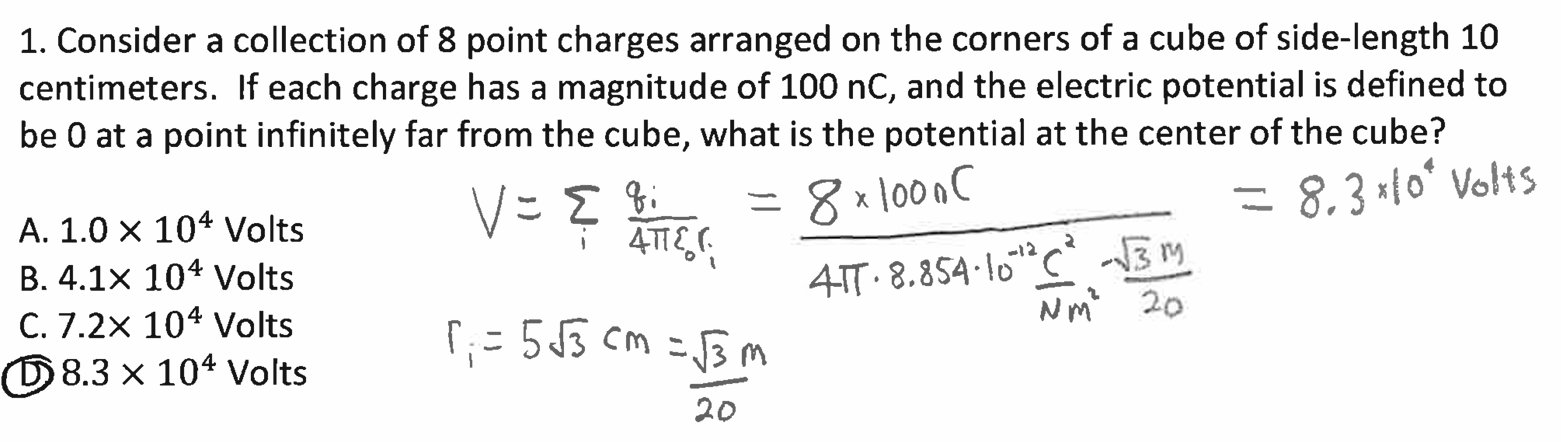
Q1. What is the electric potential at the center of a cube if 8 point charges (each 100 nC) are placed at the corners of a cube with side length 10 cm, and the potential is defined as zero at infinity?
Background
Topic: Electrostatics – Electric Potential
This question tests your understanding of how to calculate the electric potential at a point due to multiple point charges, specifically using the principle of superposition and the formula for electric potential from a point charge.
Key Terms and Formulas
Electric potential (): The work needed to bring a unit positive charge from infinity to a point in space.
Superposition principle: The total potential at a point is the sum of the potentials due to each charge.
Formula for potential from a point charge:
= charge at corner
= permittivity of free space ()
= distance from charge to the center of the cube
Step-by-Step Guidance
First, recognize that all 8 charges are identical and equidistant from the center of the cube. So, the potential at the center is the sum of the potentials from each charge.
Calculate the distance from a corner to the center of the cube. For a cube of side , the distance is , but since the side length is 10 cm, convert to meters: m.
Plug in the values for nC ( C), , and into the formula for each charge, then multiply by 8 (since there are 8 charges).
Set up the expression for the total potential at the center:
Where meters.
Try solving on your own before revealing the answer!
Final Answer: 8.3 × 10⁴ Volts
By plugging in the values and calculating, you find the electric potential at the center is approximately Volts.
This result comes from correctly applying the superposition principle and using the distance from each corner to the center.
