 Back
BackElectric Potential: Concepts, Calculations, and Applications
Study Guide - Smart Notes
 Tailored notes based on your materials, expanded with key definitions, examples, and context.
Unit 3: Electric Potential
3.1 Electric Potential
Electric potential is a fundamental concept in electromagnetism, describing the potential energy per unit charge at a point in an electric field. It is analogous to gravitational potential energy in mechanics.
Definition: The electric potential difference (ΔV) between two points is the work done by the electric field in moving a unit positive charge from one point to another.
Formula:
Potential Energy: The change in potential energy (ΔU) for a charge q is:
Work-Energy Relation: The work done by the electric field is:
Units: The SI unit of electric potential is the volt (V), where .
Example: Moving a charge against the direction of the electric field increases its electric potential energy, similar to lifting an object against gravity.
3.2 Potential Difference in a Uniform Electric Field
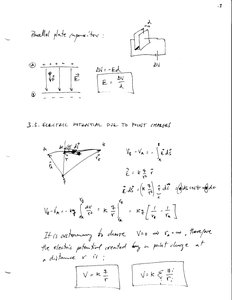
In a uniform electric field, the potential difference between two points separated by a distance d is given by:
Formula:
Equipotential Lines: These are lines or surfaces where the electric potential is constant. The electric field is always perpendicular to equipotential lines.
General Case: For any path,
Example: In a parallel plate capacitor, the electric field is uniform and the potential difference between the plates is proportional to the separation distance.
3.3 Electric Potential Due to Point Charges
The electric potential at a point due to a point charge is derived from Coulomb's law. For multiple point charges, the total potential is the algebraic sum of the potentials due to each charge.
Single Point Charge: where , q is the charge, and r is the distance from the charge.
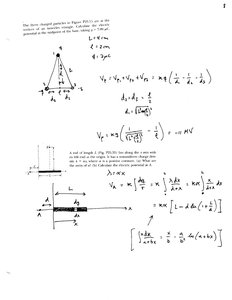
Multiple Point Charges:
Potential Energy of a System: For two charges,
Example: Calculating the potential at a vertex of an equilateral triangle due to charges at the other vertices.
3.4 Obtaining the Electric Field from the Electric Potential
The electric field is related to the spatial rate of change (gradient) of the electric potential. In one dimension:
Formula:
In three dimensions, the electric field is the negative gradient of the potential:
3.5 Electric Potential Due to Continuous Charge Distributions
For a continuous distribution of charge, the electric potential at a point is found by integrating over the charge distribution:
Formula:
This approach is analogous to calculating the electric field from a continuous charge distribution.
Worked Examples and Applications
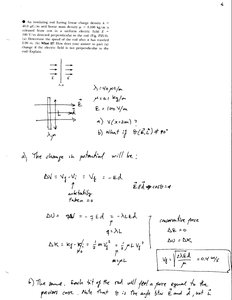
Uniformly Charged Rod in an Electric Field: Calculating the change in potential and kinetic energy as the rod moves in the field.
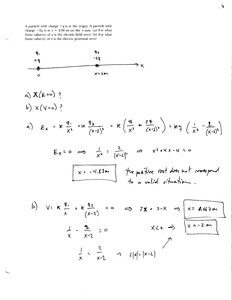
Finding Zero Electric Field and Potential: For two charges on the x-axis, solving for positions where the net electric field or potential is zero.
Potential Due to a Non-uniformly Charged Rod: Integrating the charge density to find the potential at a point.
Summary Table: Key Formulas
Concept | Formula |
|---|---|
Potential Difference (Uniform Field) | |
Potential Due to Point Charge | |
Potential Energy (Two Charges) | |
Electric Field from Potential | |
Potential (Continuous Distribution) |
Additional info: These notes cover the core concepts of electric potential, including its calculation for point charges and continuous distributions, the relationship to electric field, and practical applications such as capacitors and charge configurations. The included images reinforce the mathematical derivations and physical setups discussed in the text.
