 Back
BackElectric Potential: Concepts, Calculations, and Applications
Study Guide - Smart Notes
 Tailored notes based on your materials, expanded with key definitions, examples, and context.
Electric Potential and Electric Potential Energy
Definitions and Fundamental Concepts
Electric potential and electric potential energy are central concepts in electrostatics. Electric potential energy (U) is the energy a charged object possesses due to its position in an external electric field, while electric potential (V) is a property of the electric field itself, independent of any specific charge.
Electric Potential Energy (U): Scalar quantity measured in joules (J).
Electric Potential (V): Scalar quantity measured in volts (V), where 1 V = 1 J/C.
Relationship: , where is the test charge.
Potential Difference: The change in potential energy per unit charge between two points.
Example: Moving a charge in an electric field changes its potential energy, which can be calculated using the work done by the field.
Work and Electric Potential
When a charge moves in an electric field, the work performed is related to the change in electric potential energy:
Work Done by the Field:
Units: 1 V = 1 J/C; 1 N/C = 1 V/m
Electron-Volt (eV): A unit of energy commonly used in atomic and nuclear physics.
Example: A particle with charge moving through a potential difference of 100 V gains of energy.
Electric Potential in Uniform Electric Fields
Potential Difference and Field Direction
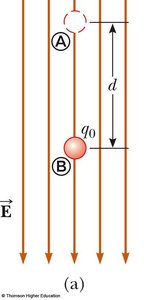
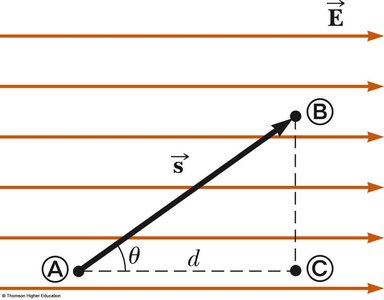
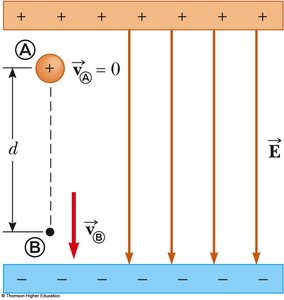
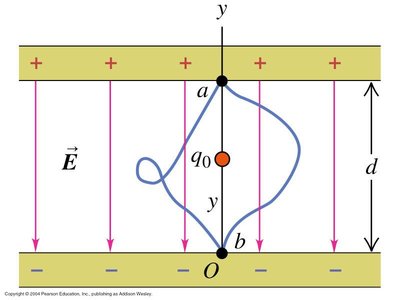
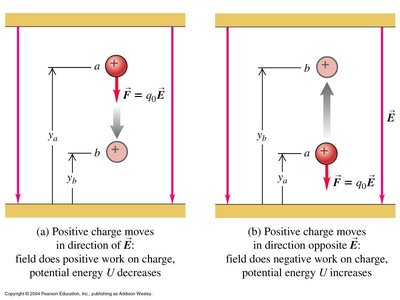
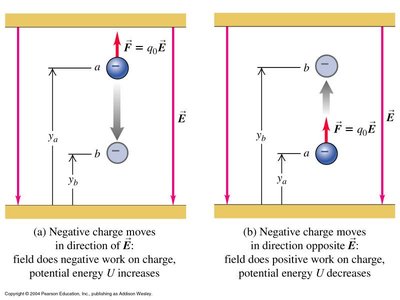
In a uniform electric field, the potential difference between two points is proportional to the distance and the field strength. The electric field always points in the direction of decreasing electric potential.
Potential Difference:
Work:
Energy Change:
Example: A positive charge moving in the direction of the field loses potential energy, while a negative charge gains potential energy.
Electric Potential Due to Point Charges
Calculation and Superposition Principle
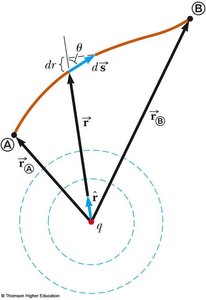
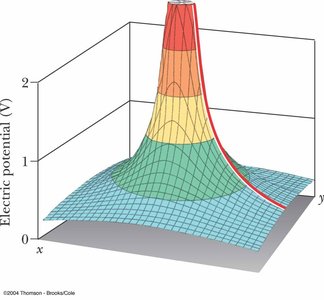
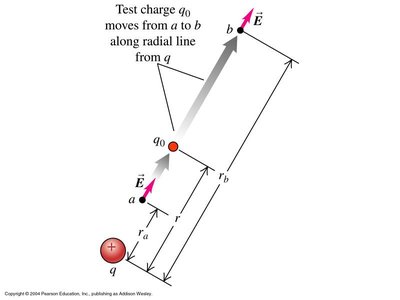
The electric potential at a point due to a single point charge is given by:
Potential at Distance r: , where is Coulomb's constant.
Potential Difference:
Superposition Principle: For multiple charges, the total potential is the algebraic sum of individual potentials.
Example: The potential at a point due to several charges:
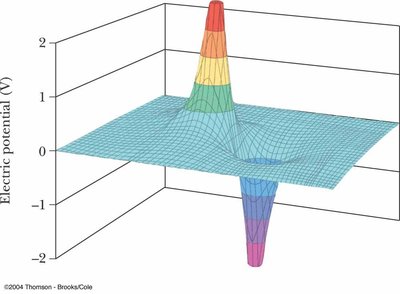
Electric Potential Energy of Systems of Charges
Two and Multiple Point Charges
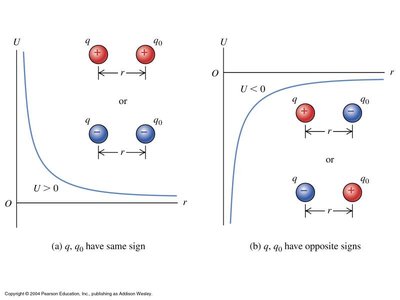
The electric potential energy of a system of two point charges is:
Two Charges:
Multiple Charges: $U = k_e \sum_{i
Significance: If charges have the same sign, U is positive; if opposite, U is negative.
Example: For three charges, sum the potential energy for each pair.
Equipotential Surfaces and Electric Fields
Properties and Visualization
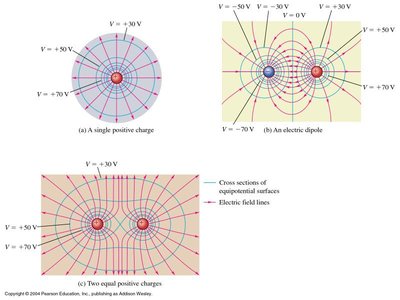
An equipotential surface is a surface where all points have the same electric potential. The electric field at every point on an equipotential surface is perpendicular to the surface.
No Work Required: Moving a charge along an equipotential surface requires no work.
Field Lines: Always perpendicular to equipotential surfaces.
Example: Equipotential surfaces for a point charge are concentric spheres.
Electric Potential for Continuous Charge Distributions
Integration Approach
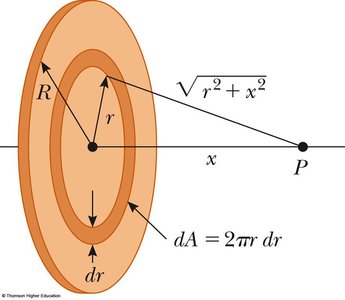
For continuous charge distributions, the electric potential at a point is calculated by integrating over the distribution:
Potential from Element:
Total Potential:
Example: Potential on the axis of a uniformly charged disk:
Electric Potential of Conductors
Charged Conductors and Equipotential Surfaces
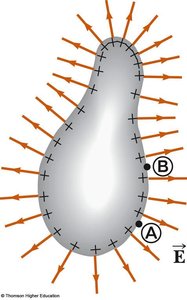
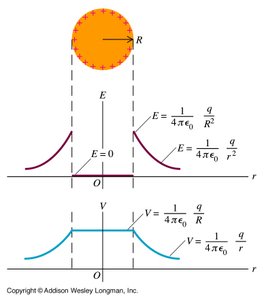
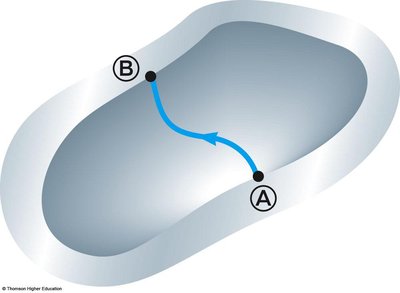
On a charged conductor in electrostatic equilibrium, the electric potential is constant everywhere on the surface and inside the conductor.
Field Inside:
Potential Difference: between any two points on the surface
Equipotential Surface: The surface of a conductor is an equipotential.
Applications and Experiments
Millikan Oil-Drop Experiment
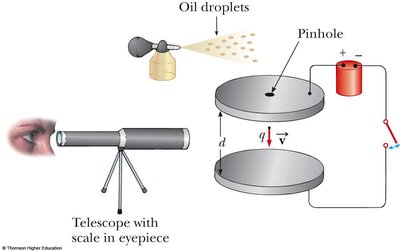
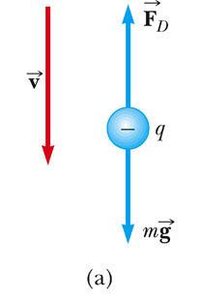
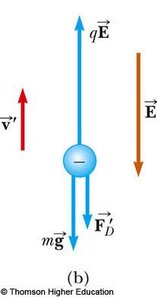
The Millikan oil-drop experiment measured the elementary charge and demonstrated charge quantization. Oil droplets are suspended between charged plates, and their motion is observed under the influence of electric and gravitational forces.
Key Result:
Quantization: , where is an integer
Van de Graaff Generator
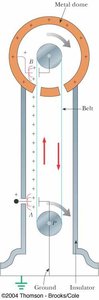
A Van de Graaff generator delivers charge to a high-potential electrode using a moving belt, generating large voltages for particle acceleration and nuclear reactions.
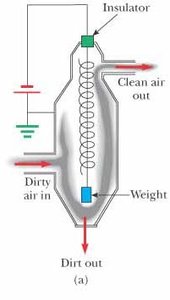
Electrostatic Precipitator and Air Cleaner
Electrostatic precipitators remove particulate matter from gases by charging particles and attracting them to walls. Electrostatic air cleaners use similar principles for home air purification.
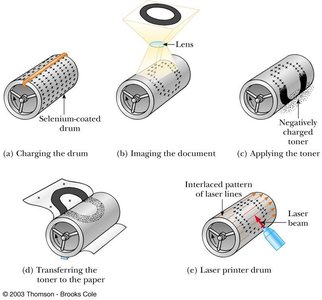
Xerographic Copiers and Laser Printers
Xerographic copiers and laser printers use photoconductive materials and electric fields to transfer toner to paper, forming images and text.
Summary Table: Key Equations and Concepts
Concept | Equation | Units |
|---|---|---|
Electric Potential | V (volt) | |
Potential Difference | V | |
Work in Electric Field | J (joule) | |
Potential (Point Charge) | V | |
Potential Energy (Two Charges) | J | |
Electron-Volt | eV, J |
