 Back
BackElectric Potential, Conductors, and Dielectrics: Study Notes
Study Guide - Smart Notes
 Tailored notes based on your materials, expanded with key definitions, examples, and context.
Electric Potential and Potential Energy
Concept of Electric Potential
Electric potential is a fundamental concept in electrostatics, describing the energy-related aspect of electric fields. It allows us to analyze electric fields using work and energy, rather than force alone.
Electric Potential (V): Defined as the electric potential energy per unit charge, measured in volts (V), where 1 V = 1 J/C.
Potential Energy (Uel): The energy a charge has due to its position in an electric field, relative to other charges.
Single Charge: Has no electric potential energy by itself, but creates electric potential for other charges to interact.
Reference Point: The potential at infinity is conventionally set to zero.
Formula:
Example: The potential at a point due to a single charge:
Comparison: Electric and gravitational potential energy have similar forms, but differ in sign and physical context.
Equipotential Surfaces
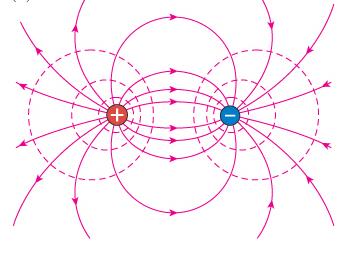
Equipotential surfaces are regions where the electric potential is constant. These surfaces are perpendicular to electric field lines and are often spherical around point charges.
Equipotential Surface: No work is required to move a charge along an equipotential surface.
Relation to Field: Electric field lines cross equipotential surfaces at right angles.
Electric Potential in Systems of Charges
Potential Due to Multiple Charges
The electric potential at a point due to several charges is the algebraic sum of the potentials from each charge.
Superposition Principle:
Potential Energy of a System: For two charges,
Adding More Charges: The total potential energy includes all pairwise interactions.
Formula for Three Charges:
Potential Difference and Path Independence
The potential difference between two points in an electric field is independent of the path taken, a property known as path independence.
Potential Difference:
Uniform Field:
Non-uniform Field:
Path Independence: The work done by the electric field depends only on the endpoints, not the path.
Uniform Electric Fields and Electron-Volt
Uniform Electric Field
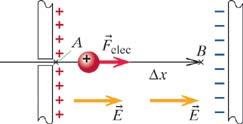
In a uniform electric field, the potential difference between two points is proportional to the distance between them.
Formula:
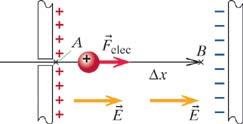
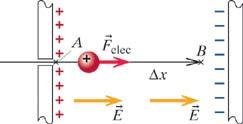
Direction: Positive charges move toward lower potential, negative charges move toward higher potential.
Electron-Volt (eV)
The electron-volt is a unit of energy commonly used in atomic and particle physics.
Definition: 1 eV is the energy gained by an electron moving through a potential difference of 1 volt.
Conversion:
Conductors in Electric Fields
Electrostatic Equilibrium
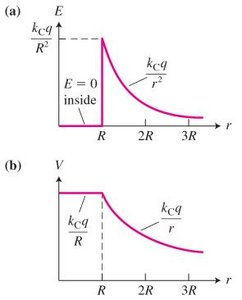
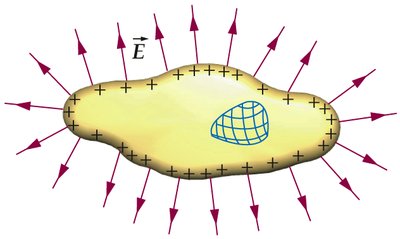
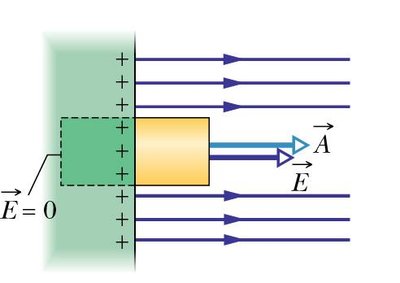
When a conductor reaches electrostatic equilibrium, the electric field inside the conductor is zero, and excess charge resides on the surface.
Key Properties: E = 0 inside the conductor; potential is constant throughout the conductor.
Surface Charges: Excess charge distributes itself on the surface.
Field Direction: The electric field just outside the surface is perpendicular to the surface.
Grounding and Charge Redistribution
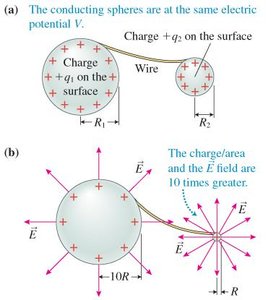
Grounding a conductor allows excess charge to flow to or from the Earth, equalizing the electric potential.
Grounding: Connecting a conductor to Earth to discharge excess charge.
Charge Redistribution: Charges move until the potential is equal on all connected conductors.
Shielding and Cavities
Conductors can shield their interiors from external electric fields. If a cavity is present, charges redistribute to cancel the field inside the cavity.
Shielding: Free electrons move to cancel external fields inside the conductor.
Cavity: Charges are drawn to the cavity surface to cancel the field inside.
Dielectric Materials in Electric Fields
Dielectric Response
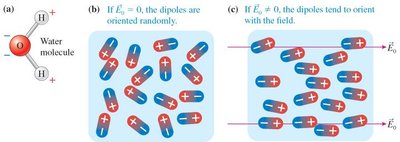
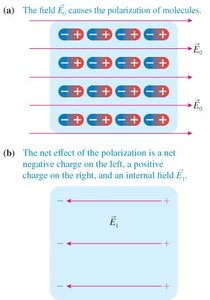
Dielectric materials respond to external electric fields by polarizing, which reduces the effective field inside the material.
Polarization: Atoms and molecules shift slightly, creating induced dipoles.
Dielectric Constant (κ): Characterizes the material's ability to reduce the internal field.
Formula:
Dielectric Constants Table
The dielectric constant varies by material, affecting how much the electric field is reduced inside the material.
Material | Dielectric Constant (κ) |
|---|---|
Vacuum | 1.0000 |
Dry air | 1.0006 |
Wax | 2.25 |
Glass | 4–7 |
Paper | 3–6 |
Axon membrane | 8 |
Body tissue | 8 |
Ethanol | 26 |
Water | 81 |
Electric Force in Dielectrics
The force between charges inside a dielectric is reduced by the dielectric constant.
Modified Coulomb's Law:
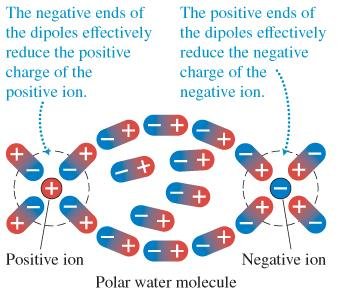
Applications: Salt Dissolving in Water
Dielectric effects explain why salt dissolves in water but not in air. The high dielectric constant of water reduces the attractive force between ions, allowing them to remain separated and participate in biological processes.
Biological Relevance: Freed sodium ions are used by the nervous system to transmit information.
Summary Table: Key Concepts
Concept | Definition | Formula |
|---|---|---|
Electric Potential (V) | Potential energy per unit charge | |
Potential Energy (Uel) | Energy due to position in field | |
Potential Difference (ΔV) | Difference between two points | |
Dielectric Constant (κ) | Field reduction factor | |
Electron-Volt (eV) | Energy unit |
Additional info: Academic context and expanded explanations were added to ensure completeness and clarity for exam preparation.
