 Back
BackElectric Potential Energy and Coulomb’s Law: Study Notes
Study Guide - Smart Notes
 Tailored notes based on your materials, expanded with key definitions, examples, and context.
Electric Potential Energy and Coulomb’s Law
Review of Work and Energy
Work is the energy transferred to or from an object via the application of force along a displacement. The work-energy equation relates the work done on a particle to its change in kinetic energy:
Work-Energy Equation:
Kinetic Energy:
SI Units: Joules (J) = Newton-meter (Nm)
For a system, the total energy (kinetic + potential) changes when external forces do work:
Electric Potential Energy
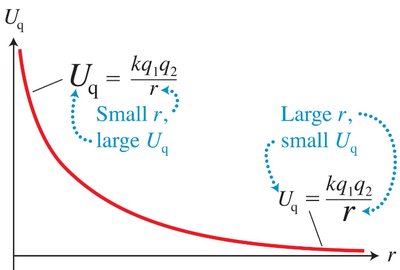
Electric potential energy arises when charged objects interact according to Coulomb’s Law. The energy is stored based on the configuration of the charges and their separation.
Definition: The energy stored due to the position of charged objects relative to each other.
Formula for Two Point Charges: , where
Significance: as
Charge Sign: Like charges (repulsion) yield positive ; opposite charges (attraction) yield negative $U_q$
Coulomb’s Law
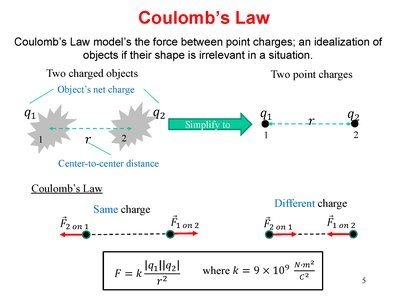
Coulomb’s Law models the force between point charges, idealizing objects if their shape is irrelevant. The force is proportional to the product of the charges and inversely proportional to the square of their separation.
Formula:
Direction: Repulsive for like charges, attractive for unlike charges
Vector Nature: The force acts along the line joining the centers of the charges
Work Done in Moving Charges
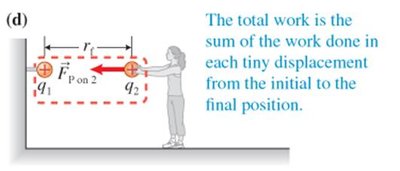
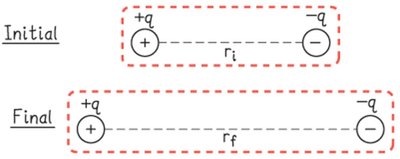
The work done by an external force to assemble a collection of charges (by bringing them from infinity to their final positions) equals the system’s potential energy.
Work-Energy Relation:
Application: Moving two charges from infinite separation to a finite distance stores potential energy
Multiple Charges: Pairwise Interactions
For a system of three or more charges, the total potential energy is the sum of the potential energies for each pair of charges.
Formula:
Each term:
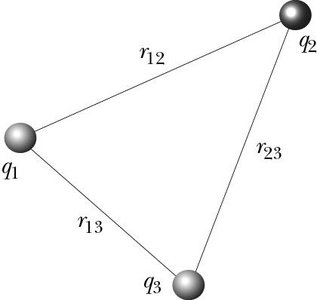
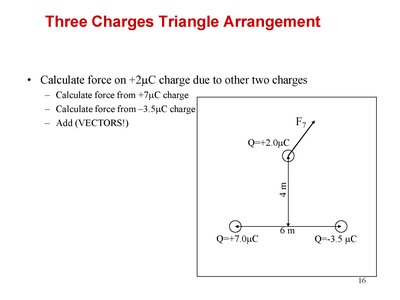
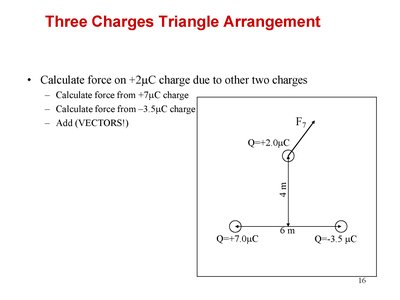
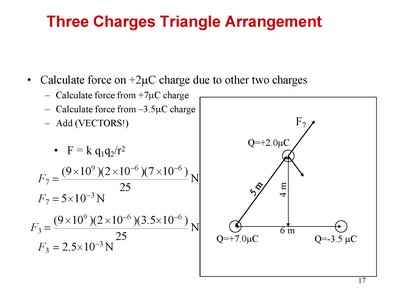
Example: Three Charges Triangle Arrangement
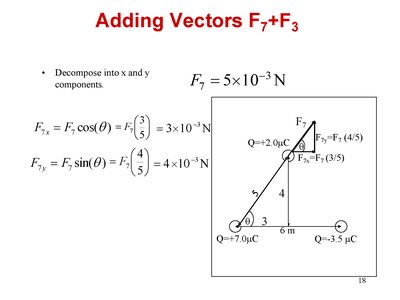
To calculate the force on a charge due to two other charges, use Coulomb’s Law for each pair and add the resulting vectors.
Calculate force from each charge separately
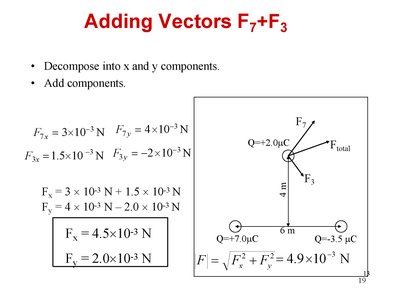
Add the forces as vectors (decompose into x and y components)
Resultant force:
Problem Solving Strategies
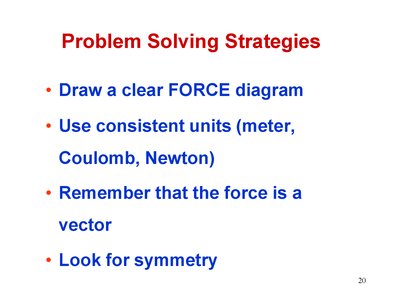
Effective strategies for solving electric force and potential energy problems include:
Draw a clear force diagram
Use consistent units (meter, Coulomb, Newton)
Remember that force is a vector
Look for symmetry in the arrangement of charges
Summary Table: Key Formulas
Concept | Formula | Description |
|---|---|---|
Coulomb’s Law | Force between two point charges | |
Electric Potential Energy | Potential energy of two point charges | |
Work-Energy Equation | Work done equals change in kinetic energy | |
Multiple Charges | $U_{total} = \sum_{i | Total potential energy for a system of charges |
Example: For three charges , , at distances , , , the total potential energy is:
Additional info: Academic context was added to clarify vector addition, the physical meaning of potential energy, and the importance of symmetry in problem solving.
