 Back
BackElectric Potential Energy and Coulomb’s Law: Study Notes
Study Guide - Smart Notes
 Tailored notes based on your materials, expanded with key definitions, examples, and context.
Electric Potential Energy and Coulomb’s Law
Electric Potential Energy: Concepts and Review
Electric potential energy is the energy stored in a system of charged objects due to their positions and interactions. It is a fundamental concept in electrostatics, describing how energy changes as charges move relative to each other.
Work-Energy Equation: The work done by external forces changes the total energy (kinetic + potential) of a system.
SI Units: Work and energy are measured in Joules (J), where 1 J = 1 Nm.
System Energy: For a system, the energy change is given by: where is the total energy (kinetic + potential) and is the external work.
Work-Energy for Charges: For charged particles, the equation becomes: where is kinetic energy and is potential energy.
Example: Moving a bead along a wire with a constant force involves calculating work using displacement and force.
Coulomb’s Law: Force Between Point Charges
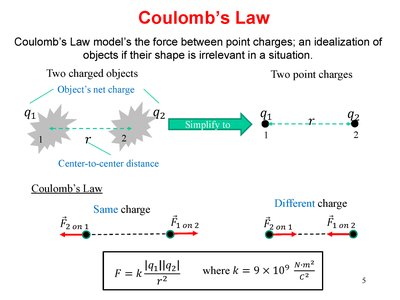
Coulomb’s Law describes the force between two point charges. The force is proportional to the product of their charges and inversely proportional to the square of the distance between them.
Formula: where , and are the charges, and is the center-to-center distance.
Direction: Like charges repel, unlike charges attract.
Vector Nature: The force acts along the line joining the charges.
Application: Used to calculate forces in systems of multiple charges.
Electric Potential Energy of Two Charges
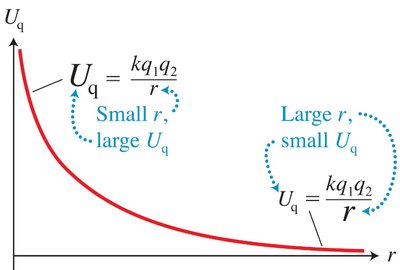
When two charges interact, they store electric potential energy. The amount depends on their magnitudes, signs, and separation.
Formula:
Significance: If , the energy is positive (repulsion); if , the energy is negative (attraction).
Separation: As , .
Graph: Shows how potential energy decreases with increasing separation.
Work Done in Moving Charges
The work required to move charges from one position to another is equal to the change in electric potential energy. This is especially important when assembling a system of charges.
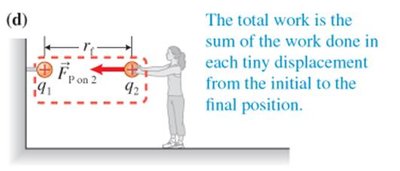
Work Calculation: The total work is the sum of the work done in each tiny displacement from the initial to the final position.
Formula: For two charges brought from infinity to a distance :
Example: Moving two charges from infinite separation to m requires work against repulsion.
Electric Potential Energy in Systems of Multiple Charges
For systems with more than two charges, the total electric potential energy is the sum of the energies for each pair of charges.
Formula:
Pairwise Interactions: Each pair of charges contributes to the total energy.
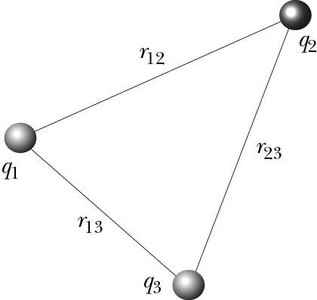
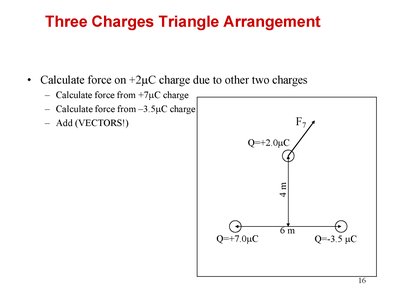
Example: Three point charges arranged in a triangle; calculate the energy for each pair and sum.
Force Calculation in Multiple Charge Systems
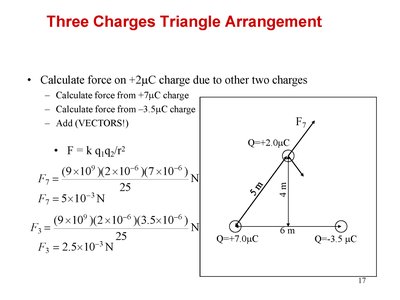
To find the force on a charge due to other charges, calculate the force from each charge separately and add them as vectors.
Step 1: Calculate force from each charge using Coulomb’s Law.
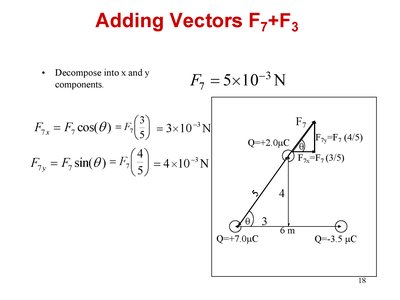
Step 2: Decompose forces into x and y components.
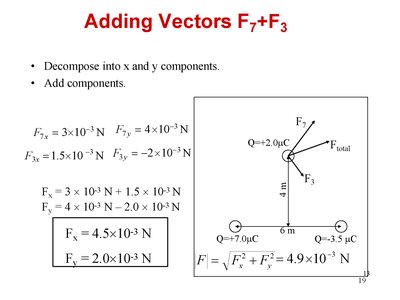
Step 3: Add components to find the total force.
Example: For a triangle arrangement, calculate forces and add vectorially.
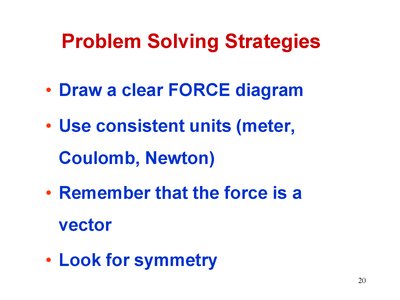
Problem Solving Strategies
Effective problem solving in electrostatics requires careful application of physical principles and mathematical techniques.
Draw a clear force diagram to visualize interactions.
Use consistent units (meter, Coulomb, Newton).
Remember that force is a vector and must be added accordingly.
Look for symmetry to simplify calculations.
Summary Table: Key Equations and Concepts
Concept | Equation | Description |
|---|---|---|
Coulomb’s Law | Force between two point charges | |
Electric Potential Energy (2 charges) | Energy stored by two charges | |
Work to assemble charges | Work equals potential energy | |
Multiple charges | Sum of pairwise energies | |
Vector addition | Total force from components |
