 Back
BackElectromagnetic Waves and the Wave Nature of Light: Study Guide
Study Guide - Smart Notes
 Tailored notes based on your materials, expanded with key definitions, examples, and context.
Electromagnetic Waves
Structure and Properties of Electromagnetic Waves
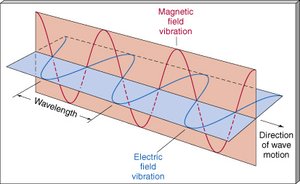
Electromagnetic waves are composed of oscillating electric and magnetic fields that are perpendicular to each other and to the direction of wave propagation. These waves do not require a medium and can travel through a vacuum.
Electric Field (E): Oscillates in one plane.
Magnetic Field (B): Oscillates perpendicular to the electric field.
Direction of Propagation: Perpendicular to both E and B fields.
Wavelength (\(\lambda\)): The distance between successive crests or troughs.
Frequency (\(f\)): Number of oscillations per second.
The Electromagnetic Spectrum
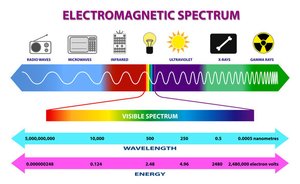
The electromagnetic spectrum encompasses all types of electromagnetic radiation, classified by wavelength or frequency. Visible light is only a small portion of this spectrum.
Radio Waves: Longest wavelength, lowest energy.
Microwaves
Infrared
Visible Light: 400–700 nm.
Ultraviolet
X-Rays
Gamma Rays: Shortest wavelength, highest energy.
Wave Nature of Light
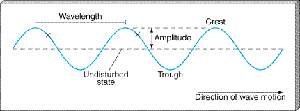
Light is a form of electromagnetic radiation and exhibits wave properties such as wavelength, frequency, and amplitude. The wavelength is the distance from one crest to the next, and amplitude is the height of the wave.
Wavelength (\(\lambda\)): Determines color in visible light.
Amplitude: Determines brightness.
Crest: Highest point of the wave.
Trough: Lowest point of the wave.
Speed of Light
Speed in Vacuum
The speed of light in a vacuum is a fundamental constant, denoted by \(c\). All electromagnetic waves travel at this speed in a vacuum.
Speed of Light:
Maximum Possible Speed: Nothing can travel faster than light.
Electromagnetic Radiation and Heat Transfer
Radiation from Hot Objects
Hot objects emit electromagnetic radiation over a range of wavelengths. The wavelength depends on the temperature of the object.
Room Temperature: Mostly infrared radiation.
Objects hotter than ~1000°C: Begin to emit visible light.
Sun (~6000°C): Emits a large amount of visible light.
Heat Transfer Mechanisms
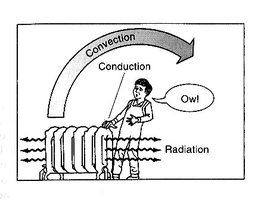
Heat can be transferred by conduction, convection, and radiation. Radiation is the transfer of energy by electromagnetic waves.
Conduction: Transfer through direct contact.
Convection: Transfer through fluid motion.
Radiation: Transfer via electromagnetic waves.
Visible Light and Color
ROY G. BIV and the Visible Spectrum
White light is composed of all colors in the visible spectrum, conventionally listed as Red, Orange, Yellow, Green, Blue, Indigo, Violet (ROY G. BIV). The visible spectrum ranges from longer wavelengths (red) to shorter wavelengths (violet).
Red: \(\lambda \approx 768 \ \text{nm}\)
Violet: \(\lambda \approx 434 \ \text{nm}\)
Infrared: Longer than red.
Ultraviolet: Shorter than violet.
Reflection and Absorption
The Law of Reflection
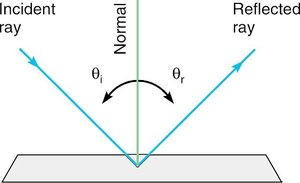
When a light ray encounters a reflective surface, the angle of incidence equals the angle of reflection, both measured relative to the normal line.
Angle of Incidence (\(\theta_i\)): Angle between incoming ray and normal.
Angle of Reflection (\(\theta_r\)): Angle between reflected ray and normal.
Law of Reflection:
Reflection and Absorption of Light
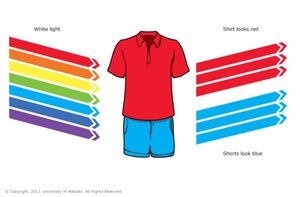
Objects have color because they reflect certain wavelengths and absorb others. The color observed is due to the reflected wavelengths.
Red objects: Reflect red wavelengths.
Blue objects: Reflect blue wavelengths.
White objects: Reflect all visible wavelengths.
Scattering and Diffraction
Scattering
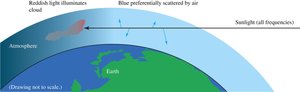
Scattering occurs when light interacts with particles in the atmosphere. Blue light is scattered more than red, making the sky appear blue.
Rayleigh Scattering: Scattering of shorter wavelengths (blue) is more intense.
Diffraction
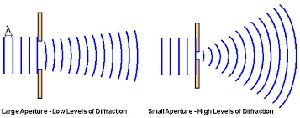
Diffraction is the bending of waves around obstacles or through slits. It is most noticeable when the opening is comparable to the wavelength.
Large Aperture: Low diffraction.
Small Aperture: High diffraction.
Interference
Constructive and Destructive Interference
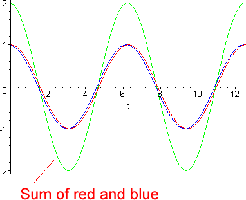
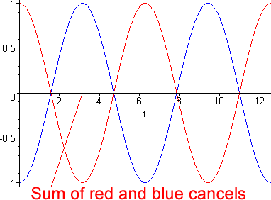
Interference occurs when two or more waves overlap. Constructive interference happens when peaks align, enhancing the wave. Destructive interference occurs when peaks align with troughs, diminishing the wave.
Constructive Interference:
Destructive Interference:
Double Slit Experiment
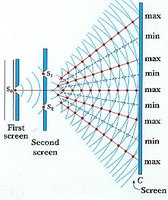
When light passes through two slits, it produces a pattern of bright and dark fringes due to interference. Bright regions indicate constructive interference, while dark regions indicate destructive interference.
Path Difference: Determines whether interference is constructive or destructive.
Fringes: Alternating bright and dark bands.
Refraction and Dispersion
Refraction
Refraction is the bending of light as it passes from one medium to another. The law of refraction states that light bends toward the normal when entering a slower medium and away from the normal when entering a faster medium.
Law of Refraction (Snell's Law):
Index of Refraction (n): Ratio of speed of light in vacuum to speed in medium.
Dispersion and Color
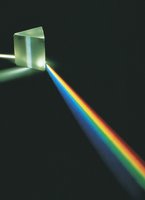
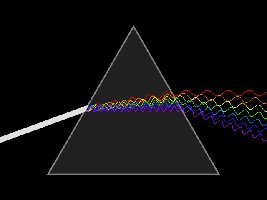
Dispersion occurs when the speed of light in a medium depends on its frequency, causing different colors to refract at different angles. Passing white light through a prism separates it into its constituent colors.
Prism: Separates light by wavelength.
Rainbow: Natural dispersion in water droplets.
Particle Nature of Light
Photoelectric Effect and Photons
While most phenomena can be explained by the wave nature of light, the photoelectric effect demonstrates its particle nature. Light can eject electrons from a material, behaving as particles called photons.
Photon: Packet of energy.
Energy of Photon:
Photoelectric Effect: Electrons are ejected when light of sufficient energy strikes a material.
Dual Nature of Light
Light exhibits both wave and particle properties, a concept known as wave-particle duality. The actual nature of the photon is not fully describable in classical terms.
Wave Properties: Interference, diffraction.
Particle Properties: Photoelectric effect, quantized energy.
