 Back
BackElectromagnetic Waves and the Wave Nature of Light: Study Guide
Study Guide - Smart Notes
 Tailored notes based on your materials, expanded with key definitions, examples, and context.
Electromagnetic Waves
Structure and Properties of Electromagnetic Waves
Electromagnetic waves are composed of oscillating electric and magnetic fields that are perpendicular to each other and to the direction of wave propagation. These waves do not require a medium and can travel through a vacuum. - Key Point 1: The electric field and magnetic field oscillate at right angles to each other. - Key Point 2: The direction of wave motion is perpendicular to both fields. - Example: Light, radio waves, and X-rays are all electromagnetic waves. 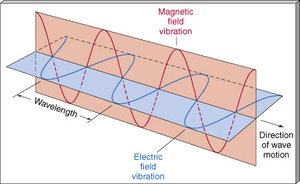
The Electromagnetic Spectrum
The electromagnetic spectrum encompasses all types of electromagnetic radiation, classified by wavelength or frequency. Visible light is only a small portion of this spectrum. - Key Point 1: Types include radio, microwave, infrared, visible, ultraviolet, X-rays, and gamma rays. - Key Point 2: Shorter wavelengths correspond to higher energy and frequency. - Example: Gamma rays have the shortest wavelength and highest energy; radio waves have the longest wavelength and lowest energy. 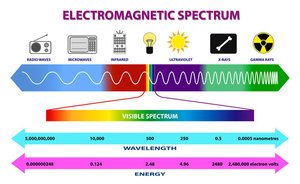
The Wave Nature of Light
Light as an Electromagnetic Wave
Light is a form of electromagnetic radiation and exhibits wave properties such as wavelength, frequency, and amplitude. - Key Point 1: Wavelength is the distance between successive crests of the wave. - Key Point 2: Amplitude is the height of the wave from its undisturbed state. - Example: Different wavelengths of visible light correspond to different colors. 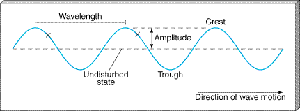
Speed of Light
All electromagnetic waves travel at the speed of light in a vacuum, denoted by c. This is the maximum possible speed for anything in the universe. - Key Point 1: - Key Point 2: Light can travel around the Earth about 7 times in one second.
Electromagnetic Spectrum and Visible Light
Visible Light and Color
The visible spectrum ranges from violet (shortest wavelength) to red (longest wavelength). White light is a combination of all visible wavelengths. - Key Point 1: The convention lists colors from longer to shorter wavelengths: Red, Orange, Yellow, Green, Blue, Indigo, Violet (ROY G. BIV). - Key Point 2: Radiation with wavelength longer than red is infrared; shorter than violet is ultraviolet. 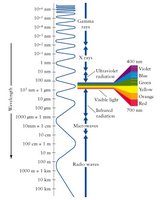
Dispersion and Color Separation
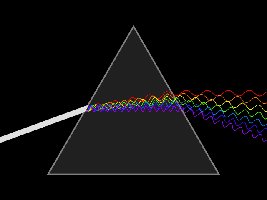
Dispersion occurs when the speed of light in a medium depends on its frequency, causing different colors to refract at different angles. - Key Point 1: Passing white light through a prism separates it into its component colors. - Key Point 2: Ultraviolet light bends more than visible light; infrared bends less. 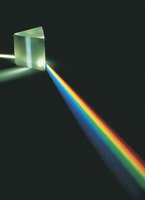
Reflection and Absorption
The Law of Reflection
When a light ray encounters a reflective surface, the angle of incidence equals the angle of reflection, both measured relative to the normal line. - Key Point 1: (angle of incidence = angle of reflection) - Key Point 2: Reflection can be specular (mirror-like) or diffuse (from rough surfaces). 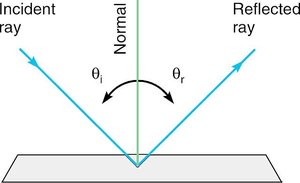
Color and Material Interaction
Objects have color because they reflect certain wavelengths and absorb others. - Key Point 1: A red shirt reflects red wavelengths and absorbs others. - Key Point 2: Shorts reflecting blue wavelengths appear blue. 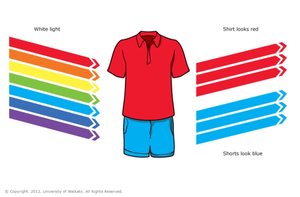
Scattering and Diffraction
Scattering
Scattering occurs when light interacts with particles in the atmosphere, causing shorter wavelengths (blue) to scatter more than longer wavelengths (red). - Key Point 1: The sky appears blue due to preferential scattering of blue light. 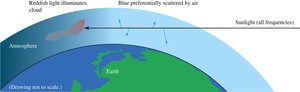
Diffraction
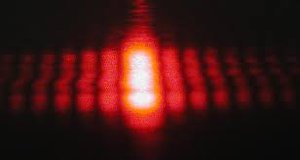
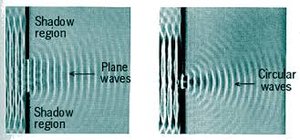
Diffraction is the bending of waves around obstacles or through slits, observable when the opening is comparable to the wavelength. - Key Point 1: Diffraction patterns show bright and dark regions due to constructive and destructive interference. 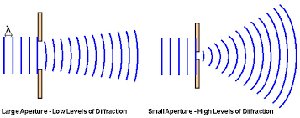
Interference
Constructive and Destructive Interference
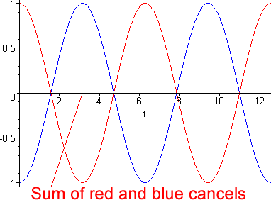
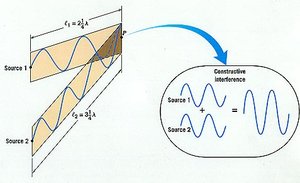
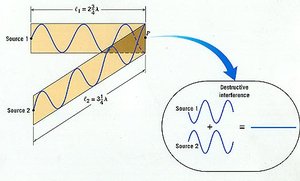
Interference occurs when two or more waves combine. Constructive interference happens when peaks align, enhancing the wave; destructive interference occurs when peaks and troughs align, diminishing the wave. - Key Point 1: Constructive interference produces bright or loud fringes. - Key Point 2: Destructive interference produces dark or mute fringes. 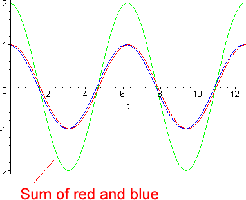
Double-Slit Experiment
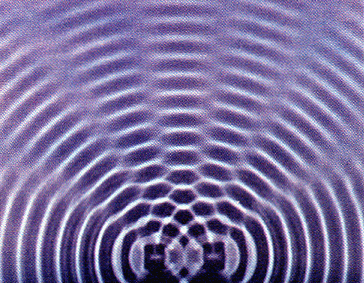
The double-slit experiment demonstrates interference patterns, with alternating bright and dark fringes due to constructive and destructive interference. - Key Point 1: Bright regions occur where waves arrive in phase. - Key Point 2: Dark regions occur where waves arrive out of phase. 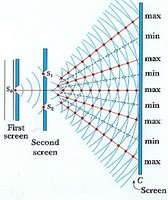
Refraction and Total Internal Reflection
Refraction
Refraction is the bending of light as it passes from one medium to another, due to a change in speed. - Key Point 1: Light bends toward the normal in a slower medium, away from the normal in a faster medium. - Key Point 2: The law of refraction is given by
Total Internal Reflection
When light travels from a more dense to a less dense medium, it can be totally reflected if the angle of incidence exceeds the critical angle. - Key Point 1: Total internal reflection is used in fiber optics.
Dispersion and Rainbows
Dispersion
Dispersion causes different frequencies of light to refract at different angles, separating white light into its component colors. - Key Point 1: Rainbows are formed by dispersion in water droplets.
Particle Nature of Light
Photoelectric Effect and Photons
The photoelectric effect demonstrates that light can behave as particles called photons, each carrying energy . - Key Point 1: The energy of a photon depends on its frequency, not its speed. - Key Point 2: Einstein explained the photoelectric effect, earning the Nobel Prize.
Dual Nature of Light
Light exhibits both wave and particle properties, a concept known as wave-particle duality. - Key Point 1: Most phenomena can be explained by wave theory, but some require particle theory. - Key Point 2: The actual nature of photons is not fully describable in classical terms. Additional info: This study guide covers the main concepts of electromagnetic waves, the wave nature of light, and related phenomena such as reflection, refraction, interference, and the photoelectric effect, suitable for college-level physics exam preparation.
