 Back
BackElectrostatics, Electric Potential, and Capacitance: Study Notes with Applications
Study Guide - Smart Notes
 Tailored notes based on your materials, expanded with key definitions, examples, and context.
Electrostatics and Conductors
Electrostatic Equilibrium in Conductors
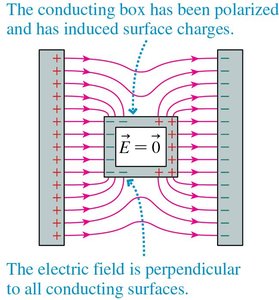
At electrostatic equilibrium, the electric field inside a conductor is zero. This results in unique charge distributions on the surfaces of conductors, especially when external charges are introduced.
Key Point 1: The net charge inside a conductor at equilibrium is zero, and any excess charge resides on the surface.
Key Point 2: If a charged object is placed inside a conductor (without touching), the inner surface acquires an equal and opposite charge, while the outer surface compensates to maintain overall neutrality.
Example: A metal ball with charge +q placed inside a neutral metal bucket induces -q on the inner surface and +q on the outer surface.
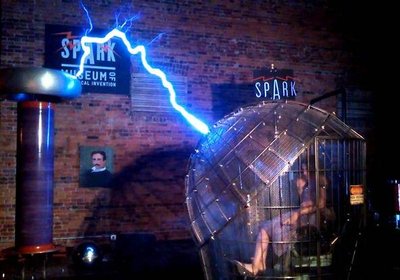
Additional info: The Faraday cage effect is used in engineering, such as in aircraft, to protect occupants from lightning strikes by redistributing charge and nullifying internal electric fields.
Electric Potential Energy
Potential Energy of Point Charges
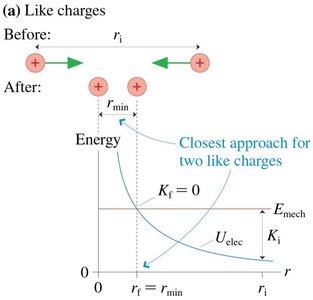
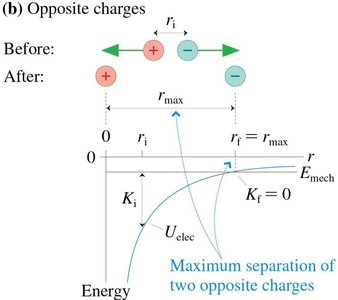
Electric potential energy is the energy stored due to the configuration of charged objects. For two point charges, the potential energy depends on their separation and magnitudes.
Key Point 1: The potential energy between two charges q1 and q2 separated by distance r is given by:
Key Point 2: For a system of multiple charges, the total potential energy is the sum over all pairs.
Example: Like charges repel and have a minimum approach distance; opposite charges attract and can be bound if kinetic energy is insufficient to escape.
Electric Potential and Equipotential Surfaces
Electric Potential of Point Charges and Spheres
The electric potential at a point due to a charge is a scalar quantity representing the work needed to bring a unit charge from infinity to that point.
Key Point 1: For a point charge q at distance r:
Key Point 2: For a sphere of radius R with charge Q, the potential outside the sphere is identical to that of a point charge.
Example: If two spheres have equal surface potential but different radii, the larger sphere must have proportionally more charge.
Electric Potential of Many Charges and Rings
The potential at a point due to multiple charges is the sum of the potentials from each charge. For continuous charge distributions, integrals are used.
Key Point 1: For N charges:
Key Point 2: For a ring of charge Q and radius R, at a point on the axis a distance z from the center:

Equipotential Surfaces and Electric Field
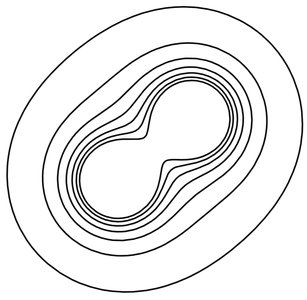
Equipotential surfaces are imaginary surfaces where the electric potential is constant. The electric field is always perpendicular to these surfaces and points in the direction of decreasing potential.
Key Point 1: The electric field magnitude between equipotential lines is given by:
Key Point 2: The closer the equipotential lines, the stronger the electric field.
Example: In a diagram with equipotential lines, the electric field is strongest where the lines are closest together.
Capacitance and Capacitors
Capacitance and Parallel-Plate Capacitors
Capacitance is the ability of a system to store charge per unit potential difference. Parallel-plate capacitors are a common configuration.
Key Point 1: Capacitance for parallel plates:
Key Point 2: The charge stored is .
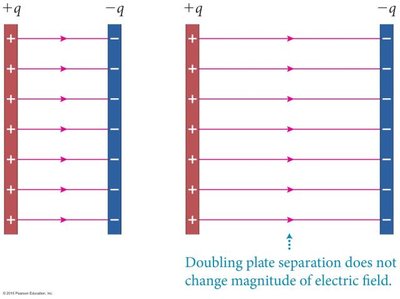
Example: Doubling plate separation does not change the electric field if the capacitor is disconnected from the battery.
Energy Stored in a Capacitor
The energy stored in a capacitor is a function of the charge and potential difference.
Key Point 1: Energy stored:
Key Point 2: Energy density in the electric field:
Example: If the plate separation is doubled after disconnecting from the battery, the energy stored doubles due to increased volume.
Dielectrics in Capacitors
Dielectrics are insulating materials placed between capacitor plates to increase capacitance by reducing the effective electric field.
Key Point 1: Capacitance with dielectric:
Key Point 2: Dielectric constant quantifies the effect; induced surface charge density is .
Example: Inserting a dielectric decreases the potential difference if the capacitor is disconnected from the battery.
Applications: Electron Guns and Electrostatic Precipitators
Electron Guns
Electron guns use electric fields to accelerate electrons, commonly found in cathode ray tube TVs.
Key Point 1: Electrons are accelerated between plates with a high potential difference.
Key Point 2: The final speed can be calculated using energy conservation:

Electrostatic Precipitators
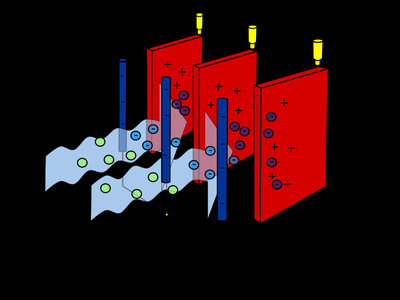
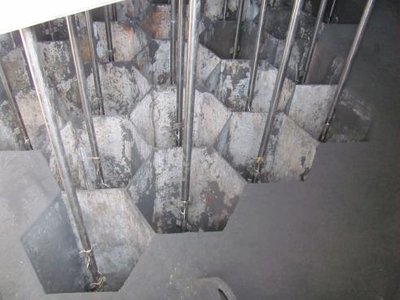
Electrostatic precipitators are used in industry to remove particles from exhaust gases by charging them and attracting them to plates.
Key Point 1: High voltage is applied to create an electric field that charges particles.
Key Point 2: Charged particles are attracted to collecting plates and removed.
Example: Used in coal-burning power plants to reduce pollution.

Summary Table: Capacitance and Dielectrics
Configuration | Capacitance Formula | Effect of Dielectric |
|---|---|---|
Parallel-plate capacitor | Capacitance increases by | |
With dielectric | Potential difference decreases if disconnected | |
Disconnected, area halved | halves | Potential difference doubles |
Additional info:
These notes cover core concepts from chapters 24, 25, 26, and 27, including electrostatics, electric potential, capacitance, and applications such as electron guns and electrostatic precipitators. The included images directly reinforce the explanations and are selected for their clear relevance to the discussed physics principles.
