 Back
BackEnergy and Conservation Laws: Physics Study Notes
Study Guide - Smart Notes
 Tailored notes based on your materials, expanded with key definitions, examples, and context.
Energy and Conservation Laws
Conservation Laws in Physics
Conservation laws are foundational principles in physics, stating that certain physical quantities remain constant within an isolated system. These laws help us understand and predict the behavior of physical systems.
Conservation of Mass: The total mass of an isolated system remains constant over time.
Conservation of Energy: The total energy in an isolated system does not change; energy can only be transformed from one form to another.
Forms of Energy
Energy exists in various forms, each associated with different physical phenomena:
Mechanical Energy: Energy due to motion or position.
Chemical Energy: Energy stored in chemical bonds.
Electromagnetic Energy: Energy carried by electromagnetic waves.
Nuclear Energy: Energy stored in the nucleus of atoms.
Energy is defined as the ability to do work. The famous equation (where is energy, is mass, and is the speed of light) shows the equivalence of mass and energy.
Potential and Kinetic Energy
Energy can be classified as either potential or kinetic:
Potential Energy (PE): Energy stored due to an object's position or configuration. Examples include gravitational, chemical, elastic, and electromagnetic potential energy.
Kinetic Energy (KE): Energy associated with the motion of an object. Examples include moving objects, heat, sound waves, and other types of waves.
Example: Living organisms obtain energy from sunlight, which is absorbed by plants and converted into high-energy compounds through photosynthesis. Animals obtain energy by consuming plants.
Work and Energy
Definition of Work
Work is defined as the product of force and the distance through which the force moves an object in the direction of the force:
Formula:
SI Unit: Joule (J), where
Energy as the Ability to Do Work
Energy is a measure of a system’s ability to do work. The symbol is used for energy, and its SI unit is the Joule (J).
Kinetic Energy
Kinetic energy is the energy associated with the motion of an object. It is given by:
Formula:
Units: Joules (J)
Example: A moving hammer has kinetic energy and can do work on a nail.

Potential Energy
Potential energy is associated with the position of an object within a system. For gravitational potential energy near Earth’s surface:
Formula:
Units: Joules (J)
Example: The potential energy of a brick relative to a table or the floor depends on its height above the reference point.
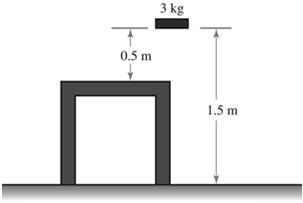
Example: A raised stone has gravitational potential energy, which is converted to work when the stone falls.
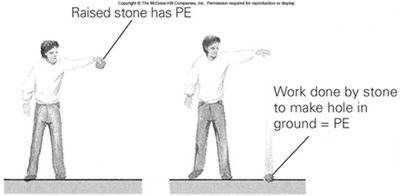
Gravitational Potential Energy
Gravitational potential energy is the energy associated with the relative position of an object in a gravitational field. It is actually the potential energy of the Earth-object system.
Formula:
Mass-Energy Equivalence
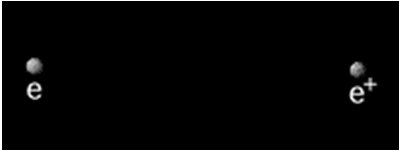
Energy can be created from mass and vice versa, as described by Einstein’s equation:
Formula:
This is significant at the subatomic level (e.g., particle physics).
Common Units of Energy
Unit | Equivalent |
|---|---|
Joule (J) | 1 J = 1 N·m |
Calorie (cal) | 1 cal = 4.184 J |
Watt hour (Wh) | 1 Wh = 3,600 J |
Kilowatt hour (kWh) | 1 kWh = 3,600,000 J |
Foot-pound (ft·lb) | 1 ft·lb = 1.356 J |
British Thermal Unit (BTU) | 1 BTU = 1,055 J |
Energy Transformations and Conservation
Energy Transformations
Energy can be transformed from one form to another. This principle is essential in physics, chemistry, biology, geology, and astronomy.
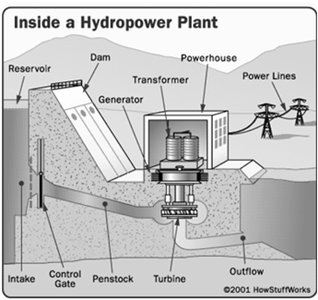
Example: In a hydropower plant, water at a height has gravitational potential energy, which is converted to kinetic energy as it falls, then to mechanical energy in the turbine, and finally to electrical energy in the generator.
Joule’s Experiment
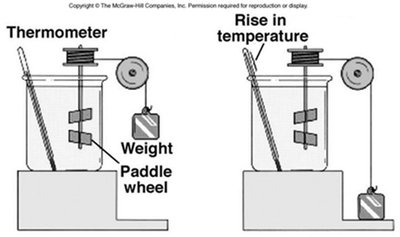
Joule’s experiment demonstrated the transformation of mechanical energy into heat energy, supporting the concept of energy conservation.
Law of Conservation of Energy
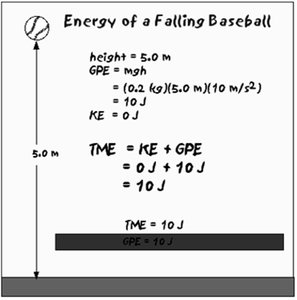
The law of conservation of energy states that energy cannot be created or destroyed; it can only be transformed from one form to another. The total energy of an isolated system remains constant.
Formula (mechanical energy):
Examples of Energy Transformation
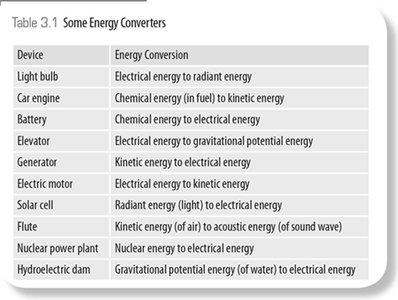
Energy transformations occur in many everyday processes and devices.
Device | Energy Conversion |
|---|---|
Light bulb | Electrical energy to radiant energy |
Car engine | Chemical energy (fuel) to kinetic energy |
Battery | Chemical energy to electrical energy |
Elevator | Electrical energy to gravitational potential energy |
Generator | Kinetic energy to electrical energy |
Electric motor | Electrical energy to kinetic energy |
Solar cell | Radiant energy (light) to electrical energy |
Flute | Kinetic energy (air) to acoustic energy (sound wave) |
Nuclear power plant | Nuclear energy to electrical energy |
Hydroelectric dam | Gravitational potential energy (water) to electrical energy |
Transferring Energy
By Work
Energy can be transferred to a system by doing work, which involves applying a force that causes displacement.

By Heat
Heat transfer occurs through collisions between molecules, resulting in energy flow from a hotter object to a cooler one.

By Mechanical Waves
Mechanical waves transfer energy through a medium by means of a disturbance. Examples include sound, water, and seismic waves.

By Electrical Transmission
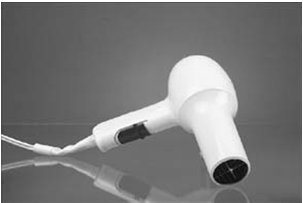
Energy can be transferred by means of electrical current, as in household appliances.
By Electromagnetic Radiation
Electromagnetic radiation transfers energy through electromagnetic waves, such as light, microwaves, and radio waves.

Power
Definition of Power
Power is the rate at which energy is transferred or work is done. It is defined as:
Formula:
SI Unit: Watt (W), where
Other units include horsepower (hp) and kilowatt-hours (kWh), commonly used in electric bills.
Laws of Thermodynamics
First Law of Thermodynamics
The first law of thermodynamics is a restatement of the law of conservation of energy, including heat:
In an isolated system, the total amount of energy, including heat, is conserved.
Energy can change forms, but the total amount remains constant.
