 Back
BackEngineering Physics 1A Study Guide: Syllabus, Structure, and Academic Procedures
Study Guide - Smart Notes
 Tailored notes based on your materials, expanded with key definitions, examples, and context.
Engineering Physics 1A: Course Overview and Syllabus
Introduction to Engineering Physics 1A
This module, PHYE0A1, is designed for first-year engineering students at the University of Johannesburg. It provides a foundational understanding of the principles of Mechanics, Waves, and Thermodynamics. The course emphasizes problem identification, scientific problem solving, and interpretation of results, preparing students for further studies in physics and related disciplines.
Course Structure and Materials
Prescribed Textbook: Douglas Giancoli, "Physics for Scientists and Engineers, with Modern Physics" (5th Edition, Pearson, 2024).
Learning Platforms: Moodle and uLink for course materials, announcements, and assignments.
Lecture, Tutorial, and Practical Timetable: Provided via Moodle and the Faculty's official schedule.
Entry Requirements
Minimum Grade 12 score of "5" in Physical Science and Mathematics.
Recognition of prior learning and equivalency for foreign students or those from other institutions, subject to approval.
A pass in Engineering Physics 1A is required for admission to Engineering Physics 1B.
Educational Methods
Three weekly lectures covering core concepts.
Introductory and four experimental practical sessions, including a practical test.
Five tutorial sessions with written assignments.
Multimodal learning: lectures, online content, self-study, and discussions.
Assessment Structure
Three semester tests: Best two count towards Theory mark.
Five tutorial tests: All count.
Four practical reports and one practical test: All count.
Final written examination: At the end of the semester.
Minimum requirements for exam admission:
40% minimum Theory Mark
50% minimum Practical Mark
Attendance at least four tutorials with assignment submission
Final Mark Calculation
Theory Mark: 70% from best two semester tests, 30% from tutorial assessments.
Practical Mark: 30% from practical test, 70% from practical reports.
Semester Mark: 70% Theory + 30% Practical.
Final Mark: Average of Semester Mark and Exam Mark (each weighted 50%).
Syllabus Breakdown
Course I: Mechanics
Mechanics forms the foundation of classical physics, focusing on the motion of objects and the forces that cause such motion. The following chapters are covered:
Chapter 1: Introduction, Measurement, Estimating (including Units, Dimensional Analysis, and Measurement; plus sections on vectors from Chapters 3, 7, and 11).
Chapter 2: Kinematics in One Dimension (Displacement, Velocity, Acceleration).
Chapter 3: Kinematics in Two/Three Dimensions (Sections 3.6–3.9; Position, Velocity, Acceleration as vectors).
Chapter 9 (Part 1): Linear Momentum (Sections 9.2–9.4).
Chapter 4: Newton's Laws of Motion (entire chapter).
Chapter 5: Using Newton's Laws (Sections 5.1–5.4).
Chapter 6: Gravitation and Newton's Synthesis (Sections 6.1–6.5, 6.7).
Chapter 7: Work and Energy (entire chapter).
Chapter 8: Conservation of Energy (all except 8.10).
Chapter 9 (Part 2): Linear Momentum (Sections 9.5–9.9).
Chapter 10: Rotational Motion (entire chapter).
Chapter 11: Angular Momentum; General Rotation (Sections 11.1–11.6, 11.8).
Chapter 12: Static Equilibrium; Elasticity and Fracture (Sections 12.1, 12.2, 12.4, 12.5).
Course II: Waves
Waves are fundamental to understanding oscillatory motion and the transmission of energy. The following chapters are covered:
Chapter 14: Oscillations (Sections 14.1–14.5; mention of 14.7, 14.8).
Chapter 15: Wave Motion (Sections 15.1–15.4, 15.6–15.9).
Chapter 16: Sound (entire chapter except 16.8, 16.9).
Course III: Thermodynamics
Thermodynamics deals with heat, energy, and the laws governing their transfer and transformation. The following chapters are covered:
Chapter 17: Temperature, Thermal Expansion, and the Ideal Gas Law (entire chapter).
Chapter 18: Kinetic Theory of Gases (entire chapter, time permitting).
Chapter 19: Heat and the First Law of Thermodynamics (entire chapter).
Chapter 20: Second Law of Thermodynamics (entire chapter except 20.3; sections 20.5, 20.6 covered first; 20.10 may be covered).
Academic Procedures and Deferred Assessment
Deferred Assessment Policy
Students unable to attend scheduled assessments due to illness or personal crisis must follow the Standard Operating Procedure (SOP) for deferred assessments. Valid reasons include:
Illness documented by a registered medical practitioner (with full details and covering the exam date).
Personal crisis (e.g., death or serious illness of a close family member, court appearance).
Applications must be submitted within seven days of the missed assessment, with supporting documentation.
Applications are reviewed by the lecturer and faculty administration. The university reserves the right to decline applications if documentation is incomplete, inauthentic, or submitted late.
Deferred Assessment Application Form
Students must complete the official application form and attach relevant medical certificates or supporting documents. The form requires:
Personal details (name, student number, contact information).
Module and date of missed assessment.
Reason for absence.
Signature and date of application.
Course Timetable and Group Allocation
Lecture, Tutorial, and Practical Times
Lectures: Tuesday, Thursday, Friday (various venues and times).
Practicals: Wednesday, Thursday, Friday (C1 Lab 227 Laboratory).
Tutorials: Wednesday, Thursday, Friday (same times as practicals).
Students are assigned to groups and must attend their designated sessions. Attendance is strictly monitored.
Summary Table: Syllabus Coverage
Course | Chapters Covered | Key Topics |
|---|---|---|
Mechanics | 1–13 | Measurement, Kinematics, Newton's Laws, Energy, Momentum, Rotation, Equilibrium |
Waves | 14–16 | Oscillations, Wave Motion, Sound |
Thermodynamics | 17–20 | Temperature, Gas Laws, Heat, First and Second Laws of Thermodynamics |
Important Academic Advice
Attend all lectures, tutorials, and practicals; punctuality is essential.
Engage with tutors and lecturers for academic support.
Use all available materials, including textbook, Moodle, and lecture notes.
Physics is best learned through understanding and problem solving, not memorization.
Relevant Images
The following image is directly relevant to the introductory context of the course, highlighting the historical and scientific foundation of physics:
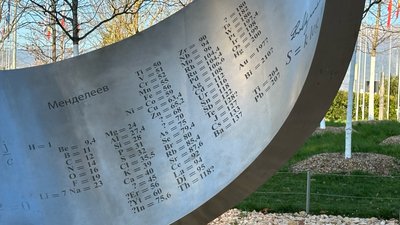
Image Description: Mendeleev’s original Periodic Table engraved on a sculpture at CERN. This image connects to the scientific heritage and foundational principles that underpin the study of physics, as referenced in the course introduction.
