 Back
BackEquilibrium and Elasticity: Structured Study Notes
Study Guide - Smart Notes
 Tailored notes based on your materials, expanded with key definitions, examples, and context.
Equilibrium and Elasticity
Introduction to Equilibrium and Elasticity
Equilibrium and elasticity are fundamental concepts in physics, especially in mechanics and material science. Equilibrium refers to the state in which a body or structure experiences no net force or torque, ensuring stability. Elasticity describes the ability of materials to return to their original shape after being deformed by external forces. These principles are crucial in engineering, architecture, and understanding natural phenomena.

Conditions for Equilibrium
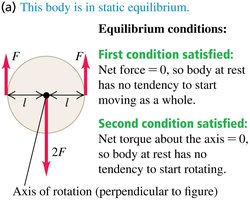
For a rigid body to be in static equilibrium, two essential conditions must be satisfied:
First Condition (Translational Equilibrium): The vector sum of all external forces acting on the body must be zero. This ensures the body does not accelerate.
Second Condition (Rotational Equilibrium): The sum of all external torques about any point must be zero. This prevents the body from rotating.


Examples of Equilibrium Conditions
Static Equilibrium: Both force and torque conditions are satisfied; the body remains at rest.
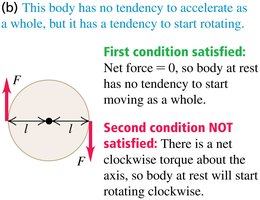
Translational Equilibrium Only: The net force is zero, but net torque is not; the body may rotate.
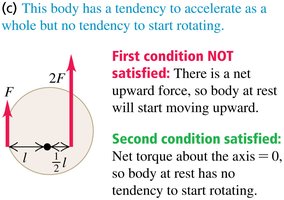
Rotational Equilibrium Only: The net torque is zero, but net force is not; the body may move linearly.
Center of Gravity
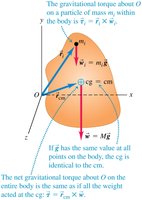
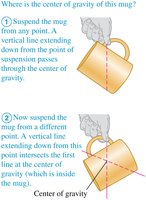
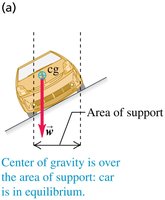
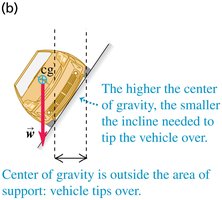
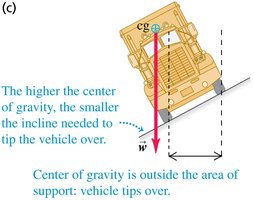
The center of gravity is the point at which the entire weight of a body can be considered to act. For most practical purposes, especially when gravity is uniform, the center of gravity coincides with the center of mass. The stability of a structure depends on the location of its center of gravity relative to its supports.
Applications and Examples
High-rise Structures: The center of gravity is crucial for stability, as seen in the Petronas Towers.
Suspension: When a body is suspended, its center of gravity aligns vertically with the suspension point.
Support Area: For equilibrium, the center of gravity must lie within the area bounded by the supports.

Problem-Solving Strategy for Static Equilibrium
Solving equilibrium problems involves systematic steps:
Sketch the physical situation and identify the body in equilibrium.
Draw a free-body diagram showing all forces and their points of application.
Choose coordinate axes and specify directions for forces and torques.
Choose a reference point for torque calculations.
Write equations for equilibrium: , , .
Check results by recalculating torques with respect to different reference points.
Strain, Stress, and Elastic Moduli
When a body is deformed by external forces, it experiences stress (force per unit area) and strain (fractional change in shape or size). The relationship between stress and strain is characterized by elastic moduli, which quantify a material's resistance to deformation.

Types of Stress
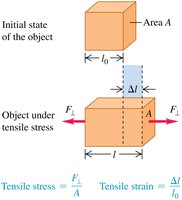
Tensile Stress: Stretching forces acting at the ends of an object.
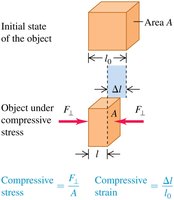
Compressive Stress: Squeezing forces acting from opposite directions.
Bulk Stress: Pressure applied uniformly from all sides.
Shear Stress: Forces applied parallel to the surface, causing deformation.
Stress and Strain Definitions
Stress:
Strain: (for tensile/compressive), (for bulk), (for shear)

Tensile Stress and Strain
Tensile stress occurs when an object is stretched. The net force is zero, but the object deforms, producing tensile strain.
Young's Modulus
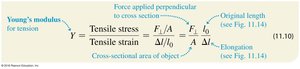
Young's modulus () quantifies the stiffness of a material under tension. For small deformations, stress and strain are proportional:
Formula:
Compressive Stress and Strain
Compressive stress occurs when an object is squeezed. The definitions mirror those for tensile stress, but represents contraction.
Compression and Tension in Beams
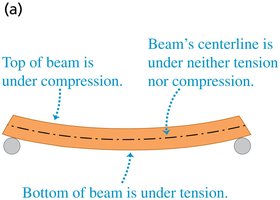
Beams supported at both ends experience both compressive and tensile stresses simultaneously. The top of the beam is under compression, while the bottom is under tension.
Bulk Stress and Strain
Bulk stress is caused by uniform pressure applied to all sides of an object, leading to a change in volume. The bulk modulus () measures resistance to uniform compression:
Formula:
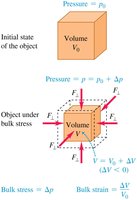
Example: Anglerfish and Bulk Stress
Deep-sea creatures like anglerfish withstand high bulk stress due to their lack of internal air spaces, allowing survival at great ocean depths.

Shear Stress and Strain
Shear stress arises from forces applied parallel to a surface, causing deformation. The shear modulus () quantifies resistance to shear:
Formula:
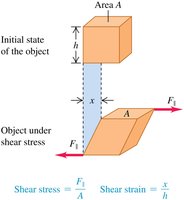
Elastic Moduli of Materials
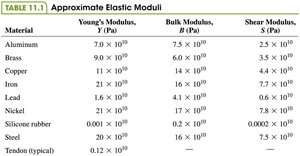
Different materials have characteristic values for Young's modulus, bulk modulus, and shear modulus, reflecting their mechanical properties.
Material | Young's Modulus, Y (Pa) | Bulk Modulus, B (Pa) | Shear Modulus, S (Pa) |
|---|---|---|---|
Aluminum | 7.0 × 10¹⁰ | 7.5 × 10¹⁰ | 2.5 × 10¹⁰ |
Brass | 9.0 × 10¹⁰ | 6.0 × 10¹⁰ | 3.5 × 10¹⁰ |
Copper | 11 × 1010 | 14 × 1010 | 4.4 × 10¹⁰ |
Iron | 21 × 1010 | 16 × 1010 | 7.6 × 10¹⁰ |
Lead | 1.6 × 10¹⁰ | 4.1 × 10¹⁰ | 0.6 × 10¹⁰ |
Nickel | 21 × 1010 | 17 × 1010 | 7.8 × 10¹⁰ |
Silicone rubber | 0.001 × 10¹⁰ | 0.002 × 10¹⁰ | 0.0002 × 10¹⁰ |
Steel | 20 × 1010 | 16 × 1010 | 7.5 × 10¹⁰ |
Tendon (typical) | 0.12 × 10¹⁰ | - | - |
Compressibility
The compressibility () of a material is the reciprocal of the bulk modulus and measures how easily a material's volume changes under pressure:
Formula:
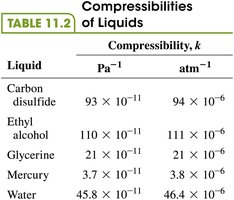
Liquid | Compressibility, k (Pa-1) | Compressibility, k (atm-1) |
|---|---|---|
Carbon disulfide | 93 × 10-11 | 94 × 10-6 |
Ethyl alcohol | 110 × 10-11 | 111 × 10-6 |
Glycerine | 21 × 10-11 | 21 × 10-6 |
Mercury | 3.7 × 10⁻¹¹ | 3.8 × 10⁻⁶ |
Water | 45.8 × 10⁻¹¹ | 46.4 × 10⁻⁶ |

Elasticity and Plasticity
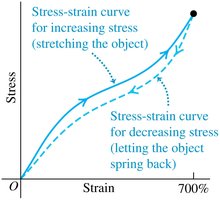
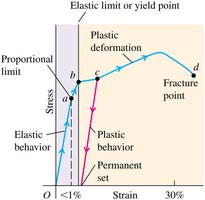
Materials exhibit elasticity when they return to their original shape after deformation, and plasticity when they undergo permanent deformation. Hooke's law describes the linear relationship between stress and strain for elastic deformations, but this law is valid only within a certain range.
Breaking Stress
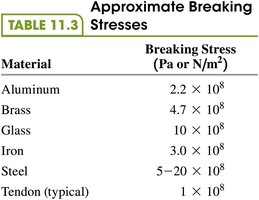
The breaking stress is the stress required to fracture a material. Different materials have characteristic breaking stresses, which are important for safety and engineering design.
Material | Breaking Stress (Pa or N/m2) |
|---|---|
Aluminum | 2.2 × 10⁸ |
Brass | 4.7 × 10⁸ |
Glass | 10 × 108 |
Iron | 3.0 × 10⁸ |
Steel | 5–20 × 108 |
Tendon (typical) | 1 × 10⁸ |
Additional info: These notes expand on the original content by providing definitions, formulas, and context for each concept, ensuring a comprehensive and self-contained study guide for college-level physics students.
