 Back
BackEquilibrium and Stability: Statics, Torque, and Types of Equilibrium
Study Guide - Smart Notes
 Tailored notes based on your materials, expanded with key definitions, examples, and context.
Equilibrium and Stability
Statics and Equilibrium
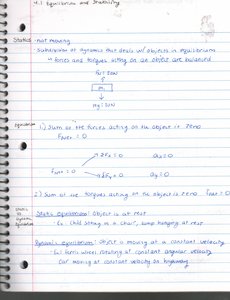
Statics is the branch of physics that analyzes the forces and torques acting on objects in equilibrium, meaning the objects are not moving. In equilibrium, both the sum of all forces and the sum of all torques on an object must be zero.
Equilibrium Condition: An object is in equilibrium if it is at rest or moving at a constant velocity.
Forces and Torques: Both must be balanced for equilibrium.
Example: A box at rest on a table has the upward normal force balancing the downward gravitational force.
Conditions for Equilibrium
First Condition (Translational Equilibrium): The sum of all forces acting on the object is zero.
Second Condition (Rotational Equilibrium): The sum of all torques acting on the object is zero.
Example: A child sitting on a swing, hanging at rest, is in equilibrium because the forces and torques are balanced.
Types of Equilibrium
Static Equilibrium: The object is at rest.
Dynamic Equilibrium: The object is moving at a constant velocity (no acceleration).
Example: A car moving at constant velocity on a highway is in dynamic equilibrium.
Statics Problem: Tension in a Rope
Finding Tension in a Rope
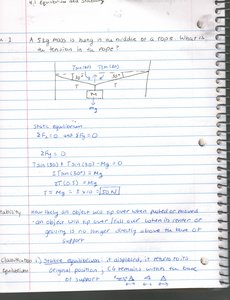
Consider a 5 kg mass hanging in the middle of a rope. To find the tension in the rope, analyze the forces acting on the mass and the rope segments. The system is in static equilibrium, so the sum of forces in both the x and y directions is zero.
Vertical Forces:
Horizontal Forces:
Solution Steps:
Draw a free-body diagram showing the tensions and the weight.
Set up equations for equilibrium in both directions.
Solve for the tension using trigonometry and the known mass.
Key Equation:
Stability and Center of Gravity
Stability of Objects
Stability refers to how likely an object is to return to its original position after being slightly disturbed. The center of gravity is the point where the object's mass is considered to be concentrated.
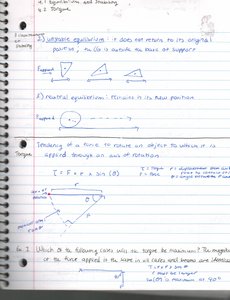
Stable Equilibrium: The object returns to its original position after a small displacement.
Unstable Equilibrium: The object does not return to its original position; it moves further away.
Neutral Equilibrium: The object remains in its new position after being displaced.
Example: A cone resting on its base is in stable equilibrium, while a cone balanced on its tip is in unstable equilibrium.
Torque
Definition and Calculation of Torque
Torque is the tendency of a force to rotate an object about an axis. It depends on the magnitude of the force, the distance from the axis of rotation, and the angle at which the force is applied.
Formula for Torque:
Direction: Torque is a vector and can be clockwise or counterclockwise.
Example: The torque is maximum when the force is applied perpendicular to the lever arm ().
Summary Table: Types of Equilibrium
Type | Description | Example |
|---|---|---|
Stable | Returns to original position | Ball in a bowl |
Unstable | Moves further from original position | Ball on top of a hill |
Neutral | Stays in new position | Ball on a flat surface |
Additional info: The notes also mention that the center of gravity must remain above the base of support for stability. If it moves outside, the object will tip over.
