 Back
BackFluid Mechanics: Pumping and Air Pressure
Study Guide - Smart Notes
 Tailored notes based on your materials, expanded with key definitions, examples, and context.
Fluid Mechanics
Pumping Water and Air Pressure
This topic explores the principles of fluid mechanics as applied to pumping water from a well, focusing on the effects of air pressure and vacuum pumps. Understanding these concepts is essential for analyzing the limitations and operation of pumps in practical scenarios.
Atmospheric Pressure: The pressure exerted by the weight of the atmosphere on the surface of the Earth. It is a key factor in determining how high water can be lifted by a pump.
Vacuum Pump: A device that removes air from a system, creating a region of reduced pressure. In the diagram, the vacuum pump is used to lower the air pressure above the water column.
Maximum Height of Water Column: The maximum height to which water can be lifted by atmospheric pressure is approximately 10.3 meters (or 19.4 meters as noted in the diagram, which may refer to a different fluid or context). This is determined by the balance between atmospheric pressure and the weight of the water column.
Key Equation: The height of the water column () that can be supported by atmospheric pressure is given by: where:
= atmospheric pressure
= density of water
= acceleration due to gravity
Reduced Air Pressure: When air pressure is reduced (e.g., by a vacuum pump), the pressure difference allows water to be lifted higher, but only up to the limit set by atmospheric pressure.
Practical Limitation: Pumps cannot lift water from depths greater than the maximum height supported by atmospheric pressure, regardless of the strength of the pump.
Example: If a vacuum pump creates a perfect vacuum above the water column, the maximum height of water that can be lifted is determined by atmospheric pressure. For water, this is about 10.3 meters at sea level.
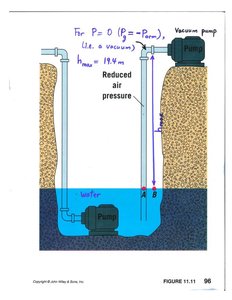
Additional info: The diagram illustrates the concept of reduced air pressure above a water column, the role of a vacuum pump, and the physical limitation imposed by atmospheric pressure. The annotated value of 19.4 meters may refer to a different fluid or a specific context; for water, the typical value is about 10.3 meters.
