 Back
BackForce and Motion: Fundamental Concepts and Applications
Study Guide - Smart Notes
 Tailored notes based on your materials, expanded with key definitions, examples, and context.
Force and Motion
Introduction to Forces
Forces are fundamental to understanding motion in physics. A force is defined as a push or pull exerted on an object, and it is a vector quantity, meaning it has both magnitude and direction. Forces can be classified based on their origin and how they act on objects.
Contact Forces: Require physical contact between objects (e.g., friction, tension, normal force).
Long-range Forces: Act over a distance without direct contact (e.g., gravity, electric, and magnetic forces).
Types of Forces
Gravitational Force: The attractive force between objects with mass, most noticeable when at least one object is planet-sized.
Spring Force: The force exerted by a stretched or compressed elastic object.
Tension Force: The pulling force transmitted by a string, rope, or cable.
Normal Force: The perpendicular contact force exerted by a surface on an object resting on it.
Frictional Forces: Forces that oppose relative motion between surfaces in contact. Includes static, kinetic, and rolling friction.
Drag: The resistive force experienced by objects moving through fluids (liquids or gases).
Thrust: The force that moves rockets and jets forward, produced by expelling mass (e.g., exhaust gases).
Frictional Forces
Kinetic, Static, and Rolling Friction
Friction is a resistive force that opposes the motion or attempted motion of an object in contact with a surface. There are three main types:
Static Friction (\(f_s\)): Prevents relative motion between surfaces up to a maximum value \(f_{s,\text{max}} = \mu_s F_N\), where \(\mu_s\) is the coefficient of static friction and \(F_N\) is the normal force.
Kinetic Friction (\(f_k\)): Acts when surfaces slide past each other, given by \(f_k = \mu_k F_N\), where \(\mu_k\) is the coefficient of kinetic friction.
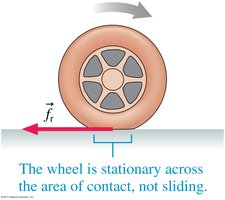
Rolling Friction (\(f_r\)): Occurs when an object rolls over a surface, typically much smaller than kinetic friction, \(f_r = \mu_r F_N\).
Example: A car tire rolling on a road experiences rolling friction, not kinetic friction, because the contact area is stationary relative to the surface.
Coefficients of Friction Table
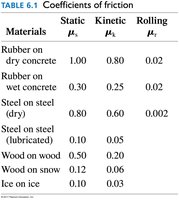
The coefficients of friction depend on the materials in contact. The table below summarizes typical values:
Materials | Static (\(\mu_s\)) | Kinetic (\(\mu_k\)) | Rolling (\(\mu_r\)) |
|---|---|---|---|
Rubber on dry concrete | 1.00 | 0.80 | 0.02 |
Rubber on wet concrete | 0.30 | 0.25 | 0.02 |
Steel on steel (dry) | 0.80 | 0.60 | 0.002 |
Steel on steel (lubricated) | 0.10 | 0.05 | |
Wood on wood | 0.50 | 0.20 | |
Wood on snow | 0.12 | 0.06 | |
Ice on ice | 0.10 | 0.03 |
Drag Force
Drag is a resistive force experienced by objects moving through fluids, such as air or water. It acts opposite to the direction of motion and depends on the object's speed, shape, and the properties of the fluid.
The drag force for objects moving at moderate speeds through air is given by:

Where:
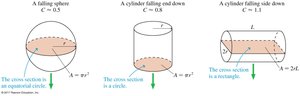
\(C\): Drag coefficient (depends on shape)
\(\rho\): Density of the fluid (e.g., air)
\(A\): Cross-sectional area perpendicular to motion
\(v\): Speed of the object
Example: The cross-sectional area for a sphere is \(A = \pi r^2\), for a cylinder end-down is \(A = \pi r^2\), and for a cylinder side-down is \(A = 2rL\).
Newton's Laws and Mechanical Equilibrium
Newton's First and Second Laws
Newton's laws describe the relationship between forces and motion:
First Law (Law of Inertia): An object at rest remains at rest, and an object in motion continues in a straight line at constant speed unless acted upon by a net external force.
Second Law: The acceleration of an object is proportional to the net force acting on it and inversely proportional to its mass:
Mechanical Equilibrium
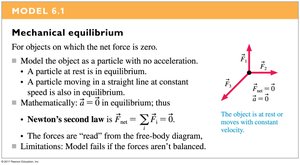
An object is in mechanical equilibrium if the net force acting on it is zero. In this state, the object is either at rest or moving with constant velocity (zero acceleration).
Mathematically, equilibrium in two dimensions is expressed as:

Example: Bridges and stationary structures are analyzed using the equilibrium model to ensure safety and stability.
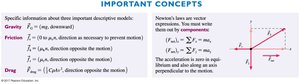
Summary Table: Important Force Models
The following table summarizes key force models and their mathematical expressions:
Force | Expression | Direction |
|---|---|---|
Gravity | Downward | |
Friction | Opposite to motion or as necessary to prevent motion | |
Drag | Opposite to motion |
Applications and Examples
Rolling Friction Example
When a wheel rolls on a surface, the area of contact is stationary relative to the surface, so rolling friction applies rather than kinetic friction. This is why rolling objects (like cars or carts) experience less resistive force than sliding objects.
Drag Force Example
For a falling object, the drag force increases with speed until it balances the gravitational force, resulting in a constant terminal speed:

Summary of Concepts
Forces are vectors and must be combined using vector addition.
Friction and drag are resistive forces that oppose motion.
Mechanical equilibrium occurs when the net force is zero.
Understanding the types and properties of forces is essential for analyzing motion and solving physics problems.
