 Back
BackForces and Newton’s Laws of Motion: Structured Study Notes
Study Guide - Smart Notes
 Tailored notes based on your materials, expanded with key definitions, examples, and context.
Forces and Newton’s Laws of Motion
The Concepts of Force and Mass
Understanding force and mass is fundamental to classical mechanics. A force is defined as a push or pull acting upon an object, and it is a vector quantity, meaning it possesses both magnitude and direction. Forces can be classified as contact forces (arising from physical contact) or action-at-a-distance forces (such as gravity and electrical forces, which do not require contact).
Force: Vector quantity; measured in newtons (N).
Mass: Quantitative measure of inertia; SI unit is kilogram (kg).
Inertia: Natural tendency of an object to resist changes in its state of motion.
Arrows: Used to represent forces; length proportional to magnitude.
Example: A force of 15 N is represented by a longer arrow than a force of 5 N.
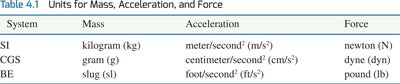
Units for Mass, Acceleration, and Force
Different systems of units are used in physics to measure mass, acceleration, and force. The SI system is most commonly used in scientific contexts.
System | Mass | Acceleration | Force |
|---|---|---|---|
SI | kilogram (kg) | meter/second2 (m/s2) | newton (N) |
CGS | gram (g) | centimeter/second2 (cm/s2) | dyne (dyn) |
BE | slug (sl) | foot/second2 (ft/s2) | pound (lb) |
Newton’s Laws of Motion
Newton’s First Law of Motion (Law of Inertia)
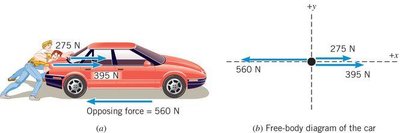
Newton’s First Law states that an object at rest remains at rest, and an object in motion continues in motion at a constant speed in a straight line, unless acted upon by a net force. The net force is the vector sum of all forces acting on the object.
Net Force: Vector sum of all forces; determines changes in motion.
SI Unit of Force: Newton (N).
Example: If three forces (3 N, 4 N, 5 N) act on an object, the net force is their vector sum.
Newton’s Second Law of Motion
Newton’s Second Law quantifies the relationship between force, mass, and acceleration. The net external force acting on an object is equal to the product of its mass and acceleration:
Mathematical Form:
Direction: Acceleration is in the direction of the net force.
SI Unit:
Example: If a car of mass 1850 kg experiences a net force of 110 N, its acceleration is:
Newton’s Third Law of Motion
Newton’s Third Law states that for every action, there is an equal and opposite reaction. Whenever one body exerts a force on another, the second body exerts a force of equal magnitude and opposite direction on the first.
Action-Reaction Pair: Forces always occur in pairs.
The Vector Nature of Newton’s Second Law
Newton’s Second Law can be applied to each component of force and acceleration:
This allows for analysis of forces in two or more dimensions.
Types of Forces
The Tension Force
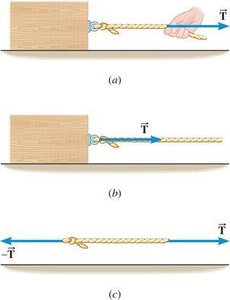
Tension is the force transmitted through a rope, cable, or string when it is pulled tight by forces acting from opposite ends. In an ideal (massless) rope, tension is undiminished throughout its length, even when passing over a massless, frictionless pulley.
Tension: Acts along the length of the rope, away from the object.
Massless Rope: Tension is the same at both ends.
The Gravitational Force
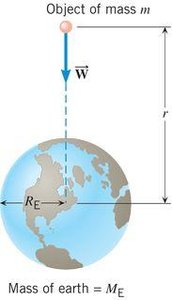
Newton’s Law of Universal Gravitation states that every particle in the universe exerts an attractive force on every other particle. The force is directed along the line joining the particles and is given by:
G: Universal gravitational constant ()
Weight: Gravitational force exerted by Earth on an object; always acts downward.
SI Unit of Weight: Newton (N)
Example: The weight of an object of mass at distance from Earth’s center:
On Earth’s surface, , so .
The Normal Force
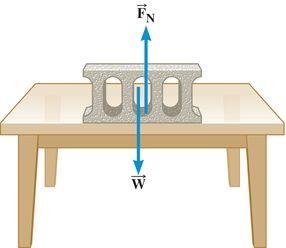
The normal force is the component of the force that a surface exerts on an object in contact with it, perpendicular to the surface. It balances the weight of the object when the surface is horizontal and there are no other vertical forces.
Normal Force (): Perpendicular to the surface.
Weight (): Acts downward.
Static and Kinetic Frictional Forces
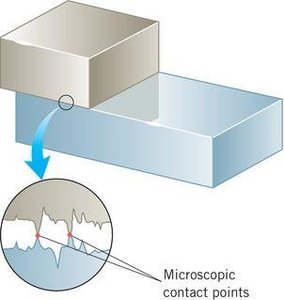
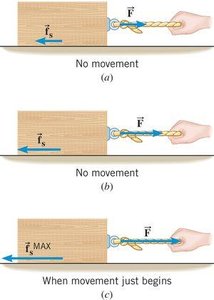
Friction is the force that opposes the relative motion or tendency of such motion of two surfaces in contact. It acts parallel to the surface.
Static Friction (): Prevents motion; acts when surfaces are not sliding.
Kinetic Friction (): Opposes motion; acts when surfaces are sliding.
Coefficient of Static Friction ():
Coefficient of Kinetic Friction ():
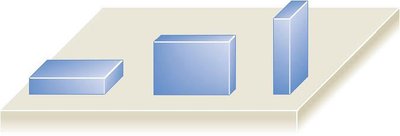
Contact Area: Friction does not depend on contact area.
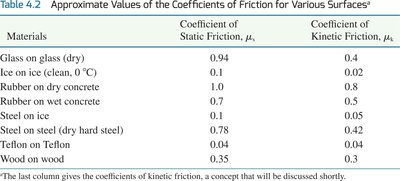
Materials | Coefficient of Static Friction () | Coefficient of Kinetic Friction () |
|---|---|---|
Glass on glass (dry) | 0.94 | 0.4 |
Ice on ice (clean, 0°C) | 0.1 | 0.02 |
Rubber on dry concrete | 1.0 | 0.8 |
Rubber on wet concrete | 0.7 | 0.5 |
Steel on ice | 0.01 | 0.05 |
Steel on steel (dry hard steel) | 0.78 | 0.42 |
Teflon on Teflon | 0.04 | 0.04 |
Wood on wood | 0.35 | 0.3 |
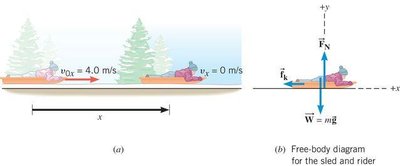
Example: If a sled of mass 40 kg is on a surface with , the kinetic frictional force is:
Equilibrium and Application of Newton’s Laws
Definition of Equilibrium
An object is in equilibrium when it has zero acceleration. This means the sum of all forces acting on the object is zero in every direction:
Reasoning Strategy:
Select the object(s) for analysis.
Draw a free-body diagram, including only forces acting on the object.
Choose axes and resolve all forces into components.
Apply equilibrium equations and solve for unknowns.
Example: A block resting on a table is in equilibrium; the normal force balances the weight.
----------------------------------------
