 Back
BackEXAM #3 DAY 13 Friction: Modeling, Factors, and Problem Solving in Physics
Study Guide - Smart Notes
 Tailored notes based on your materials, expanded with key definitions, examples, and context.
Friction: Modeling, Factors, and Problem Solving
Introduction to Friction
Friction is a fundamental force that opposes the relative motion or attempted motion between two surfaces in contact. It plays a crucial role in everyday phenomena and is essential for understanding motion in physics. Friction can be categorized into two main types: static friction (prevents motion) and kinetic friction (opposes ongoing motion).
Forces and Newton's Laws
Newton's Second Law and Types of Forces
Newton's Second Law relates the net force acting on an object to its acceleration:
Normal Force (n): The perpendicular contact force exerted by a surface, resulting from compression at the boundary.
Tension Force: The pulling force transmitted through a string, rope, or cable when it is stretched.
Frictional Force (f): The force that resists sliding motion, arising from shearing at the boundary between surfaces.
Weight (w): The gravitational force acting on an object, given by , where is the gravitational field strength (approximately near Earth's surface).
Conceptual Model of Friction
Static vs. Kinetic Friction
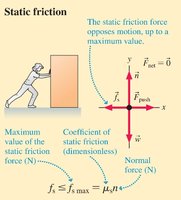
Static Friction (): The force that prevents the initiation of sliding motion between two surfaces. It adjusts up to a maximum value to oppose applied forces.
Kinetic Friction (): The force that opposes the motion of two surfaces sliding past each other. It typically has a constant value once motion begins.
Key Point: Static friction can vary up to a maximum value, while kinetic friction remains constant (and is usually less than the maximum static friction).
Physical Experience of Friction
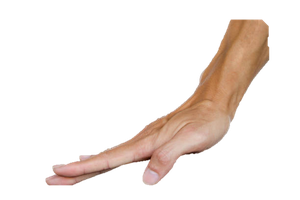
When you slide your hand across a table, you experience kinetic friction. Increasing the downward force (compression) increases the frictional force, while decreasing compression reduces it.
Factors Affecting Friction
Normal Force and Material Properties
Normal Force (): The greater the normal force ("squishing" the surfaces together), the greater the frictional force.
Material Properties: The nature of the surfaces in contact (roughness, texture, and material type) affects the coefficient of friction.
Surface area in contact does not significantly affect friction; rather, it is the normal force and the materials involved that are most important.
Coefficient of Friction
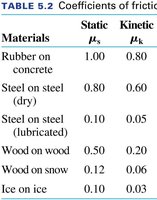
The coefficient of friction () is a dimensionless quantity that characterizes the interaction between two surfaces. There are two types:
Static coefficient (): For static friction.
Kinetic coefficient (): For kinetic friction.
Materials | Static | Kinetic |
|---|---|---|
Rubber on concrete | 1.00 | 0.80 |
Steel on steel (dry) | 0.80 | 0.60 |
Steel on steel (lubricated) | 0.10 | 0.05 |
Wood on wood | 0.50 | 0.20 |
Wood on snow | 0.12 | 0.06 |
Ice on ice | 0.10 | 0.03 |
Mathematical Models of Friction
Static Friction
The maximum static friction force is given by:
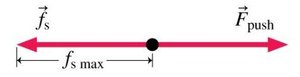
The actual static friction force can take any value up to this maximum, depending on the applied force:
Kinetic Friction
Once motion begins, the kinetic friction force is:
Kinetic friction acts opposite to the direction of motion and remains constant regardless of speed (for most materials).
Distinguishing Mass and Friction
Mass is a property of an object that determines its resistance to acceleration (inertia). Friction is an interaction between surfaces that must be overcome to initiate or maintain motion. Mass does not need to be "overcome"; it affects how much acceleration results from a given net force.
Problem-Solving with Friction
Typical Problem Steps
Draw a free-body diagram showing all forces (applied, friction, normal, weight).
Calculate the normal force (often for horizontal surfaces).
Determine the maximum static friction force: .
Compare the applied force to to see if the object moves.
If the object moves, use kinetic friction: .
Apply Newton's Second Law to solve for acceleration: .
Example: Box on a Surface
Mass of box:
Applied force:
Weight: (rounded to for simplicity)
Normal force:
If , then
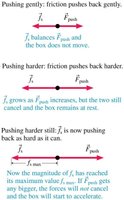
Since , the box does not move; static friction balances the applied force ().
If the applied force increases to , the box moves, and kinetic friction applies ().
Summary Table: Static vs. Kinetic Friction
Type | Symbol | Formula | Behavior |
|---|---|---|---|
Static Friction | Varies up to a maximum; prevents motion | ||
Kinetic Friction | Constant value; opposes ongoing motion |
Free-Body Diagrams and Equilibrium
Free-body diagrams are essential for visualizing forces acting on an object. In equilibrium (static or dynamic), the net force is zero. When the applied force exceeds maximum static friction, the object accelerates.
Key Takeaways
Friction depends on the normal force and the nature of the surfaces in contact.
Static friction prevents motion up to a maximum value; kinetic friction opposes motion with a constant value.
Surface area does not significantly affect friction; mass affects the normal force and thus friction.
Problem-solving involves identifying forces, calculating friction, and applying Newton's laws.
Additional info: The notes above synthesize and expand upon the provided lecture content, integrating standard textbook explanations and formulas for clarity and completeness.
