 Back
BackGauss' Law and Electric Field Flux: Study Notes
Study Guide - Smart Notes
 Tailored notes based on your materials, expanded with key definitions, examples, and context.
Gauss' Law and Electric Field Flux
Flux of a Uniform Electric Field Through a Flat Surface
The electric flux through a surface quantifies the number of electric field lines passing through that surface. For a uniform electric field \( \vec{E} \) and a flat surface A in the (xz)-plane, the flux is defined as:
Definition: \( \Phi_E = EA \) when \( \vec{E} \) is perpendicular to the surface.
Tangential Field: If the electric field is tangential to the surface (i.e., \( E_y = 0 \)), then \( \Phi_E = 0 \).
Normal Component: For an arbitrary direction, only the normal component contributes: \( \Phi_E = A E_n = A \vec{E} \cdot \hat{n} \), where \( \hat{n} \) is the unit vector perpendicular to A.
Vector Area: Define \( \vec{A} = A \hat{n} \), so \( \Phi_E = \vec{E} \cdot \vec{A} \).
Example: A flat surface perpendicular to a uniform field has maximum flux; parallel orientation yields zero flux.
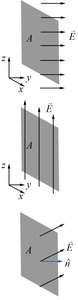
Flux of an Electric Field Through Arbitrary Surfaces
For non-uniform fields or curved surfaces, the flux calculation requires dividing the surface into infinitesimal patches:
Patch Flux: The flux through a small patch \( \Delta \vec{A}(\vec{r}) \) is \( \Delta \Phi_E(\vec{r}) = \vec{E}(\vec{r}) \cdot \Delta \vec{A}(\vec{r}) \).
Total Flux: Sum over all patches: \( \Phi_E = \sum_{\text{patches}} \vec{E}(\vec{r}) \cdot \Delta \vec{A}(\vec{r}) \).
Integral Form: In the limit of infinitesimal patches, \( \Phi_E = \int_S d\vec{A}(\vec{r}) \cdot \vec{E}(\vec{r}) \).
Field Lines: Flux is proportional to the number of field lines passing through the surface.
Example: Calculating flux through a curved surface requires integrating the dot product of the field and the local area vector.
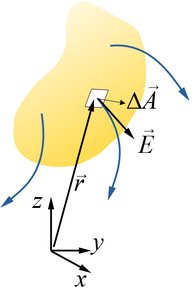
Special Case: Point Charge Inside a Closed Surface
When a point charge q is enclosed by a closed surface, the electric field is radial and constant in magnitude on a spherical surface centered at the charge:
Electric Field: \( \vec{E}(\vec{r}) = \frac{1}{4\pi\epsilon_0} \frac{q}{r^2} \hat{r} \).
Flux Through Sphere: \( \Phi_E = \int_S d\vec{A} \cdot \vec{E} = E(r) \int_{\text{sphere}} dA = E(r) 4\pi r^2 = \frac{q}{\epsilon_0} \).
Generalization: The flux through any closed surface surrounding the charge is \( \Phi_E = \frac{q}{\epsilon_0} \).
Example: The field lines passing through a sphere are the same as those passing through any closed surface around the charge.
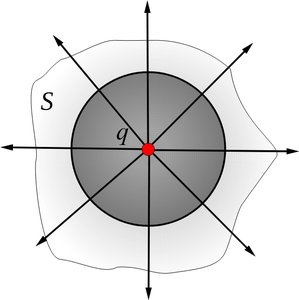
Gauss' Law
Gauss' law relates the electric flux through a closed surface to the net charge enclosed by that surface:
Statement: \( \Phi_E = \int_S d\vec{A}(\vec{r}) \cdot \vec{E}(\vec{r}) = \frac{q_{\text{in}}}{\epsilon_0} \).
Multiple Charges: The total flux is the sum of individual fluxes from each enclosed charge.
Charge Distribution: The enclosed charge \( q_{\text{in}} \) can be distributed arbitrarily within S.
External Charges: Charges outside the closed surface do not contribute to the flux.
Example: Applying Gauss' law to a sphere enclosing several point charges yields the sum of their charges divided by \( \epsilon_0 \).
Applications of Gauss' Law to Find the Electric Field
Gauss' law is especially useful for charge distributions with high symmetry:
Planar Symmetry: Charge density depends only on distance to a plane, e.g., \( \rho(x, y, z) = \rho(z) \).
Cylindrical Symmetry: Charge density depends only on distance to an axis, e.g., \( \rho(x, y, z) = \rho(\sqrt{x^2 + y^2}) \).
Spherical Symmetry: Charge density depends only on distance to a point, e.g., \( \rho(x, y, z) = \rho(\sqrt{x^2 + y^2 + z^2}) \).
General Strategy:
Identify the symmetry of the charge distribution.
Draw a Gaussian surface matching the symmetry.
Find the total charge inside the surface.
Calculate the flux as \( q_{\text{in}}/\epsilon_0 \).
Identify regions where the field is normal to the surface.
Divide the flux by the area contributing to the flux to find the electric field.
Example: For a spherical charge distribution, use a spherical Gaussian surface.
General Expression: For arbitrary distributions, use:
Exercises: Electric Field Flux and Field Calculations
Exercise 1: Find the electric field flux through a closed surface for the following configurations:
Electric dipole inside a spherical surface
A charge −1 nC inside a toroidal surface and another charge 100 nC in the center of the torus
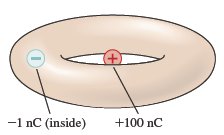
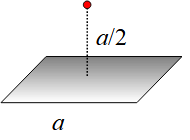
A charge 1 nC located at a distance a/2 directly above a square of side length a
Exercise 2: Find the electric field \( \vec{E}(\vec{r}) \) produced inside and outside a uniformly charged ball of radius R with charge density \( \rho \). The ball is centered at the origin.
Exercise 3: Find the electric field \( \vec{E}(\vec{r}) \) produced inside and outside a uniformly charged thin spherical shell of radius R with surface charge density \( \sigma \). The shell is centered at the origin.
Exercise 4: Find the electric field \( \vec{E}(\vec{r}) \) produced by a surface charge density \( \sigma \) uniformly spread in the (yz)-plane.
Exercise 5: Find the electric field \( \vec{E}(\vec{r}) \) produced by a linear charge density \( \lambda \) uniformly distributed on the x-axis.
