 Back
BackGauss's Law and Electric Fields: A Comprehensive Study Guide
Study Guide - Smart Notes
 Tailored notes based on your materials, expanded with key definitions, examples, and context.
Gauss's Law and Electric Fields
Introduction to Gauss's Law
Gauss's Law is a fundamental principle in electromagnetism that relates the electric flux through a closed surface to the charge enclosed by that surface. It is especially useful for calculating electric fields in situations with high symmetry, such as spherical, cylindrical, or planar charge distributions.
Electric Flux (\( \Phi_E \)): The measure of the number of electric field lines passing through a surface.
Gauss's Law (Integral Form): \( \Phi_E = \oint \vec{E} \cdot d\vec{A} = \frac{q_{enc}}{\epsilon_0} \)
Permittivity of Free Space (\( \epsilon_0 \)): \( 8.85 \times 10^{-12} \; \mathrm{C^2/N \cdot m^2} \)
Key Concepts and Definitions
Area Vector (\( \vec{A} \)): A vector whose magnitude is the area of the surface and whose direction is perpendicular to the surface.
Surface Integral: The sum (integral) of the electric field over a surface, accounting for the direction of the field and the surface.
Closed Surface: A surface that completely encloses a volume (e.g., sphere, cube).
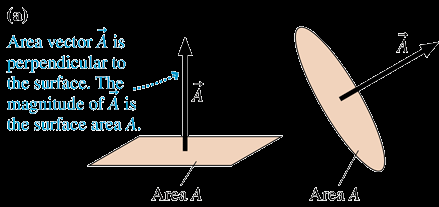
Electric Flux Through a Surface
The electric flux through a surface depends on the angle between the electric field and the area vector. The flux is maximized when the field is perpendicular to the surface and zero when parallel.
Mathematical Expression: \( \Phi_E = \vec{E} \cdot \vec{A} = EA \cos \theta \)
Sign Convention: Flux is positive when field lines exit the surface, negative when they enter.
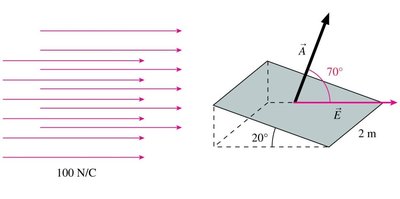
Examples: Calculating Electric Flux
For a uniform field and a flat surface at an angle \( \theta \): \( \Phi_E = EA \cos \theta \)
For a closed surface, sum the flux through all surface elements.
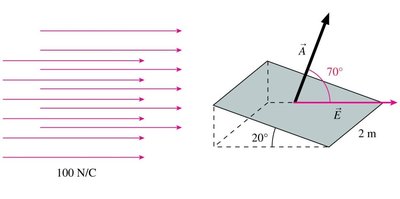
Superposition Principle and Symmetry
When dealing with multiple charges, the total electric field is the vector sum of the fields produced by each charge (superposition). For continuous charge distributions, symmetry simplifies the calculation of the net field.
Superposition: \( \vec{E}_{total} = \sum \vec{E}_i \)
Symmetry: Use symmetry to choose a Gaussian surface that makes the dot product \( \vec{E} \cdot d\vec{A} \) easy to evaluate.
Application of Gauss's Law: Common Symmetries
Gauss's Law is most useful for charge distributions with high symmetry. The three fundamental symmetries are:
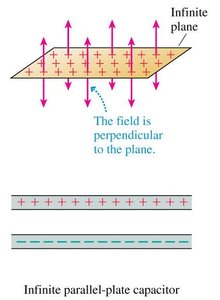
Planar Symmetry: Infinite plane of charge or parallel-plate capacitor.
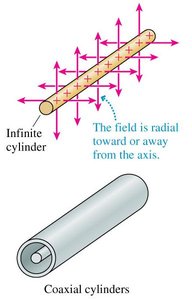
Cylindrical Symmetry: Infinite line of charge or coaxial cylinders.
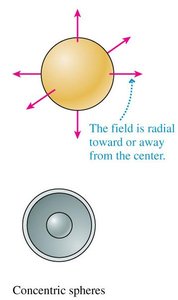
Spherical Symmetry: Point charge or concentric spheres.
Symmetry | Gaussian Surface | Field Direction |
|---|---|---|
Planar | Box or pillbox | Perpendicular to plane |
Cylindrical | Cylinder | Radial from axis |
Spherical | Sphere | Radial from center |
Example: Point Charge
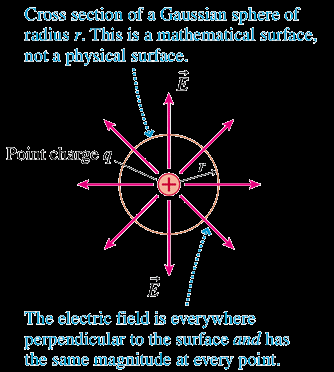
For a point charge \( q \), the electric field at a distance \( r \) is:
\( E = \frac{q}{4\pi \epsilon_0 r^2} \)
The field is radial and the same at every point on a spherical surface centered on the charge.
Example: Infinite Line of Charge
For an infinite line of charge with linear charge density \( \lambda \):
Choose a cylindrical Gaussian surface of radius \( d \) and length \( L \).
\( E = \frac{\lambda}{2\pi d \epsilon_0} \)
The field is radial and perpendicular to the cylinder's surface.
Example: Infinite Plane of Charge
For an infinite plane with surface charge density \( \sigma \):
\( E = \frac{\sigma}{2\epsilon_0} \)
The field is perpendicular to the plane and uniform on both sides.
Faraday Cages and Conductors
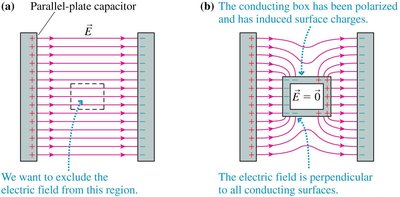
In a conductor at electrostatic equilibrium, the electric field inside is zero. Any excess charge resides on the surface. A Faraday cage uses this property to shield its interior from external electric fields.
Screening: The use of a conducting enclosure to block electric fields.
Induced Charges: Charges rearrange on the surface to cancel internal fields.
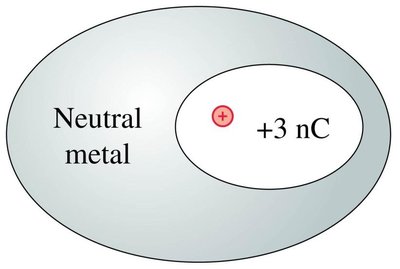
Charge Inside a Conductor with a Cavity
If a charge is placed inside a cavity within a conductor, the conductor's inner surface acquires an induced charge of opposite sign, and the outer surface acquires a charge equal to the original charge to maintain neutrality.
Summary Table: Gauss's Law for Different Geometries
Geometry | Gaussian Surface | Electric Field (E) |
|---|---|---|
Point Charge | Sphere | \( \frac{q}{4\pi \epsilon_0 r^2} \) |
Infinite Line | Cylinder | \( \frac{\lambda}{2\pi d \epsilon_0} \) |
Infinite Plane | Box/Pillbox | \( \frac{\sigma}{2\epsilon_0} \) |
Key Takeaways
Gauss's Law is a powerful tool for calculating electric fields in symmetric situations.
Choose a Gaussian surface that matches the symmetry of the charge distribution.
For conductors, the field inside is zero and excess charge resides on the surface.
Electric flux depends only on the enclosed charge, not on the size or shape of the surface.
