 Back
BackGeometrical Optics: Fundamentals of Light, Reflection, and Refraction
Study Guide - Smart Notes
 Tailored notes based on your materials, expanded with key definitions, examples, and context.
Geometrical Optics
Introduction to Optics
Optics is the branch of physics that studies the behavior and properties of light. It can be approached in several ways, including geometrical optics (light as rays), physical optics (light as waves), and quantum optics (atomic phenomena involving light). In this section, we focus on geometrical optics, which treats light as straight-line rays and is foundational for understanding lenses, mirrors, and image formation.
Geometrical Optics: Light is modeled as rays that travel in straight lines, reflecting and refracting at surfaces.
Physical Optics: Light is treated as a wave, explaining phenomena like interference and diffraction.
Quantum Optics: Light is considered in terms of photons and atomic interactions.
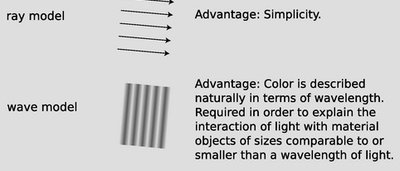
Light as a Ray
Basic Properties of Light Rays
In geometrical optics, a light ray is an abstract concept representing the path along which light energy travels. This model is valid when the dimensions of optical elements (lenses, mirrors) are much larger than the wavelength of light.
Light rays travel in straight lines in a homogeneous medium.
The speed of light in a medium is , where is the speed of light in vacuum and is the refractive index.
Light rays can cross without affecting each other (no interference in this model).
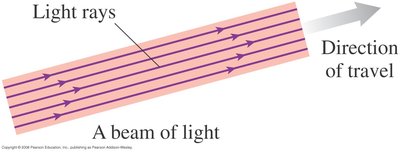
Light Sources and Bundles
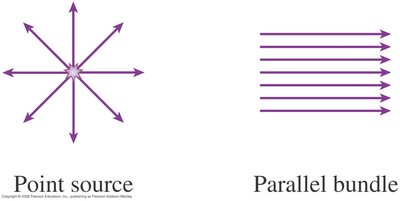
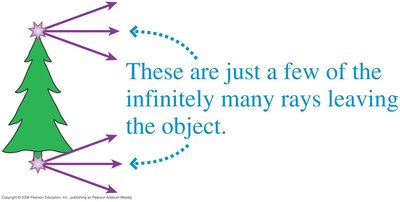
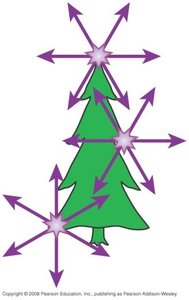
Every point on an object can be considered a source of light rays, emitting in all directions. There are two idealized cases:
Point Source: Emits rays in all directions.
Parallel Bundle: All rays are parallel, as from a distant source or a laser.
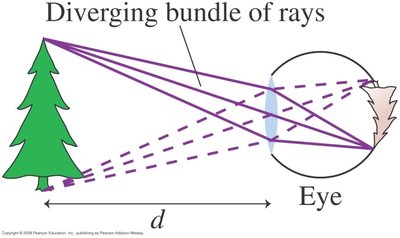
How We See Objects
The human eye perceives objects by focusing diverging bundles of rays from each point on the object onto the retina. The lens of the eye adjusts to focus these rays, allowing us to perceive distance and clarity.
Self-Luminous and Reflective Objects
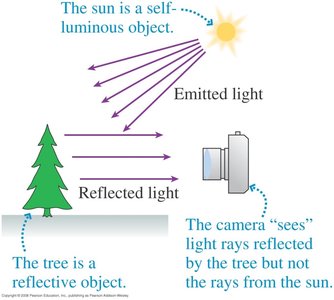
Some objects emit their own light (e.g., the Sun, a lamp), while most objects are visible because they reflect light from other sources. The camera or eye detects only the rays that enter it, not all rays emitted or reflected by the object.
Camera Obscura and Apertures
Image Formation with a Pinhole
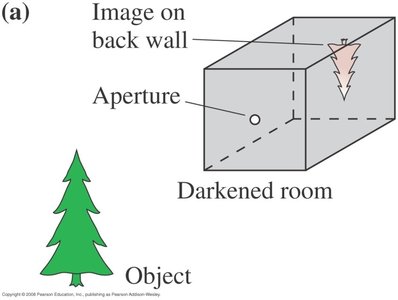
A camera obscura (pinhole camera) demonstrates how light rays from an object pass through a small aperture to form an inverted image on a screen. The size of the aperture affects the sharpness and brightness of the image.
Smaller aperture: Sharper but dimmer image.
Larger aperture: Brighter but blurrier image due to overlapping rays.
Mathematical Relationship in Pinhole Cameras
The relationship between object height (), image height (), object distance (), and image distance () is given by:
This equation allows us to determine the size of the image formed by a pinhole camera.
Basic Laws of Geometrical Optics
Reflection and Refraction
When light encounters a boundary between two media, it can be reflected, refracted (bent), scattered, or absorbed. The basic laws governing these phenomena are:
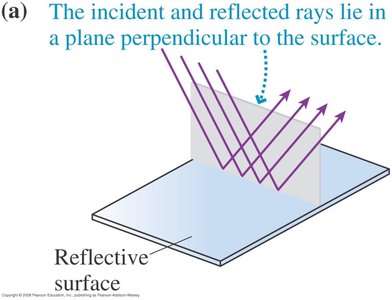
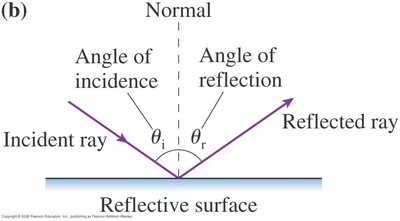
Reflection: The angle of incidence equals the angle of reflection ().
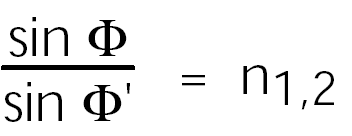
Refraction (Snell's Law):
Refractive Index
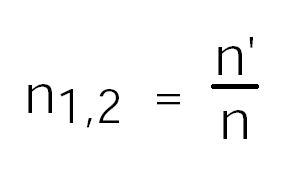
The refractive index () of a material quantifies how much it slows down light compared to vacuum. Typical values are:
Material | Refractive Index () |
|---|---|
Air | 1.0003 |
Water | 1.333 |
Glass | 1.5 - 1.9 |
Diamond | 2.419 |
Gallium Phosphide | 3.5 |
Additional info: See full table in source for more materials. |
Snell's Law (Law of Refraction)
Snell's Law relates the angles of incidence and refraction to the refractive indices of the two media:
or equivalently,
Optical Path Length and Fermat's Principle
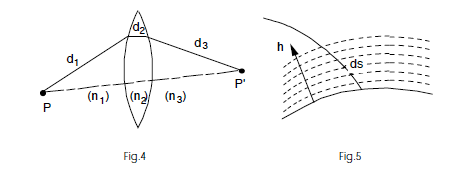
The optical path length is defined as , where is the physical distance traveled in a medium of refractive index . Fermat's Principle states that the path taken by light between two points is the one that minimizes (or makes stationary) the optical path length.
Reflection: Plane Mirrors
Image Formation by Plane Mirrors
Plane mirrors form virtual images that appear to be behind the mirror at the same distance as the object is in front. Each point on the object has a corresponding image point.
Virtual images cannot be projected onto a screen.
Multiple images can form with multiple mirrors.
Diffuse Reflection
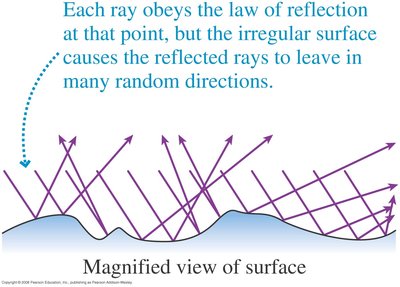
Most real-world surfaces are rough on a microscopic scale, causing diffuse reflection. This means light is reflected in many directions, allowing us to see objects from various angles.
Refraction: Bending of Light
Refraction at a Boundary
When light passes from one medium to another (e.g., air to glass), it bends according to Snell's Law. If the second medium has a higher refractive index, the ray bends toward the normal; if lower, away from the normal.
Critical angle: Beyond a certain angle, total internal reflection occurs (important in fiber optics).
Dispersion and Color
Dispersion of Light
Dispersion occurs because the refractive index of a material varies with wavelength. This causes different colors (wavelengths) of light to refract by different amounts, separating white light into its constituent colors (e.g., in a prism or a rainbow).
Red light (longer wavelength) bends less than blue/violet light (shorter wavelength).
Applications: Rainbows, color separation in lenses, and optical instruments.
Summary Table: Key Optical Phenomena
Phenomenon | Description |
|---|---|
Reflection | Bouncing of light off a surface |
Refraction | Bending of light as it passes between media |
Scattering | Light interacting with matter and spreading in various directions |
Absorption | Transfer of light energy to matter |
Key Equations
Speed of light in medium:
Law of reflection:
Snell's Law:
Magnification in pinhole camera:
Optical path length:
Additional info: For a deeper understanding, study the derivations of Snell's Law from Fermat's Principle, the effect of aperture size on image sharpness, and the quantitative treatment of dispersion (Fraunhofer lines, color filters, and atmospheric effects).
