 Back
BackGrade 11 Physics and Chemistry Essentials: Structured Study Notes
Study Guide - Smart Notes
 Tailored notes based on your materials, expanded with key definitions, examples, and context.
Vectors in 2D
Resolving Vectors and Force Triangles
Understanding vectors in two dimensions is essential for analyzing forces and motion in physics. Vectors can be resolved into perpendicular components, and force triangles are used to determine resultant forces or equilibrants.
Vector Components: Any vector F can be resolved into x and y components using trigonometric functions:
Components on a Slope: Weight (Fg) is often resolved into parallel and perpendicular components:
Force Triangle Construction: When forces are not co-linear, a force triangle can be constructed to determine resultant or equilibrant forces. The length and direction of arrows must remain consistent.
Parallelogram Method: Used for vectors acting concurrently; the resultant is the diagonal of the parallelogram originating from the tail of the vectors.
Tail-to-Head Method: Used for consecutive vectors; the resultant is from the tail of the first to the head of the last vector.
Resolving into Components: Diagonal vectors can be broken into x- and y-components to determine their effects along each axis.
Equilibrant: The force that keeps a system in equilibrium; equal in magnitude but opposite in direction to the resultant force.
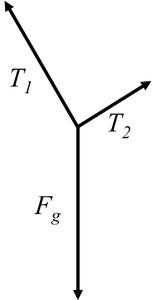
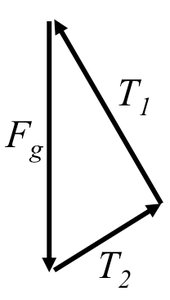
Example: An object suspended from a ceiling by two cables can be analyzed using a free body diagram and a force triangle to calculate the tensions T1 and T2.
Sine Rule and Pythagoras
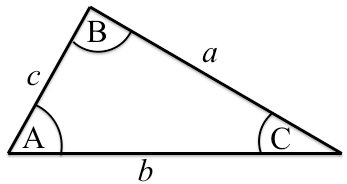
For non-right angle triangles, the sine rule is used to find sides and angles. For right angle triangles, Pythagoras' theorem applies.
Sine Rule:
Pythagoras (90° only):
Trigonometric Ratios:
Example: A boat travels 90 m east and 50 m north. The displacement is calculated using Pythagoras and trigonometry.
Newton’s Laws of Motion
Types of Forces and Free Body Diagrams
Newton's laws describe the relationship between forces and motion. Forces can be contact or non-contact, and are always vectors.
Contact Forces: Forces exerted between objects in contact (e.g., friction, normal force, tension).
Non-Contact Forces: Forces exerted over a distance (e.g., gravitational, electrostatic, magnetic).
Normal Force (FN): Perpendicular force exerted by a surface on an object.
Frictional Force (Ff): Opposes motion; can be static (fs) or kinetic (fk).
Newton’s Three Laws
First Law (Inertia): An object remains at rest or in uniform motion unless acted upon by a net force.
Second Law: The acceleration of an object is proportional to the net force and inversely proportional to its mass.
Third Law: For every action, there is an equal and opposite reaction.
Example: Calculating acceleration and applied force for objects on an incline, considering friction and gravity.
Geometric Optics
Reflection, Refraction, and Optical Density
Geometric optics deals with the behavior of light as it interacts with different media.
Reflection: The angle of reflection equals the angle of incidence.
Refraction: Bending of light as it passes between media of different optical densities; described by Snell's Law:
Optical Density: Higher optical density means slower light speed and greater refraction.
Refractive Index: Ratio of speed of light in vacuum to speed in a medium:
Critical Angle and Total Internal Reflection
Critical Angle: The angle of incidence for which the angle of refraction is 90°.
Total Internal Reflection: Occurs when the angle of incidence exceeds the critical angle and light is reflected internally.
Molecular Structure
Covalent, Ionic, and Metallic Bonding
Molecular structure determines physical and chemical properties. The type of bond depends on electronegativity differences.
Covalent Bond: Sharing of electron pairs between non-metals.
Ionic Bond: Transfer of electrons from metals to non-metals, forming cations and anions.
Metallic Bond: Bond between positive metal kernels and a sea of delocalized electrons.
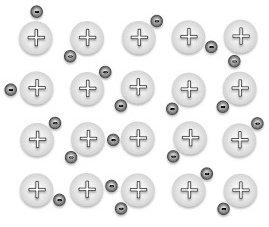
Bond Energy and Bond Length
Bond Energy: Energy required to break one mole of a specific covalent bond in gaseous phase.
Bond Length: Average distance between nuclei of two bonded atoms; shorter bonds are stronger.
Lewis Diagrams and VSEPR Theory
Lewis Diagrams: Visualize valence electrons and bonding pairs.
VSEPR Theory: Predicts molecular shape based on electron pairs around the central atom.
Quantitative Aspects of Chemical Change
The Mole and Molar Mass
The mole is a fundamental unit for counting particles in chemistry. Molar mass is the mass of one mole of particles.
Mole: particles (Avogadro's number).
Molar Mass: Mass of one mole of a substance, measured in g·mol-1.
Formula:
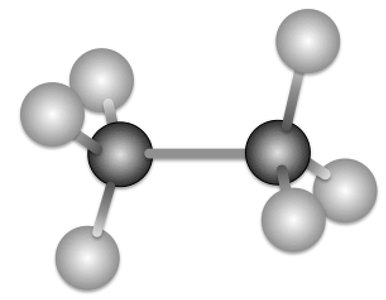
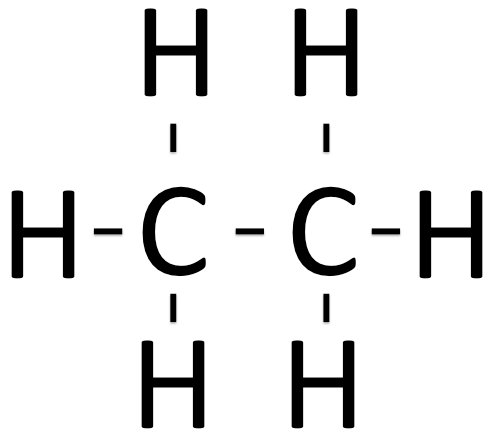
Empirical and Molecular Formula
Empirical Formula: Simplest whole number ratio of atoms in a compound.
Molecular Formula: Actual number of atoms in a molecule; calculated from empirical formula and molar mass.
Molar Volume of Gases
Molar Volume: At STP, one mole of any gas occupies 22.4 dm3.
Formula:
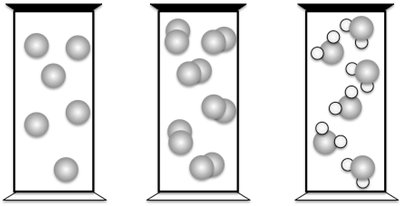
Concentration of Solutions
Concentration: Number of moles of solute per unit volume of solution.
Intermolecular Forces
Types and Effects of Intermolecular Forces
Intermolecular forces (IMF) are weak attractions between molecules, affecting physical properties such as boiling point, melting point, and solubility.
Types of IMF: Hydrogen bonding, ion-dipole, dipole-dipole, dipole-induced dipole, London dispersion forces.
Strength Order: Hydrogen bonding > ion-dipole > dipole-dipole > ion-induced dipole > dipole-induced dipole > London dispersion.
Physical Properties: Stronger IMF leads to higher boiling/melting points, greater viscosity, and lower evaporation rates.
Example: Water's high boiling point and specific heat capacity are due to strong hydrogen bonding.
Ideal Gases
Kinetic Molecular Theory and Gas Laws
Ideal gases are theoretical models that obey gas laws under all conditions. The kinetic molecular theory describes their behavior.
Boyle’s Law: (constant T)
Charles’ Law: (constant P)
Gay-Lussac’s Law: (constant V)
Ideal Gas Equation:
Example: Calculating the new volume of a balloon when pressure changes using Boyle’s Law.
----------------------------------------
