 Back
BackGravity and Circular Orbits: Forces, Motion, and Orbital Dynamics
Study Guide - Smart Notes
 Tailored notes based on your materials, expanded with key definitions, examples, and context.
Q1. Describe the direction of the force of gravity on the Earth, exerted by the Sun.
Background
Topic: Gravitational Force in Circular Orbits
This question tests your understanding of how gravity acts as a centripetal force, keeping planets in orbit around the Sun.
Key Terms and Formulas
Gravitational Force: The attractive force between two masses, such as the Earth and the Sun.
Centripetal Force: The force that keeps an object moving in a circular path, always directed toward the center of the circle.
Newton's Law of Universal Gravitation:
Where:
= gravitational force
= universal gravitational constant
= masses of the two objects
= distance between the centers of the two masses
Step-by-Step Guidance
Visualize the Earth's orbit around the Sun as a nearly circular path.
Recall that gravity acts as the centripetal force, always pulling the Earth directly toward the center of the Sun.
At any point in the orbit, the direction of the gravitational force is along the line connecting the centers of the Earth and the Sun, pointing inward toward the Sun.
Try describing the direction in your own words before checking the answer!
Q2. On the diagram below, sketch vectors that represent the force of gravity on the Earth at each of the locations provided.
Background
Topic: Vector Representation of Forces in Circular Motion
This question asks you to apply your understanding of force vectors to a planetary orbit, showing the direction of gravity at different points.
Key Terms and Formulas
Force Vector: An arrow showing the direction and relative magnitude of a force.
Gravity in Orbit: Always points toward the center of the mass being orbited (the Sun).
Step-by-Step Guidance
For each position of the Earth in its orbit, draw an arrow (vector) from the Earth pointing directly toward the Sun.
Make sure each vector starts at the Earth's position and points inward, toward the center of the orbit (the Sun).
The length of the vectors can be kept the same if the orbit is a perfect circle, since the distance to the Sun does not change.
Try sketching the vectors before checking your work!
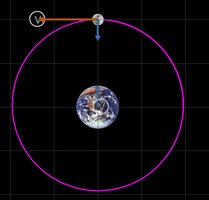
Q3. While Earth is moving, turn off gravity. What does the Earth do? With reference to Newton’s 1st law of motion, explain why the Earth moved in this manner once gravity was turned off.
Background
Topic: Newton's First Law and Inertia in Orbital Motion
This question tests your understanding of what happens to an object in motion when the force acting on it is removed, specifically in the context of planetary motion.
Key Terms and Formulas
Newton's First Law of Motion: An object in motion will remain in motion in a straight line at constant speed unless acted upon by a net external force.
Inertia: The tendency of an object to resist changes in its state of motion.
Step-by-Step Guidance
Consider what force is keeping the Earth in its circular path (gravity).
When gravity is turned off, there is no longer a force pulling the Earth toward the Sun.
According to Newton’s First Law, the Earth will continue moving in a straight line at constant velocity in the direction it was moving at the instant gravity was turned off.
Try explaining this in your own words before checking the answer!
Q4. Exercise 2: Orbital Velocity and Radius for Uniform Circular Motion
Background
Topic: Orbital Motion, Gravitational Force, and Velocity
This set of questions explores how changing the radius of an orbit affects the force of gravity and the velocity required for a stable circular orbit.
Key Terms and Formulas
Orbital Velocity: The speed needed for an object to stay in a circular orbit at a given radius.
Gravitational Force:
Centripetal Force for Circular Motion:
Setting Gravitational Force equal to Centripetal Force:
Step-by-Step Guidance
When the moon is moved farther from the Earth (from 2 boxes to 3 boxes), observe whether it still follows a circular path and returns to its starting position.
Check if the force of gravity is still present by looking for the force vectors in the simulation.
Note the direction of the force vector—does it still point from the moon toward the Earth?
Consider how the magnitude of the gravitational force changes as the distance increases (remember the inverse square law: force decreases as distance squared increases).
Think about why the moon might not stay in a circular orbit at a larger radius without adjusting its velocity.
Try answering each part before checking the explanations!
Q5. Adjusting Orbital Velocity for a Larger Radius
Background
Topic: Relationship Between Orbital Radius, Velocity, and Gravitational Force
This question asks you to explore how changing the moon's velocity allows it to maintain a circular orbit at a different radius.
Key Terms and Formulas
Orbital Velocity Formula:
Radius (): The distance from the center of the Earth to the moon.
Velocity (): The speed required to maintain a circular orbit at radius .
Step-by-Step Guidance
After moving the moon to a larger radius, adjust the velocity vector until the moon follows a circular path again.
Observe how the required velocity changes as the radius increases (hint: it should decrease).
Compare the force of gravity at different radii using the formula .
Predict what will happen to the radius, force of gravity, and required velocity if the moon is moved closer (to 1 box away).
Try making your predictions and adjustments before checking the answer!
Q6. Summary: As the radius of the orbit decreases, what happens to the force of gravity? What happens to the velocity if you want to maintain a circular orbit?
Background
Topic: Inverse Square Law and Orbital Dynamics
This summary question asks you to synthesize your understanding of how gravitational force and orbital velocity depend on the radius of the orbit.
Key Terms and Formulas
Gravitational Force:
Orbital Velocity:
Step-by-Step Guidance
As the radius decreases, substitute smaller values into the formulas to see how and change.
Notice that as gets smaller, increases rapidly (since it is proportional to ).
Similarly, as decreases, increases (since it is proportional to ).
Try summarizing these relationships in your own words before checking the answer!
