 Back
BackHeat Transfer Mechanisms in Physics
Study Guide - Smart Notes
 Tailored notes based on your materials, expanded with key definitions, examples, and context.
Heat Transfer Mechanisms
Introduction to Heat Transfer
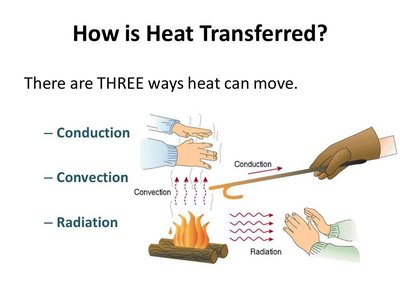
Heat transfer is the process by which thermal energy moves from a region of higher temperature to a region of lower temperature. In physics, understanding the mechanisms of heat transfer is essential for analyzing energy exchanges in natural and engineered systems. There are four primary mechanisms by which heat is transferred: conduction, convection, radiation, and evaporation.
Conduction
Definition and Physical Principles
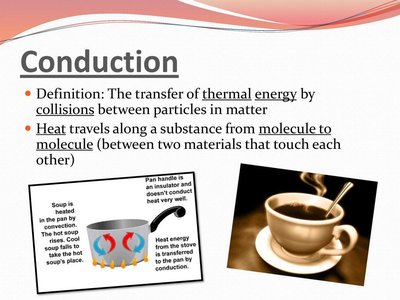
Conduction is the transfer of thermal energy through direct contact between particles in a material, without any bulk movement of the material itself. This process occurs due to collisions between particles, allowing energy to flow from the hotter region to the colder region.
Thermal conductivity (k): A material property that quantifies how well a material conducts heat. Higher values of k indicate better conductors.
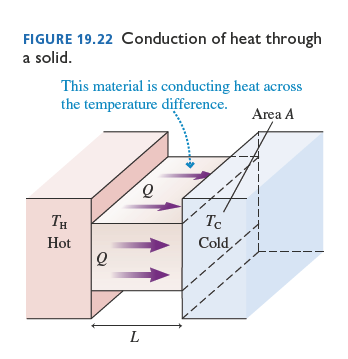
Heat transfer rate: The rate at which heat flows through a material depends on the temperature difference, the cross-sectional area, and the thickness of the material.
Mathematical Description
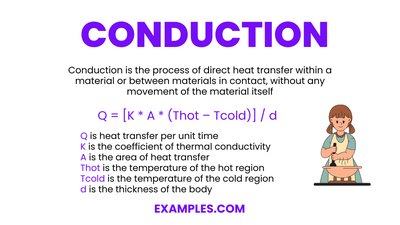
The rate of heat transfer by conduction through a slab of material is given by:
dQ/dt: Rate of heat transfer (Watts, W)
k: Thermal conductivity (W/m·K)
A: Cross-sectional area (m2)
L: Thickness of the material (m)
T_H, T_C: Temperatures of the hot and cold sides (K or °C)
Thermal Conductivities of Common Materials
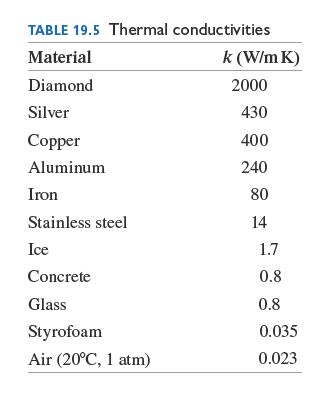
The ability of materials to conduct heat varies widely. The following table lists thermal conductivities for several common materials:
Material | k (W/m·K) |
|---|---|
Diamond | 2000 |
Silver | 430 |
Copper | 400 |
Aluminum | 240 |
Iron | 80 |
Stainless steel | 14 |
Ice | 1.7 |
Concrete | 0.8 |
Glass | 0.8 |
Styrofoam | 0.035 |
Air (20°C, 1 atm) | 0.023 |
Example: Keeping a Freezer Cold
Consider a freezer insulated with Styrofoam. Given the dimensions and temperature difference, the rate of heat transfer into the freezer can be calculated using the conduction formula.
Thermal conductivity of Styrofoam: W/m·K
Thickness: m
Temperature difference: K
Total surface area: m2

The rate of heat transfer is:

Convection
Definition and Physical Principles
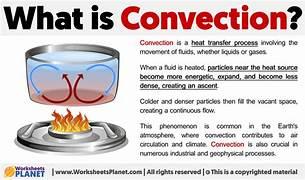
Convection is the transfer of thermal energy by the bulk movement of a fluid (liquid or gas). When a fluid is heated, it expands, becomes less dense, and rises, while cooler, denser fluid sinks, creating a circulation pattern that transfers heat.
Natural convection: Driven by buoyancy forces due to density differences.
Forced convection: Occurs when a fluid is forced to flow over a surface by external means (e.g., a fan or pump).
Mathematical Description
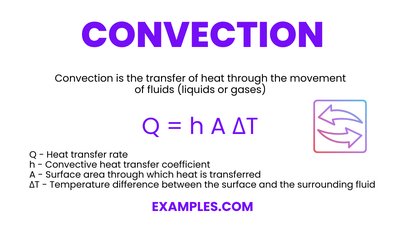
The rate of heat transfer by convection is given by:
h: Convective heat transfer coefficient (W/m2·K)
A: Surface area (m2)
ΔT: Temperature difference between the surface and the fluid (K or °C)
Radiation
Definition and Physical Principles
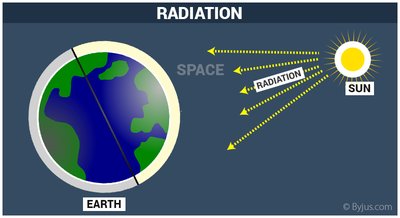
Radiation is the transfer of energy by electromagnetic waves, primarily in the infrared region. Unlike conduction and convection, radiation does not require a medium and can occur through a vacuum.
All objects emit and absorb thermal radiation depending on their temperature and surface properties.
The emissivity (e) of a surface (0 ≤ e ≤ 1) quantifies how effectively it emits or absorbs radiation.
Mathematical Description
The power radiated by an object is given by the Stefan-Boltzmann law:
e: Emissivity of the surface
σ: Stefan-Boltzmann constant ( W/m2·K4)
A: Surface area (m2)
T: Absolute temperature (K)
The net rate of heat transfer, accounting for both emission and absorption, is:
T_0: Temperature of the surroundings (K)
Blackbody Radiation
A black body is an idealized object that absorbs all incident radiation (e = 1) and is also the most efficient emitter. The radiation emitted by a black body is called black-body radiation.
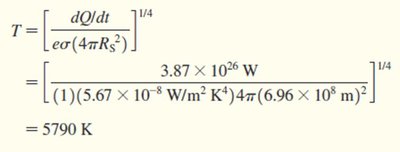
Example: Temperature of the Sun
Given the intensity of solar radiation at Earth's distance and the radius of the sun, the surface temperature of the sun can be estimated using the Stefan-Boltzmann law:
Evaporation
Definition and Physical Principles
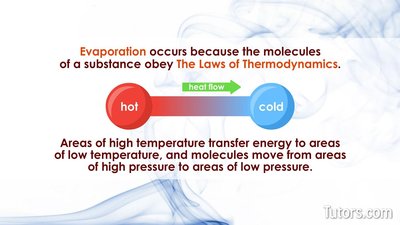
Evaporation is the process by which molecules at the surface of a liquid gain enough energy to escape into the gas phase, carrying away thermal energy and thus cooling the remaining liquid. This process is governed by the laws of thermodynamics and is an important mechanism for heat loss in biological and environmental systems.
The Greenhouse Effect
Physical Principles
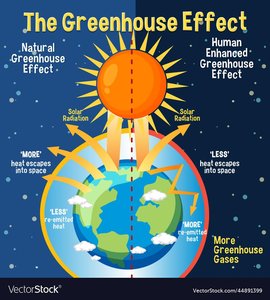
The greenhouse effect is a natural phenomenon where certain gases in Earth's atmosphere trap heat, maintaining the planet's temperature within a range suitable for life. Solar radiation passes through the atmosphere, is absorbed by the surface, and then re-emitted as infrared radiation. Greenhouse gases absorb and re-emit some of this infrared radiation, warming the atmosphere.
Summary Table: Heat Transfer Mechanisms
Mechanism | Description | Key Equation |
|---|---|---|
Conduction | Direct transfer through a material | |
Convection | Transfer by bulk movement of fluid | |
Radiation | Transfer by electromagnetic waves | |
Evaporation | Heat loss by phase change at surface | Depends on latent heat and mass loss |
Additional info: The notes above expand on the original content by providing definitions, equations, and examples for each mechanism, as well as a summary table for comparison.
