Back
BackInduced Electric and Magnetic Fields, Maxwell’s Equations, and Paradoxes
Study Guide - Smart Notes
 Tailored notes based on your materials, expanded with key definitions, examples, and context.
Induced Electric Fields
Faraday's Law of Induction
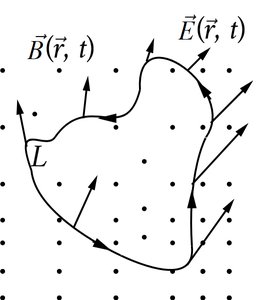
When a magnetic field changes with time, it induces an electromotive force (emf) in a conducting loop. This phenomenon is described by Faraday's Law of Induction, which states that the emf is equal to the negative rate of change of magnetic flux through the loop. The induced electric field is not confined to the wire but exists throughout space.
Emf Definition: The emf is the work performed by an electric field to transfer a unit charge around a loop:
Faraday's Law:
Induced Electric Field: A time-dependent magnetic field induces an electric field in space, not just in the loop.
Induced vs. Electrostatic Electric Fields
Comparison of Field Properties
Induced electric fields and electrostatic fields differ fundamentally in their origins and properties. Electrostatic fields are produced by stationary charges, while induced fields arise from changing magnetic fields.
Electrostatic Field (): Produced by electric charges, conservative (), derived from electric potential, field lines begin/end on charges or at infinity.
Induced Field (): Produced by time-dependent magnetic fields, non-conservative (), not derived from potential, field lines are closed loops.
Gauss' Law for Electrostatic Field:
Gauss' Law for Induced Field:
Displacement Current and Maxwell's Generalization
Displacement Current in Capacitors
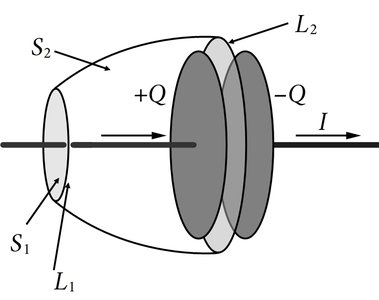
In situations such as charging a capacitor, the traditional definition of current in Ampère’s law is insufficient. Maxwell introduced the concept of displacement current to account for the changing electric field between capacitor plates.
Ampère’s Law:
Displacement Current:
Maxwell-Ampère Law:
Physical Meaning: Magnetic fields are generated not only by moving charges (current) but also by changing electric fields.
Maxwell’s Equations in Vacuum
Unified Laws of Electromagnetism
Maxwell’s equations describe the behavior of electric and magnetic fields in vacuum. They unify the laws of electricity and magnetism and predict electromagnetic waves.
Gauss’ Law for Electric Field:
Gauss’ Law for Magnetic Field:
Maxwell-Ampère Law:
Faraday’s Law:
Example: Induced Electric Fields in a Circular Loop
Uniform Magnetic Field Increasing with Time
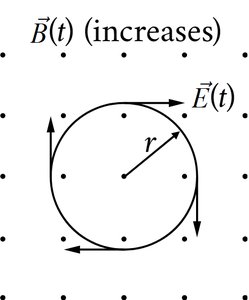
An increasing uniform magnetic field induces an emf in a circular loop. By symmetry, the induced electric field is tangential at every point on the loop.
Induced emf:
Line Integral:
Induced Electric Field Magnitude:
Paradox #1: Induced Electric Field at Intersection of Loops
Multiple Loops in an Increasing Magnetic Field
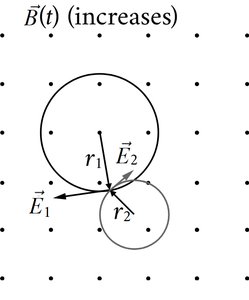
If two loops of different radii intersect in a region of increasing magnetic field, each loop has a different induced electric field at the intersection point. This raises the question of whether the induced electric field is uniquely defined at that point.
Induced Electric Field in Loop 1:
Induced Electric Field in Loop 2:
Paradox: Any point can be the intersection of many loops; is the induced electric field concept meaningful?
Solution to Paradox #1: Boundary Conditions
Finite Systems and Symmetry
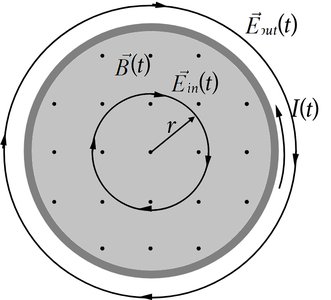
The paradox arises only in infinite space. In real, finite-sized systems, the induced electric field must be consistent with the symmetry of the setup. For example, inside a solenoid, the field is determined by the geometry and current distribution.
Uniform Magnetic Field in Solenoid:
Electric Field Inside Solenoid:
Electric Field Outside Solenoid:
Paradox #2: Induced Electric Field from Increasing Current in a Wire
Induced Field at Distance from a Straight Wire
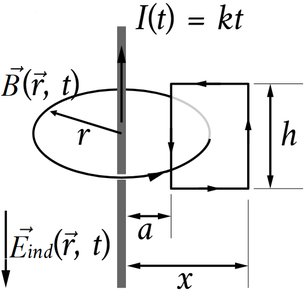
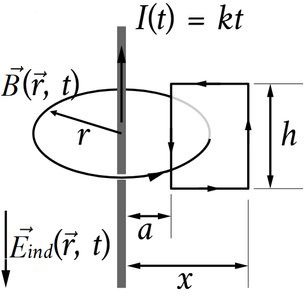
When the current in a straight wire increases linearly with time, the induced electric field at a distance x from the wire can be calculated using Faraday’s law. However, the result appears to diverge at large distances, which is unphysical.
Current:
Magnetic Field:
Magnetic Flux:
Induced Electric Field:
Paradox: diverges as
Solution to Paradox #2: Quasistatic Approximation
Finite Speed of Electromagnetic Disturbance
The divergence arises because the finite speed of electromagnetic propagation (speed of light, c) was neglected. The quasistatic approximation assumes that relevant length and time scales are such that , making the approximation valid for most practical cases.
Retarded Fields: To go beyond the quasistatic approximation, retarded fields must be used, accounting for the finite speed of light.
Validity: The approximation holds when changes propagate much faster than the system size.
Exercises
Exercise 1: Induced Electric Field Outside a Solenoid
A long solenoid with n = 400 turns/m and radius R = 1.1 cm has a current increasing at rate . At a point 3.50 cm from its axis, the induced electric field is V/m. Find k and the expression for the induced electric field outside the solenoid.
Induced Electric Field Outside:
Given: V/m, m, m,
Find:
Exercise 2: Magnetic Field Inside a Moving Capacitor
The plates of a parallel-plate capacitor are kept under a fixed voltage V and move away from each other with velocity u. The initial distance between plates at t = 0 is . Find the magnetic field inside the capacitor.
Displacement Current:
Magnetic Field: Use Maxwell-Ampère law to relate displacement current to magnetic field.
Exercise 3: Loop Pulled from Magnetic Field Region
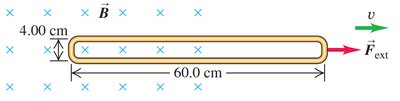
A rectangular loop slides without friction on a horizontal surface. Initially, 90% of its area is in a region of uniform magnetic field ( T). The loop has dimensions cm, cm, mass g, and resistance mΩ. A constant force N is applied. Is the loop still in the region where the magnetic field exists after 1 s?
Relevant Concepts: Induced emf, magnetic force, energy dissipation, motion equations.
Application: Calculate velocity and displacement after 1 s, compare with field region size.