 Back
BackInterpreting Piecewise Acceleration in 1D Kinematics
Study Guide - Smart Notes
 Tailored notes based on your materials, expanded with key definitions, examples, and context.
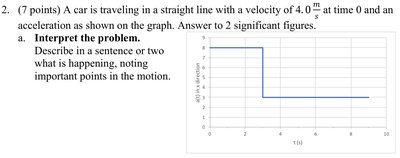
Q2. A car is traveling in a straight line with a velocity of 4.0 m/s at time 0 and an acceleration as shown on the graph. Answer to 2 significant figures.
Background
Topic: 1D Kinematics, Piecewise Acceleration
This question is testing your ability to interpret a motion scenario where a car starts with an initial velocity and then experiences two intervals of constant acceleration, as depicted in the acceleration vs. time graph. You are asked to describe the motion qualitatively before proceeding to calculations.
Key Terms:
Velocity (): The speed and direction of the car at any moment.
Acceleration (): The rate of change of velocity, which can vary over time.
Piecewise Acceleration: The acceleration changes at specific times, creating distinct intervals.
Step-by-Step Guidance
Examine the acceleration vs. time graph. Notice that the car experiences a large positive acceleration for the first interval (e.g., 0–3 s), then a smaller positive acceleration for the next interval (e.g., 3–9 s).
Describe the motion: The car starts with an initial velocity of 4.0 m/s and speeds up quickly during the first interval due to the larger acceleration. After this, it continues to speed up, but at a slower rate, during the second interval.
Identify important points: The transition between acceleration intervals (at t = 3 s) is a key moment. The car's velocity increases more rapidly at first, then less rapidly after the change.
Think about how the velocity changes: Since acceleration is always positive, the car never slows down; it just speeds up at different rates.
Try solving on your own before revealing the answer!
