Back
BackKinematics and Projectile Motion: Study Notes
Study Guide - Smart Notes
 Tailored notes based on your materials, expanded with key definitions, examples, and context.
1D Kinematics Basics
Displacement, Position, and Time
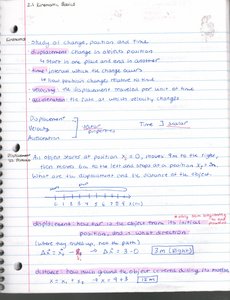
Kinematics is the study of change, position, and time. It focuses on describing how objects move without considering the forces causing the motion.
Displacement: Change in position; a vector quantity indicating how far and in what direction an object has moved.
Position: The location of an object at a given time.
Time: The duration over which motion occurs.
Velocity: The rate of change of displacement; a vector quantity.
Acceleration: The rate at which velocity changes with time.
Example: If an object moves from position m to m, the displacement is m.
Distance vs. Displacement
Distance is the total length of the path traveled, regardless of direction, while displacement is the straight-line change in position.
Distance: Scalar quantity; always positive.
Displacement: Vector quantity; can be positive or negative.
Velocity and Speed
Definitions and Formulas
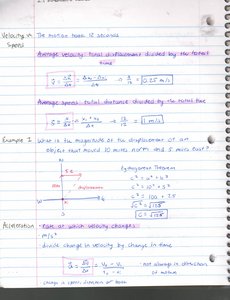
Velocity and speed are both measures of how fast an object moves, but velocity includes direction.
Average velocity:
Average speed:
Example: If an object moves 10 m north and 5 m east, the magnitude of displacement is found using the Pythagorean theorem: m.
Acceleration
Definition and Calculation
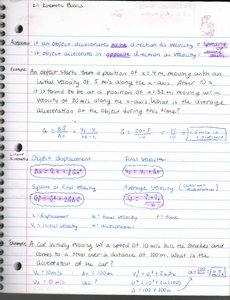
Acceleration is the rate at which velocity changes. It is a vector quantity and can be positive (speeding up) or negative (slowing down).
Average acceleration:
Where is the change in velocity and is the change in time.
Object Displacement and Velocity Equations
Key kinematic equations relate displacement, velocity, acceleration, and time:
Graphical Analysis of Motion
Displacement vs. Time and Velocity vs. Time Graphs
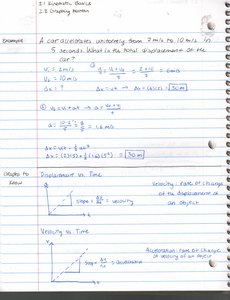
Graphs are essential tools for visualizing motion. The slope of a displacement vs. time graph gives velocity, while the slope of a velocity vs. time graph gives acceleration.
Displacement vs. Time: Slope = velocity
Velocity vs. Time: Slope = acceleration
Area Under Graphs
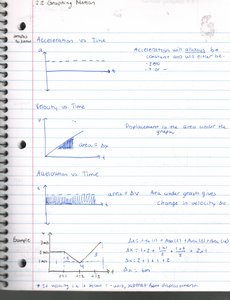
The area under a velocity vs. time graph represents displacement, and the area under an acceleration vs. time graph represents change in velocity.
For constant acceleration, area is a rectangle or triangle.
For variable acceleration, area can be calculated using integration or summing smaller areas.
Motion Scenarios
Common Graph Shapes
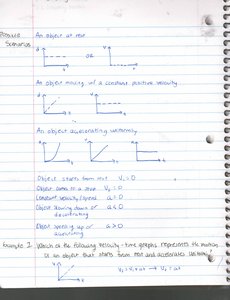
Different motion scenarios produce characteristic graph shapes:
Object at rest: Flat line on velocity vs. time graph.
Object moving at constant velocity: Horizontal line above zero.
Object accelerating uniformly: Straight line with positive or negative slope.
Free Fall
Motion Under Gravity
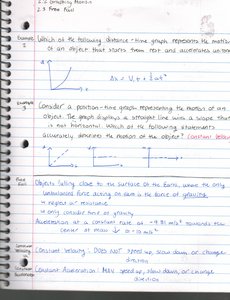
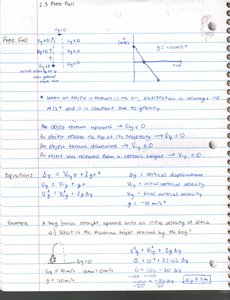
Objects in free fall experience constant acceleration due to gravity ( m/s2 downward). The equations of motion for free fall are:
Examples and Graphs
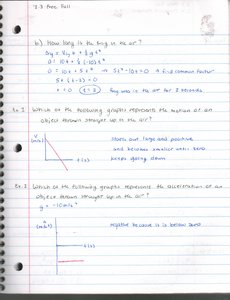
Example: A ball thrown upward with initial velocity will reach a maximum height where , then fall back down.
Time in air, maximum height, and velocity at different points can be calculated using kinematic equations.
Projectile Motion
Two-Dimensional Motion
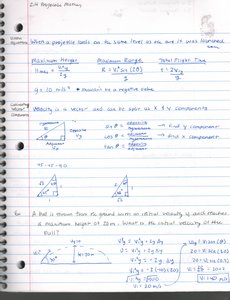
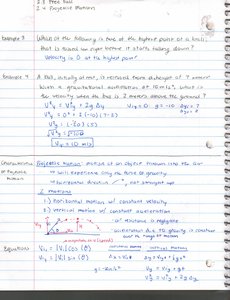
Projectile motion involves both horizontal and vertical components. The horizontal motion has constant velocity, while the vertical motion has constant acceleration due to gravity.
Horizontal displacement:
Vertical displacement:
Maximum height:
Range: (for symmetric projectile motion)
Velocity Components and Example Problems
Velocity is resolved into x and y components using trigonometry:
Example: A ball thrown at an angle with initial velocity will have both horizontal and vertical motion, and its trajectory can be analyzed using the above equations.
Summary Table: Kinematic Equations
Equation | Variables | Application |
|---|---|---|
Displacement, initial velocity, acceleration, time | General motion with constant acceleration | |
Final velocity, initial velocity, acceleration, time | Finding velocity after time with constant acceleration | |
Final velocity, initial velocity, acceleration, displacement | Finding velocity or displacement without time | |
Horizontal displacement, horizontal velocity, time | Projectile motion (horizontal) | |
Vertical displacement, vertical velocity, gravity, time | Projectile motion (vertical) |