 Back
BackMidterm 1
Study Guide - Smart Notes
 Tailored notes based on your materials, expanded with key definitions, examples, and context.
Q1. Comparing Average Speeds from Position-Time Graphs
Background
Topic: Kinematics (Position-Time Graphs)
This question tests your ability to interpret position vs. time graphs and compare the average speeds of two bodies (A and B) over different time intervals.
Key Terms and Formulas:
Average speed: The total distance traveled divided by the total time taken.
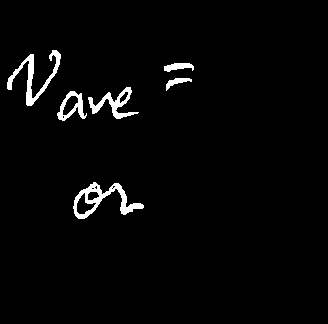
For a position-time graph, average speed between and is given by:
Where and are the positions at times and respectively.
Step-by-Step Guidance
Identify the positions of bodies A and B at the specified times (0, 1, and 2 seconds) from the graph.
Calculate the change in position () for each body over each interval (0–1 s, 1–2 s, 0–2 s).
Use the average speed formula for each interval and each body.
Compare the calculated average speeds for A and B in each interval to determine which is greater.
Try solving on your own before revealing the answer!
Q2. Launching a Ball Vertically: Finding Initial Speed
Background
Topic: Kinematics (Vertical Motion under Gravity)
This question asks you to determine the initial speed required for a ball to reach a certain height when launched vertically upward, neglecting air resistance.
Key Terms and Formulas:
Kinematic equation for vertical motion:
At the highest point, (the ball stops before falling back down).
Acceleration (where as given).
Step-by-Step Guidance
Set the final velocity at the top to zero.
Substitute the known values into the kinematic equation: (where is the maximum height).
Rearrange the equation to solve for in terms of and .
Plug in and , but do not compute the final value yet.
Try solving on your own before revealing the answer!
Q3. Average Acceleration with Changing Direction
Background
Topic: Kinematics (Vector Acceleration)
This question involves finding the average acceleration of a body whose velocity changes in both magnitude and direction over a time interval.
Key Terms and Formulas:
Average acceleration:
Velocity is a vector, so consider both magnitude and direction (use vector subtraction).
Step-by-Step Guidance
Write the initial velocity vector () and final velocity vector () in component form (east-west and north-south).
Subtract the initial velocity vector from the final velocity vector to find the change in velocity ().
Divide by the time interval ( s) to find the average acceleration vector.
Determine the magnitude and direction of the average acceleration vector.
Try solving on your own before revealing the answer!
Q4. Boat Crossing a River with Current
Background
Topic: Relative Velocity (Riverboat Problems)
This question tests your understanding of relative velocity and how to aim a boat to reach a point directly across a river with a current.
Key Terms and Formulas:
Relative velocity:
To go straight across, the boat must have a velocity component upstream to cancel the downstream flow.
Step-by-Step Guidance
Draw a vector diagram showing the boat's velocity relative to the water and the river's velocity.
Set up the equation so that the resultant velocity is perpendicular to the riverbanks (i.e., straight across).
Use trigonometry to find the angle at which the boat must be aimed upstream.
Check if the boat's speed is sufficient to overcome the river's current.
Try solving on your own before revealing the answer!
Q5. Two Balls Thrown from a Building: Time and Speed on Impact
Background
Topic: Projectile Motion
This question asks you to compare the time to hit the ground and the speed upon impact for two balls thrown from a building at the same speed but at different angles (one above, one below the horizontal).
Key Terms and Formulas:
Projectile motion equations:
Time to hit the ground depends on the vertical component of velocity.
Speed on impact is found by combining the final horizontal and vertical velocity components.
Step-by-Step Guidance
Write the vertical motion equations for both balls, considering the direction of the initial velocity component.
Set (ground level) and solve for for each ball.
Calculate the final vertical velocity for each ball just before impact.
Combine the horizontal and vertical components to find the magnitude of the final speed for each ball.
Try solving on your own before revealing the answer!
Q6. Height of a Cliff from Projectile Range
Background
Topic: Projectile Motion (Horizontal Launch)
This question involves finding the height of a cliff given the horizontal range and launch speed of a projectile.
Key Terms and Formulas:
Horizontal motion:
Vertical motion:
Time of flight is determined by the vertical drop.
Step-by-Step Guidance
Express the time of flight in terms of the horizontal range and initial speed.
Substitute this time into the vertical motion equation to solve for the height of the cliff.
Rearrange the equation to express the height in terms of the given parameters.
Try solving on your own before revealing the answer!
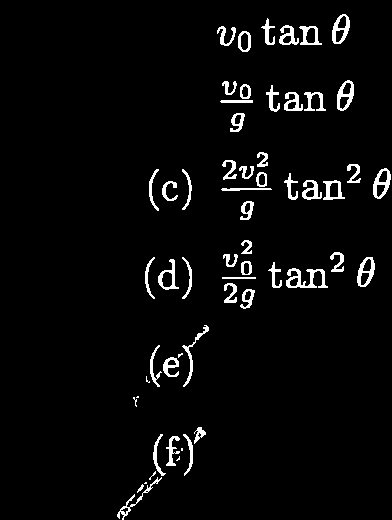
Q7. Apple and Melon Dropped Together: Gravitational Acceleration
Background
Topic: Newton's Laws of Motion (Gravity)
This question tests your understanding of how gravity acts on objects of different masses and why they fall at the same rate (in the absence of air resistance).
Key Terms and Formulas:
Newton's Second Law:
Gravitational force:
Step-by-Step Guidance
Recognize that the force of gravity is proportional to mass, but so is the inertia (resistance to acceleration).
Set up the equation for both objects.
Conclude that both objects accelerate at the same rate regardless of mass.
Try solving on your own before revealing the answer!
Q8. Interaction Pair for a Skydiver
Background
Topic: Newton's Third Law (Action-Reaction Pairs)
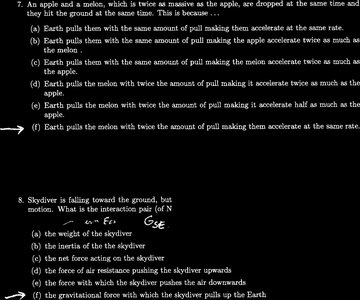
This question asks you to identify the correct interaction pair (action-reaction forces) for a skydiver falling toward the ground.
Key Terms and Formulas:
Newton's Third Law: For every action, there is an equal and opposite reaction.
The gravitational force the Earth exerts on the skydiver is paired with the force the skydiver exerts on the Earth.
Step-by-Step Guidance
Identify the force acting on the skydiver (gravity from Earth).
State the reaction force (skydiver pulling up on the Earth with equal magnitude).
Remember, action-reaction pairs always act on different objects.
Try solving on your own before revealing the answer!
Q9. Apparent Weight in an Elevator
Background
Topic: Forces and Apparent Weight
This question involves understanding how acceleration affects the apparent weight of a person in an elevator.
Key Terms and Formulas:
Apparent weight: The normal force exerted by the floor, which can differ from true weight if the elevator accelerates.
When accelerating upward:
When accelerating downward:
Step-by-Step Guidance
Identify the direction of acceleration (up or down).
Write the equation for normal force (apparent weight) based on the direction of acceleration.
Compare the apparent weight to the true weight () to determine if it is greater, less, or equal.
Try solving on your own before revealing the answer!
Q10. Two Blocks Connected by a Pulley: Predicting Motion
Background
Topic: Dynamics (Atwood Machine, Inclined Planes)
This question asks you to predict the motion of two blocks connected by a rope and pulley, considering their masses and the incline angle.
Key Terms and Formulas:
Newton's Second Law for each block:
For Block 1 on the incline: (down the ramp)
For Block 2 hanging: (downward)
Step-by-Step Guidance
Write force equations for each block, considering the direction of motion and the tension in the rope.
Set up the system of equations to relate the accelerations of both blocks (they move together).
Analyze how the motion changes if Block 1 is initially moving up the ramp and Block 2 is moving down.
Try solving on your own before revealing the answer!
