 Back
BackKinematics in One Dimension: Structured Study Notes
Study Guide - Smart Notes
 Tailored notes based on your materials, expanded with key definitions, examples, and context.
Chapter 2: Kinematics in One Dimension
Introduction to Kinematics in One Dimension
Kinematics is the branch of physics that describes the motion of objects without considering the forces that cause the motion. In one-dimensional kinematics, we analyze motion along a straight line, typically using the x-axis as a reference. This chapter covers motion diagrams, displacement, velocity, acceleration, and the application of calculus to motion analysis.
Motion Diagrams
Motion diagrams are visual representations of an object's position at successive time intervals. They help infer displacement, velocity, and acceleration by showing the object's location and the direction and length of velocity arrows.
Point Mass Approximation: The object's mass is concentrated at a single point, ignoring rotation.
Time Indexing: The earliest time is labeled with the smallest index.
Inference: Displacement, velocity, and acceleration can be deduced from the diagram.
Example: A car slowing down has displacement and velocity to the right, but acceleration to the left.

One-Dimensional Coordinate System
Motion in one dimension is described using the x-axis, which can represent horizontal, vertical, or inclined directions. The position of an object is given by its x-coordinate.
Reference Point: The origin (x = 0) is chosen for convenience.
Direction: Positive x is to the right of the origin; negative x is to the left.
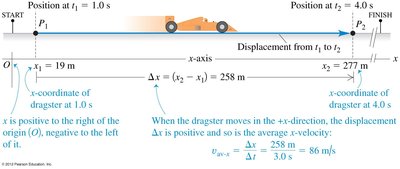
Displacement, Time, and Average Velocity
Displacement is the change in position of an object, and average velocity is the rate of change of displacement over time.
Displacement:
Average Velocity:
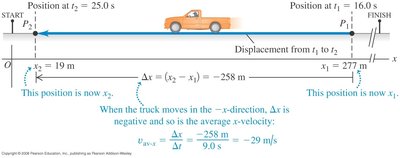
Direction: If displacement is negative, average velocity is negative.
Example: A truck moving in the negative x-direction has negative displacement and velocity.
Position-Time (x-t) Graphs
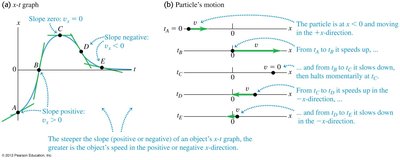
An x-t graph shows how an object's position changes with time. The slope of the graph represents the average velocity.
Slope:
Positive Slope: Indicates positive velocity (object moving right).
Negative Slope: Indicates negative velocity (object moving left).
Zero Slope: Object is stationary.
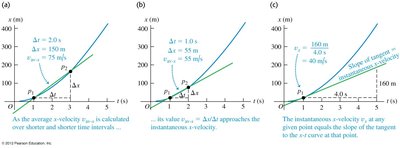
Instantaneous Velocity
Instantaneous velocity is the velocity at a specific instant, given by the derivative of position with respect to time.
Definition:
Graphical Interpretation: The slope of the tangent to the x-t curve at a point gives the instantaneous velocity.
Average and Instantaneous Acceleration
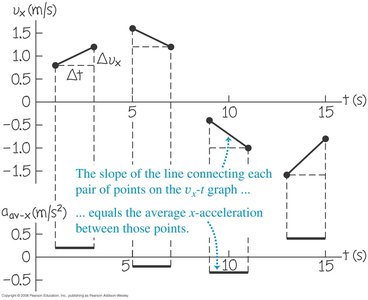
Acceleration measures how quickly velocity changes. Average acceleration is the change in velocity over a time interval, while instantaneous acceleration is the derivative of velocity with respect to time.
Average Acceleration:
Instantaneous Acceleration:
Graphical Interpretation: The slope of the vx-t graph gives acceleration.

Motion Diagrams and Graphs
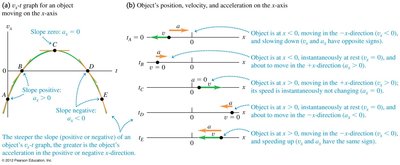
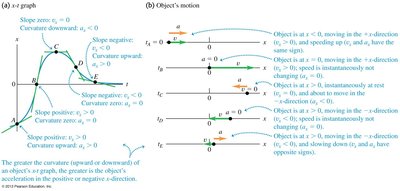
Motion diagrams can be paired with x-t and vx-t graphs to visualize position, velocity, and acceleration at various instants.
Position: Shown as dots on the diagram.
Velocity: Arrows indicate direction and magnitude.
Acceleration: Changes in velocity arrows show acceleration.
Calculus Applications in Kinematics
Calculus allows for precise analysis of motion by differentiating and integrating position, velocity, and acceleration functions.
Position Function:
Velocity Function:
Acceleration Function:
Example Calculations:
At ,
Velocity is zero at
Acceleration at is
Leftmost position is
Displacement between and is ; distance is
Summary Table: Kinematic Quantities
Quantity | Definition | Formula |
|---|---|---|
Displacement | Change in position | |
Average Velocity | Rate of change of displacement | |
Instantaneous Velocity | Velocity at a specific instant | |
Average Acceleration | Rate of change of velocity | |
Instantaneous Acceleration | Acceleration at a specific instant |
Additional info:
These notes expand on the brief points in the original materials, providing full academic context, definitions, and examples. All included images directly reinforce the explanations and are relevant to the adjacent paragraphs.
