 Back
BackKinematics in Two and Three Dimensions: Vectors, Motion, and Forces
Study Guide - Smart Notes
 Tailored notes based on your materials, expanded with key definitions, examples, and context.
Vectors and Unit Vectors
Introduction to Vectors
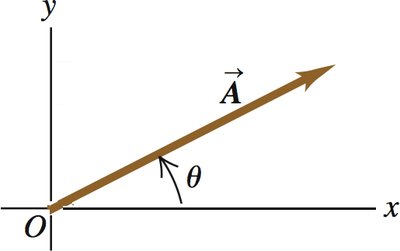
Vectors are quantities that have both magnitude and direction, essential for describing physical phenomena such as displacement, velocity, and force. In physics, vectors are often represented graphically by arrows and analytically by components along coordinate axes.
Magnitude: The length of the vector arrow represents its magnitude.
Direction: The orientation of the arrow shows the direction of the vector, often measured as an angle from a reference axis.
Notation: Vectors are typically denoted with an arrow above the symbol, e.g., .
Unit Vectors
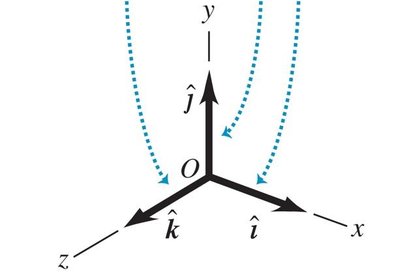
Unit vectors are dimensionless vectors of length one, used to specify directions along coordinate axes. In three-dimensional Cartesian coordinates, the standard unit vectors are:
\( \hat{i} \): Points in the positive x-direction
\( \hat{j} \): Points in the positive y-direction
\( \hat{k} \): Points in the positive z-direction
Vector Components
Any vector in three dimensions can be expressed as the sum of its components along the x, y, and z axes:

Position Vector
Definition and Representation
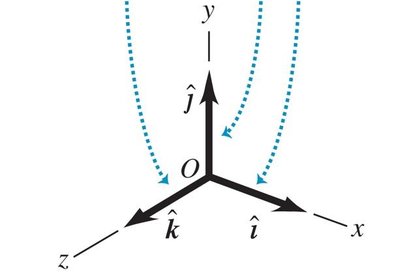
The position vector locates a particle in space relative to an origin. Its components are the coordinates of the particle at a given time:
\( x, y, z \): The coordinates of the particle
\( \vec{r} = x \hat{i} + y \hat{j} + z \hat{k} \): The position vector in component form
Velocity
Average and Instantaneous Velocity
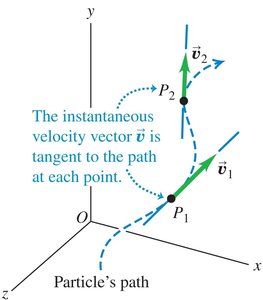
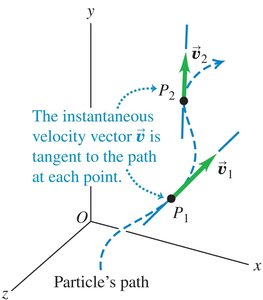
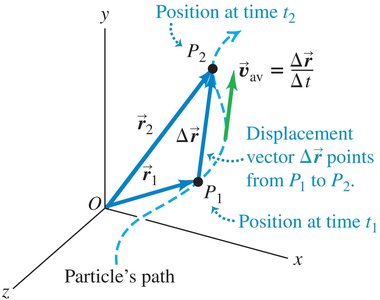
Velocity is a vector quantity describing the rate of change of position with respect to time. It can be average or instantaneous:
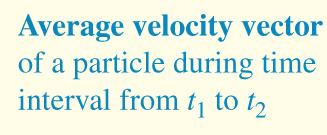
Average velocity:
Instantaneous velocity:

Velocity Components
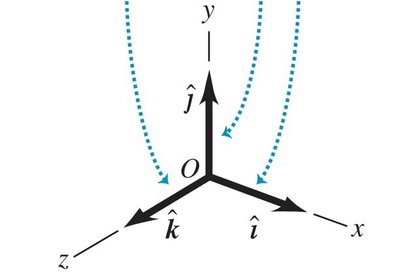
The velocity vector can be broken into components along each axis:
Speed
Speed is the magnitude of the velocity vector:
Acceleration
Average and Instantaneous Acceleration
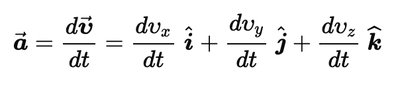
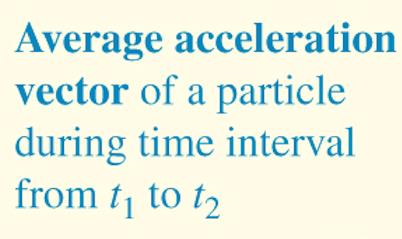
Acceleration is the rate of change of velocity with respect to time. Like velocity, it can be average or instantaneous:
Average acceleration:
Instantaneous acceleration:
Acceleration Components
The acceleration vector can be expressed in terms of its components:
Acceleration in Curved Motion
When a particle moves along a curved path, its acceleration can have two components:
Tangential acceleration: Changes the speed along the path
Radial (centripetal) acceleration: Changes the direction of the velocity vector
Projectile Motion
Equations of Motion for Projectiles
Projectile motion is a classic example of two-dimensional motion under constant acceleration (gravity). The key assumptions are:
No air resistance
Constant acceleration due to gravity () in the vertical direction
Horizontal velocity remains constant
The equations of motion for a projectile launched from with initial velocity components and are:
Horizontal position:
Vertical position:
Horizontal velocity:
Vertical velocity:
Example: If two balls are released from the same height, one dropped and one projected horizontally, both hit the ground at the same time (neglecting air resistance), because their vertical motions are identical.
Forces and Newton's Laws (Introduction)
Definition of Force
A force is an interaction between two objects or between an object and its environment. Forces can cause changes in motion (acceleration) according to Newton's laws.
Contact forces: Result from physical contact (e.g., friction, tension, normal force)
Field forces: Act at a distance (e.g., gravity, electromagnetic force)
Superposition of Forces
Forces are vectors and combine according to the principle of superposition. The net force (resultant) acting on an object is the vector sum of all individual forces:
Net force:
Summary Table: Kinematic Quantities in Vector Form
Quantity | Symbol | Vector Equation | Physical Meaning |
|---|---|---|---|
Position | Location of a particle in space | ||
Velocity | Rate of change of position | ||
Acceleration | Rate of change of velocity |
Additional info: This guide covers the foundational concepts of kinematics in two and three dimensions, including vectors, position, velocity, acceleration, and an introduction to forces. These topics are essential for understanding more advanced topics in classical mechanics.
