 Back
BackKinematics in Two Dimensions and Vectors: Study Notes
Study Guide - Smart Notes
 Tailored notes based on your materials, expanded with key definitions, examples, and context.
Chapter 3: Kinematics in Two Dimensions and Vectors
3-1 Vectors and Scalars
Kinematics in two dimensions requires understanding both vectors and scalars. Vectors are quantities that have both magnitude and direction, while scalars have only magnitude.
Vector quantities: displacement, velocity, force, momentum
Scalar quantities: mass, time, temperature
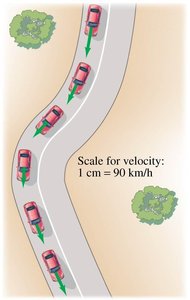
Vectors are represented graphically by arrows; the length indicates magnitude and the arrow points in the direction.
3-2 Addition of Vectors—Graphical Methods
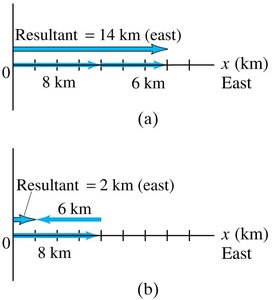
Vectors can be added graphically. In one dimension, simple addition and subtraction suffice, but in two dimensions, graphical methods are used.
Collinear vectors: Add or subtract magnitudes, being careful with direction (sign).
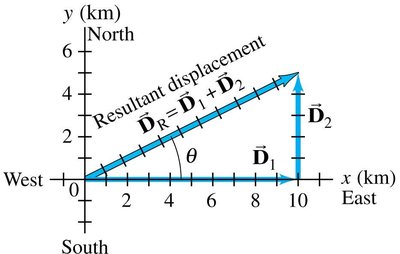
Perpendicular vectors: Use the Pythagorean theorem to find the resultant.
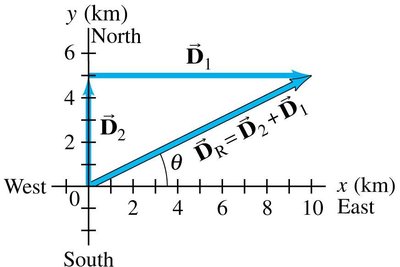
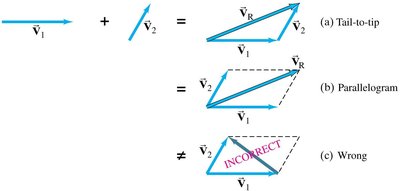
Tail-to-tip method: Place the tail of the second vector at the tip of the first; the resultant is from the tail of the first to the tip of the last.
Parallelogram method: Place vectors tail-to-tail and complete the parallelogram; the diagonal is the resultant.
Order of addition does not affect the resultant vector.
3-3 Subtraction of Vectors, and Multiplication of a Vector by a Scalar
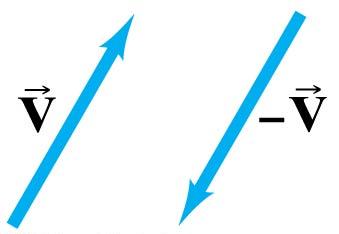
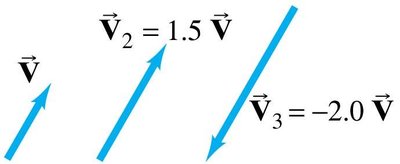
Vector subtraction is defined by adding the negative of a vector. Multiplying a vector by a scalar changes its magnitude but not its direction (unless the scalar is negative).
Negative vector: Same magnitude, opposite direction.
Subtraction: \( \vec{A} - \vec{B} = \vec{A} + (-\vec{B}) \)
Scalar multiplication: \( c\vec{V} \) has magnitude \( |c|V \) and direction of \( \vec{V} \) if \( c > 0 \), opposite if \( c < 0 \).

3-4 Adding Vectors by Components
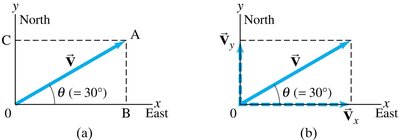
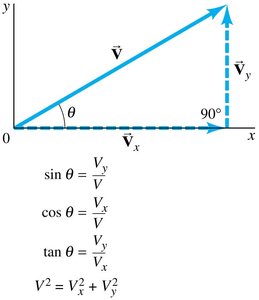
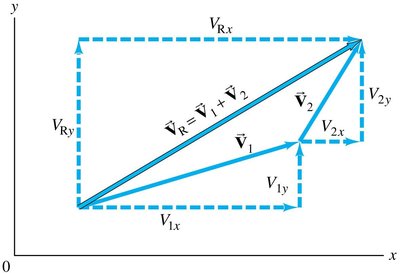
Any vector can be resolved into perpendicular components, usually along the x and y axes. This allows for algebraic addition of vectors by adding their respective components.
Component form: \( \vec{V} = V_x \hat{i} + V_y \hat{j} \)
Finding components: If \( \vec{V} \) makes an angle \( \theta \) with the x-axis:
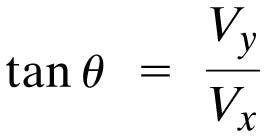
Magnitude and direction:
Adding vectors: Add x-components and y-components separately.
3-5 Projectile Motion
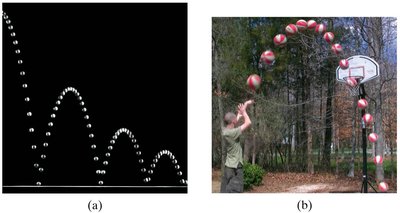
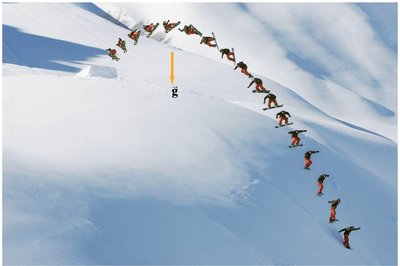
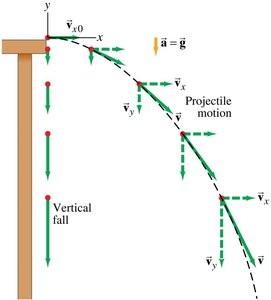
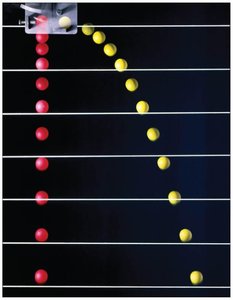
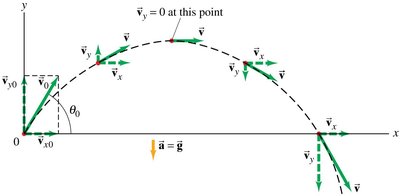
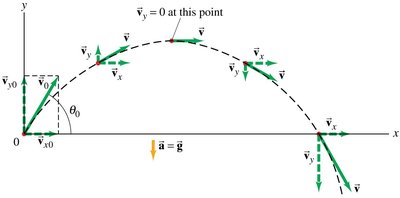
Projectile motion describes the motion of an object moving in two dimensions under the influence of gravity. The path is a parabola, and the horizontal and vertical motions are analyzed separately.
Horizontal motion: Constant velocity (no horizontal acceleration).
Vertical motion: Constant acceleration due to gravity (\( g \)).
At the highest point, the vertical component of velocity is zero.
Projectile motion can be solved by separating the x and y motions and using kinematic equations.
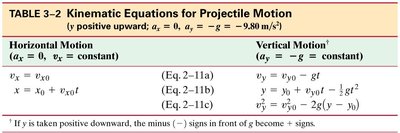
Kinematic Equations for Projectile Motion
Horizontal Motion (a_x = 0, v_x = constant) | Vertical Motion (a_y = -g = constant) | |
|---|---|---|
Velocity | ||
Position | ||
Velocity squared |
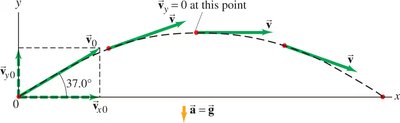
Example: Kicked Football
A football is kicked at an angle \( \theta_0 = 37.0^\circ \) with a velocity of 20.0 m/s. To find the maximum height, time of flight, and range:
Resolve initial velocity into components:
Use kinematic equations for vertical and horizontal motion.
Conceptual Questions
Magnitude of a vector: Always positive; can only be zero if all components are zero.
Projectile at highest point: Has the least speed (vertical velocity is zero).
Horizontal range: For the same initial speed, a lower angle (but not too low) gives a greater range than a very steep angle.
Cart firing a ball vertically: The ball lands back in the cart if there is no air resistance and the cart moves at constant velocity.
Summary Table: Key Properties of Vectors and Projectile Motion
Property | Vector | Scalar |
|---|---|---|
Magnitude | Yes | Yes |
Direction | Yes | No |
Addition | Graphical or by components | Algebraic |
Examples | Displacement, velocity, force | Mass, time, temperature |
Additional info: The above notes expand on the graphical and analytical methods for vector addition, subtraction, and projectile motion, providing context and equations for solving typical physics problems in two dimensions.
