 Back
BackMagnetic Fields and Forces: Study Notes
Study Guide - Smart Notes
 Tailored notes based on your materials, expanded with key definitions, examples, and context.
Magnetism and Magnetic Materials
Introduction to Magnetism
Magnetism is a fundamental force of nature, distinct from electricity, though the two are closely related. Magnets interact with each other and with certain materials, producing forces that can act at a distance. The study of magnetism begins with simple experiments involving bar magnets, compasses, and various materials.
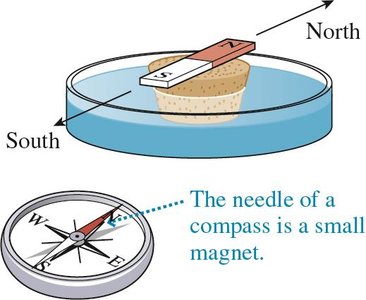
Magnetic Poles: Every magnet has two poles: a north pole and a south pole. The north pole is the end that points north when the magnet is freely suspended.
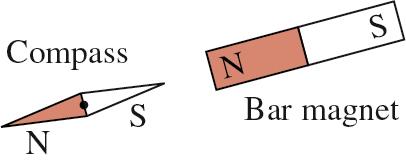
Compass: A compass is a small, pivoting magnet that aligns itself with Earth's magnetic field.
Magnetic Interactions
Magnets exert forces on each other and on certain materials. These interactions can be summarized as follows:
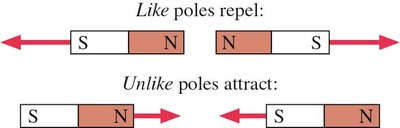
Like poles repel, unlike poles attract: The north pole of one magnet repels the north pole of another, while the north pole attracts the south pole.
Cutting a Magnet: If a bar magnet is cut in half, each piece becomes a smaller magnet with its own north and south poles. Magnetic monopoles do not exist in isolation.

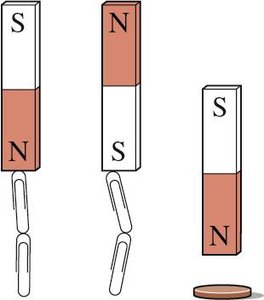
Magnetic Materials: Only certain materials, such as iron, are attracted to magnets. These are called magnetic materials. Most materials, including copper, aluminum, glass, and plastic, are not affected by magnets.
Magnetism vs. Electricity: Magnetism is not the same as electricity. For example, a magnet does not affect an electroscope, which is sensitive to electric charge.
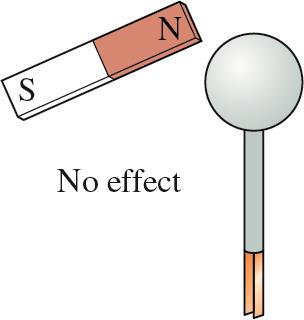
Summary of Magnetic Properties
Magnetism is a long-range force; magnets do not need to touch to exert forces on each other.
Magnets are always dipoles (having both north and south poles).
Magnetic materials are attracted to both poles of a magnet.
The Magnetic Field
Definition and Representation
Every magnet creates a magnetic field in the space around it. This field can exert forces on other magnets or magnetic materials brought into the region.
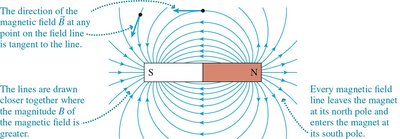
Magnetic Field Vector (\( \vec{B} \)): The magnetic field is a vector quantity, having both magnitude and direction. The direction of \( \vec{B} \) is defined as the direction the north pole of a compass needle points.
Measuring the Field: The strength of the field is proportional to the torque felt by a compass needle as it aligns with the field.
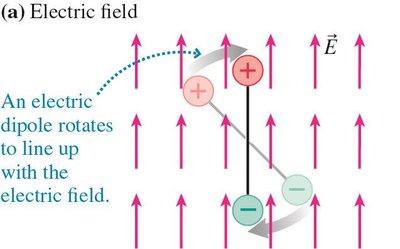
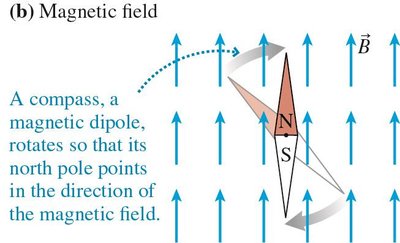
Visualizing Magnetic Fields
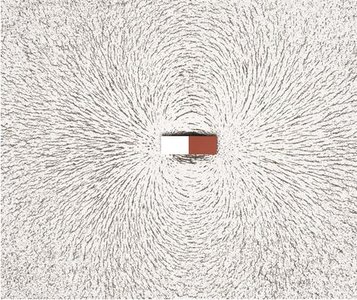
Magnetic fields can be visualized using iron filings or by mapping the direction of compass needles at various points around a magnet.
Iron Filings: Each iron filing acts like a tiny compass, aligning with the local magnetic field direction.
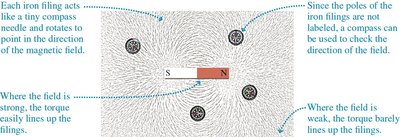
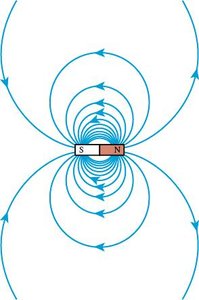
Field Lines: Magnetic field lines exit the north pole of a magnet and enter the south pole. The density of lines indicates the strength of the field.
Magnetic Dipoles
All magnets are magnetic dipoles, meaning they have two poles. Cutting a magnet in half always results in two smaller dipoles.
Electric Currents and Magnetic Fields
Currents Create Magnetic Fields
Electric currents generate magnetic fields. The shape of the field depends on the geometry of the current-carrying conductor.
Straight Wire: The magnetic field lines form concentric circles around the wire. The field strength decreases with distance from the wire.
Circular Loop: The field lines curve through the center of the loop and resemble those of a bar magnet at a distance.
Solenoid: A solenoid is a coil of wire; the field inside is strong and uniform, while the field outside is weak.
Right-Hand Rule for Magnetic Fields
The direction of the magnetic field around a current-carrying wire can be determined using the right-hand rule:
Point your right thumb in the direction of the current.
Your fingers curl in the direction of the magnetic field lines.
Magnetic Field Strength Equations
For a long, straight wire:
\( B \): Magnetic field strength (tesla, T)
\( \mu_0 \): Permeability of free space (\( 4\pi \times 10^{-7} \) T·m/A)
\( I \): Current (A)
\( r \): Distance from the wire (m)
For a circular loop (center):
\( R \): Radius of the loop (m)
For a solenoid (inside):
\( n \): Number of turns per unit length (turns/m)
Magnetic Forces
Force on Moving Charges
A magnetic field exerts a force on a moving charged particle. The force is given by:
\( q \): Charge of the particle (C)
\( \vec{v} \): Velocity of the particle (m/s)
\( \vec{B} \): Magnetic field (T)
The force is perpendicular to both the velocity and the magnetic field. If the velocity is parallel to the field, the force is zero. The magnitude is maximized when the velocity is perpendicular to the field:
\( \theta \): Angle between \( \vec{v} \) and \( \vec{B} \)
Motion of Charged Particles in Magnetic Fields
If a charged particle moves perpendicular to a uniform magnetic field, it undergoes uniform circular motion. The radius of the path is:
\( m \): Mass of the particle (kg)
If the velocity has a component parallel to the field, the particle follows a helical path.
Force on a Current-Carrying Wire
A current-carrying wire in a magnetic field experiences a force:
\( I \): Current (A)
\( \vec{L} \): Vector length of the wire in the field (m)
The direction of the force is given by the right-hand rule.
Summary Table: Typical Magnetic Field Strengths
Field Source and Location | Field Strength (T) |
|---|---|
10 cm from a wire with 1 A current | 2 × 10⁻⁶ |
Surface of the earth | 5 × 10⁻⁵ |
1 cm from a wire with 10 A current | 2 × 10⁻⁴ |
Refrigerator magnet | 5 × 10⁻³ |
100-turn coil, 1 cm diameter, 1 A current | 1 × 10⁻² |
Surface of the sun, in a sunspot | 1 × 10⁻¹ |
Near a rare-earth magnet | 1 |
MRI solenoid | 1 |
World’s strongest magnet | 45 |
Key Concepts and Applications
Magnetic Dipoles: All magnets are dipoles; isolated magnetic monopoles have not been observed.
Right-Hand Rule: Used to determine the direction of the magnetic field or force in various situations involving currents and fields.
Magnetic Materials: Only certain materials (e.g., iron, nickel, cobalt) are strongly affected by magnetic fields.
Applications: Magnetic fields are essential in electric motors, generators, MRI machines, and many other technologies.
