 Back
BackMagnetic Fields, Forces, and Applications: Velocity Selector & Mass Spectrometer
Study Guide - Smart Notes
 Tailored notes based on your materials, expanded with key definitions, examples, and context.
Magnetic Fields and Forces
Magnetic Force on a Moving Charge
The force experienced by a charged particle moving in a magnetic field is a fundamental concept in electromagnetism. This force is always perpendicular to both the velocity of the particle and the direction of the magnetic field.
Magnetic Force Formula: The magnitude of the force is given by where is the charge, is the velocity, is the magnetic field strength, and is the angle between and .
Direction: Determined by the right-hand rule (for positive charges).
Circular Motion: If is perpendicular to (), the force acts as a centripetal force, causing the particle to move in a circular path.
Equation for Circular Motion in a Magnetic Field:
The centripetal force required for circular motion is provided by the magnetic force:
Solving for the radius of the circular path:
Key dependencies: The radius increases with greater mass or velocity, and decreases with stronger magnetic field or larger charge.
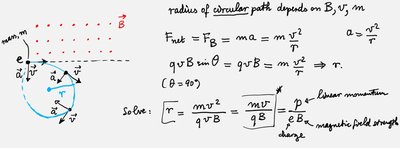
Additional info: The circular path's radius is a direct indicator of the particle's momentum and charge-to-mass ratio, which is crucial for applications like mass spectrometry.
Applications of Magnetic Forces
Velocity Selector
A velocity selector is a device that uses perpendicular electric and magnetic fields to filter charged particles by velocity. Only particles with a specific velocity pass through undeflected.
Principle: The electric force and the magnetic force act in opposite directions.
Condition for Selection: For a particle to pass straight through, .
Application: Used in mass spectrometers to ensure all particles entering the next stage have the same velocity.
Mass Spectrometer
A mass spectrometer separates ions based on their mass-to-charge ratio by passing them through a magnetic field after velocity selection. The resulting circular arcs have radii that depend on the mass of the ions.
Process: A mixture of ions with the same charge and velocity enters a region with a uniform magnetic field.
Separation: Each ion follows a circular path with radius , so ions with different masses hit different positions on a detector.
Detection: The position along the detector corresponds to the ion's mass; larger radii indicate greater mass.
Key Equation: (mass is proportional to the radius for fixed , , and )
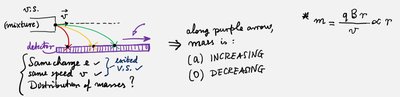
Example: In a mass spectrometer, a mixture of singly-ionized particles with the same velocity but different masses will be separated spatially on the detector. The mass increases with the radius of the arc traced by the particle.
Summary Table: Key Relationships in Magnetic Force Applications
Application | Key Equation | Physical Meaning |
|---|---|---|
Magnetic Force | Force on a moving charge in a magnetic field | |
Circular Motion | Radius of path for perpendicular entry | |
Velocity Selector | Only particles with this velocity pass through | |
Mass Spectrometer | Mass determined by radius of arc |
Additional info: These principles are foundational for understanding how charged particles behave in magnetic fields and are widely used in experimental physics and analytical chemistry.
