 Back
BackMagnetic Flux, Induced Current, and Electromagnetic Waves – Step-by-Step Physics Guidance
Study Guide - Smart Notes
 Tailored notes based on your materials, expanded with key definitions, examples, and context.
Q1. What is the magnetic flux through a circular coil with 130 turns, a uniform magnetic field of 1.6 T directed at an angle of 35° to the plane of the coil, and an enclosed area of 9.0 × 10⁻³ m2?
Background
Topic: Magnetic Flux in a Coil
This question tests your understanding of how to calculate magnetic flux through a coil when the magnetic field is at an angle to the coil's plane.
Key Terms and Formulas
Magnetic flux (): The measure of the amount of magnetic field passing through a given area.
Formula:
= number of turns
= area of the coil
= magnetic field strength
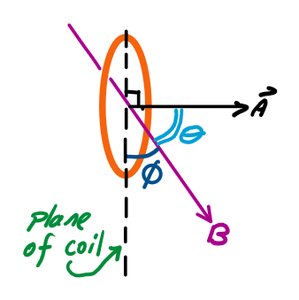
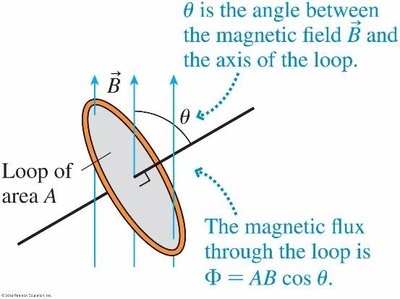
= angle between the magnetic field and the axis perpendicular to the coil's plane
Step-by-Step Guidance
Identify the given values: , , , angle to the plane .
Determine the correct angle for the formula. $\theta$ is the angle between the magnetic field and the axis perpendicular to the coil's plane. If the field is at to the plane, then .
Write the formula for magnetic flux: .
Set up the calculation: .
Try solving on your own before revealing the answer!
Final Answer: 1.1 T·m2
The calculation uses the correct angle and significant figures, giving the magnetic flux through the coil.
Q2. When a conducting coil lies flat on a tabletop and the magnetic field pointing straight up suddenly grows weaker, what is the direction of the induced current in the coil as viewed from above?
Background
Topic: Lenz's Law and Induced Current
This question tests your understanding of how a changing magnetic field induces a current in a coil, and how to determine the direction of that current using Lenz's Law.
Key Terms and Concepts
Lenz's Law: The induced current will flow in a direction that opposes the change in magnetic flux.
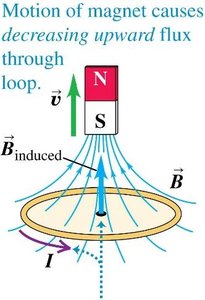
Induced magnetic field: Created by the induced current to oppose the decrease in the original field.
Step-by-Step Guidance
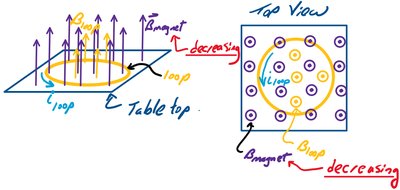
Recognize that the magnetic field is pointing upward and is decreasing.
Apply Lenz's Law: The induced current will try to maintain the upward magnetic field by creating its own upward field.
Determine the direction of current needed to produce an upward magnetic field inside the loop (using the right-hand rule).
From above, a counterclockwise current produces an upward field.
Try solving on your own before revealing the answer!
Final Answer: Counterclockwise
The induced current flows counterclockwise as seen from above, to oppose the decrease in upward magnetic flux.
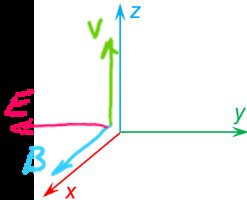
Q3. An electromagnetic wave is propagating in the +z direction. At a particular moment, the electric field is in the -y direction. What is the direction of the magnetic field?
Background
Topic: Electromagnetic Waves and the Right-Hand Rule
This question tests your ability to use the right-hand rule to determine the orientation of electric and magnetic fields in an electromagnetic wave.
Key Terms and Formulas
Electromagnetic wave: Consists of perpendicular electric () and magnetic () fields.
Right-hand rule: Thumb points in direction of wave propagation (), fingers in direction of , palm points in direction of .
Step-by-Step Guidance
Identify the directions: Wave propagates in , electric field is in .
Use the right-hand rule: Point your thumb in (direction of propagation), fingers in (direction of ).
Your palm will face the direction of , which is .
Try solving on your own before revealing the answer!
Final Answer: +x direction
The magnetic field points in the +x direction, perpendicular to both the electric field and the direction of propagation.
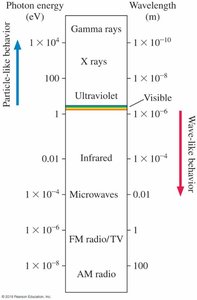
Q4. In the vacuum of space, which statement correctly compares the energies and speeds of an infrared photon to a visible photon?
Background
Topic: Photon Energy and Speed in Electromagnetic Spectrum
This question tests your understanding of the relationship between photon energy, wavelength, and speed for different types of electromagnetic radiation.
Key Terms and Formulas
Speed of light (): (same for all photons in vacuum)
Photon energy:
= Planck's constant ()
= wavelength
Step-by-Step Guidance
Recall that all photons travel at the same speed in vacuum: .
Compare energies: Visible photons have shorter wavelengths than infrared, so .
Use the formula to see that energy increases as wavelength decreases.
Try solving on your own before revealing the answer!
Final Answer: The visible photon is more energetic, and they have the same speed.
Visible photons have higher energy due to their shorter wavelength, but both visible and infrared photons travel at the same speed in vacuum.
Q5. What is the magnitude of the induced current (in mA) in a single-turn loop of wire with resistance 6.00 Ω, area 300.0 cm2, perpendicular to a uniform magnetic field that increases from 0.200 T to 3.60 T in 0.500 seconds?
Background
Topic: Faraday's Law and Induced Current
This question tests your ability to calculate the induced current in a loop due to a changing magnetic field, using Faraday's Law and Ohm's Law.
Key Terms and Formulas
Faraday's Law:
Ohm's Law:
Magnetic flux change: (since area is constant)
Area conversion:
Step-by-Step Guidance
Convert area to SI units: .
Calculate change in magnetic field: .
Set up Faraday's Law: .
Apply Ohm's Law: , so .
Plug in the values: .
Try solving on your own before revealing the answer!
Final Answer: 34.0 mA
The induced current is calculated using Faraday's Law and Ohm's Law, with proper unit conversions and significant figures.
