 Back
BackMagnetic Forces on a Current Loop and Solenoid Properties
Study Guide - Smart Notes
 Tailored notes based on your materials, expanded with key definitions, examples, and context.
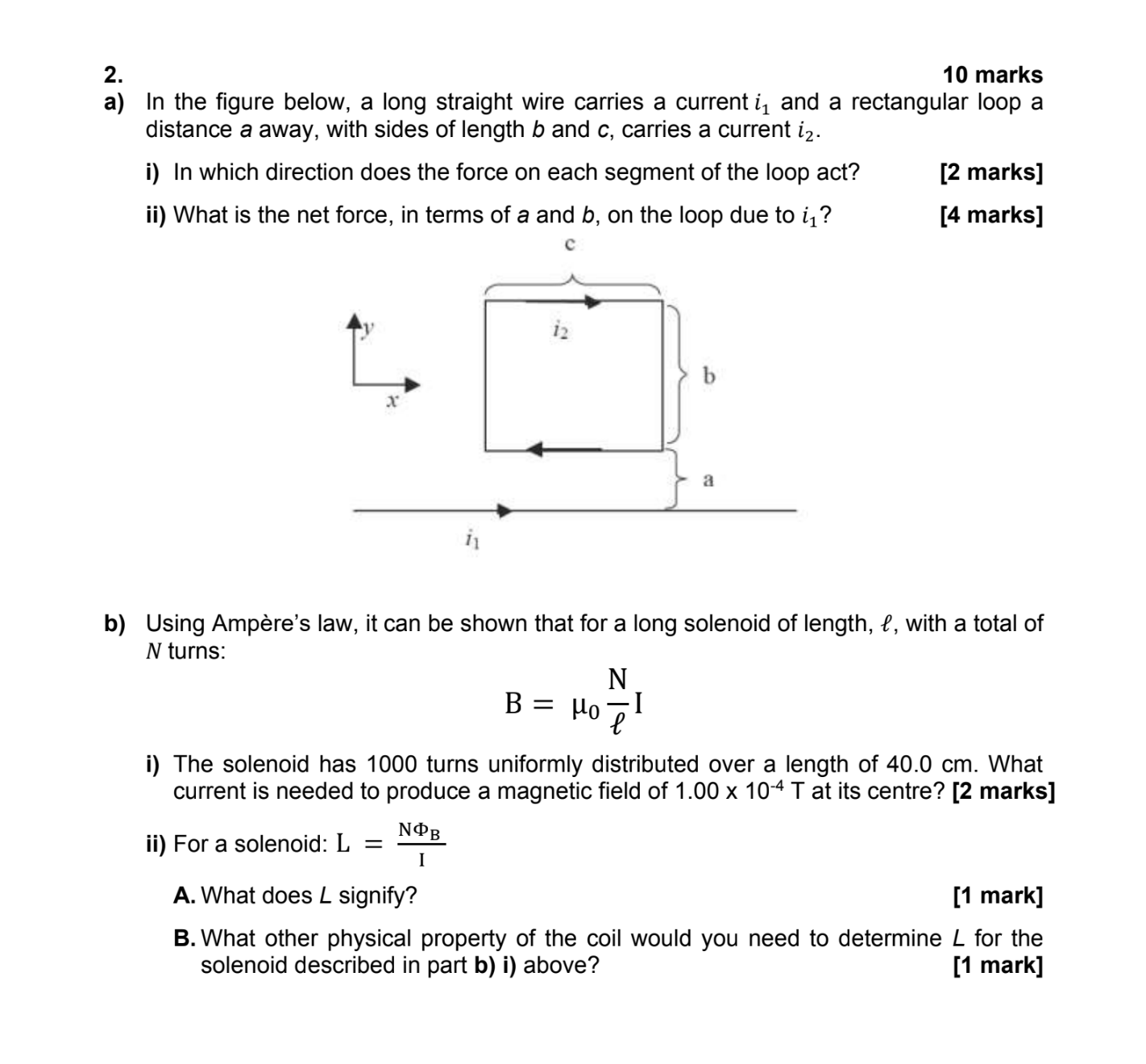
Q2a. A long straight wire carries a current and a rectangular loop (distance away, sides and ) carries a current .
In which direction does the force on each segment of the loop act?
What is the net force, in terms of and , on the loop due to ?
Background
Topic: Magnetic Forces Between Currents
This question tests your understanding of the magnetic force exerted on a current-carrying loop by another current-carrying wire, using the right-hand rule and the Biot–Savart law or Ampère’s law.
Key Terms and Formulas
Magnetic field from a long straight wire:
Force on a segment of wire in a magnetic field:
Right-hand rule: Used to determine the direction of the magnetic force.
Step-by-Step Guidance
Identify the direction of the magnetic field produced by the straight wire at the location of each segment of the loop using the right-hand rule.
For each segment of the loop, determine the direction of the current and use the right-hand rule to find the direction of the force ().
Consider the forces on the two sides of the loop parallel to the wire (length ), which are at distances and from the wire. Write expressions for the magnetic field at each side.
Write the force on each of these sides using and substitute the appropriate value for at each distance.
Set up the net force as the sum of the forces on the two parallel sides, noting that the forces on the sides perpendicular to the wire cancel out due to symmetry.
Try solving on your own before revealing the answer!
Q2b. Solenoid Magnetic Field and Inductance
The solenoid has 1000 turns uniformly distributed over a length of 40.0 cm. What current is needed to produce a magnetic field of T at its centre?
For a solenoid:
A. What does signify?
B. What other physical property of the coil would you need to determine for the solenoid described in part b) i) above?
Background
Topic: Magnetic Field in Solenoids and Inductance
This part tests your understanding of how to calculate the magnetic field inside a solenoid using Ampère’s law, and how to interpret and calculate the inductance of a solenoid.
Key Terms and Formulas
Magnetic field in a solenoid:
Inductance of a solenoid:
Magnetic flux: (where is the cross-sectional area)
Step-by-Step Guidance
For the magnetic field, identify the known values: , m, T, T·m/A.
Rearrange the solenoid field formula to solve for the current :
For inductance, recall that and .
To find , you need to know the cross-sectional area of the solenoid in addition to , , and .
Try solving on your own before revealing the answer!
Final Answers
Q2a: The forces on the sides of the loop parallel to the wire are in opposite directions; the net force is given by:
Q2b:
The required current is A.
signifies the inductance of the solenoid, which measures its ability to store energy in its magnetic field.
You would need the cross-sectional area of the solenoid to determine .
