 Back
BackMagnetic Suspension: Calculating the Required Current for Floating a Wire
Study Guide - Smart Notes
 Tailored notes based on your materials, expanded with key definitions, examples, and context.
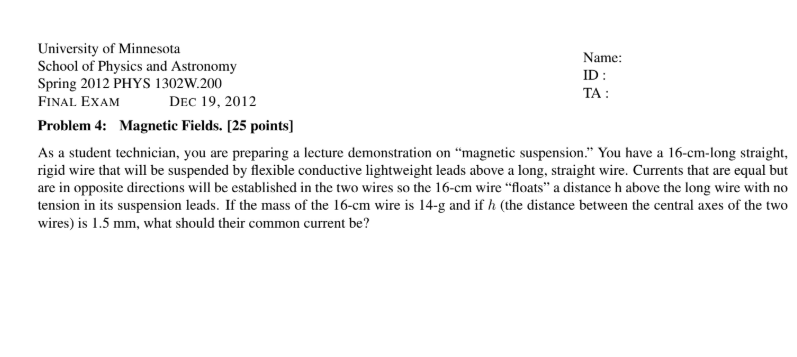
Q4. What should the common current be in two parallel wires (16 cm long, 14 g mass, separated by 1.5 mm) so that the upper wire 'floats' above the lower wire with no tension in its suspension leads?
Background
Topic: Magnetic Fields and Forces Between Parallel Currents
This question tests your understanding of the magnetic force between two parallel wires carrying currents in opposite directions, and how this force can counteract gravity to achieve magnetic suspension.
Key Terms and Formulas
Magnetic Force per Unit Length Between Parallel Wires:
Total Magnetic Force:
Gravitational Force:
Where:
= permeability of free space ( T·m/A)
= currents in the wires (equal in this case)
= separation between wires (in meters)
= length of the wire (in meters)
= mass of the wire (in kilograms)
= acceleration due to gravity ( m/s)
Step-by-Step Guidance
Convert all quantities to SI units: m, kg, m.
Write the expression for the magnetic force per unit length between the wires: (since ).
Calculate the total magnetic force acting on the 16-cm wire: .
Set the total magnetic force equal to the gravitational force to achieve suspension: .
Substitute the formulas and solve for the current (do not compute the final value yet): .
Try solving on your own before revealing the answer!
Final Answer: A
Plugging in the values and solving gives the required current for the wire to float. This ensures the upward magnetic force exactly balances the downward gravitational force.
