 Back
BackMagnetism and the Biot-Savart Law: Foundations and Applications
Study Guide - Smart Notes
 Tailored notes based on your materials, expanded with key definitions, examples, and context.
Magnetism: Basic Phenomena
Magnetic Poles and Compass Behavior
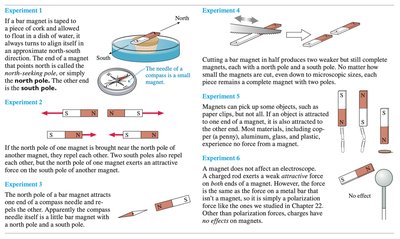
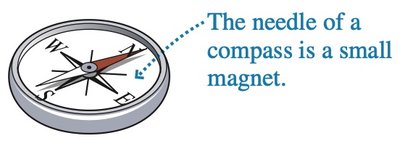
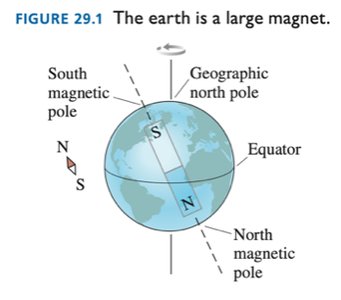
Magnetism is a fundamental property of certain materials, arising from their atomic structure. Magnets have two poles: north and south. Like poles repel, and unlike poles attract. A compass needle is a small magnet that aligns itself with Earth's magnetic field, pointing toward the geographic north, which is actually the Earth's magnetic south pole.
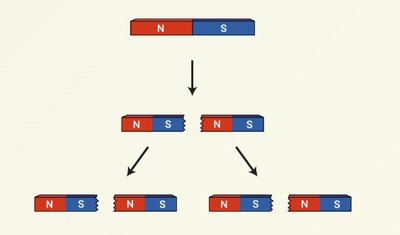
Magnetic poles always come in pairs: Breaking a magnet results in two smaller magnets, each with a north and south pole.
Compass needles align with the Earth's magnetic field, demonstrating the planet's large-scale magnetism.
Earth as a Magnet
The Earth itself acts as a giant magnet, with a magnetic field that extends from the geographic south to the geographic north. The magnetic field at the Earth's surface ranges from about 0.3 to 0.6 Gauss (30,000 to 60,000 nT).
Geographic vs. Magnetic Poles: The geographic north pole is near the Earth's magnetic south pole, and vice versa.
Units: The SI unit for magnetic field strength is the Tesla (T), where 1 T = 10,000 Gauss.
Properties of Magnetic Fields
Magnetic Field Lines
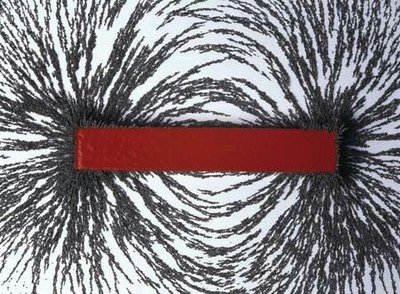
Magnetic field lines provide a visual representation of the direction and strength of magnetic forces. They emerge from the north pole and enter the south pole outside the magnet, forming closed loops. The density of lines indicates the field's strength.
Field lines never intersect.
Iron filings can be used to visualize magnetic field patterns around a bar magnet.
Gauss's Law for Magnetism
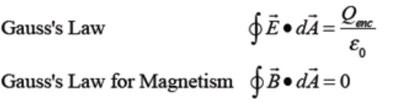
Gauss's Law for Magnetism states that the net magnetic flux through any closed surface is zero, reflecting the absence of magnetic monopoles. This is analogous to Gauss's Law for electric fields, but with a key difference: isolated magnetic poles do not exist.
Mathematical form:
Magnetic Fields and Electric Currents
Magnetic Field Due to a Current-Carrying Wire
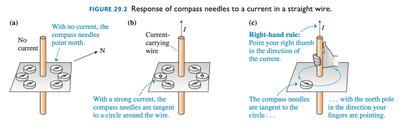
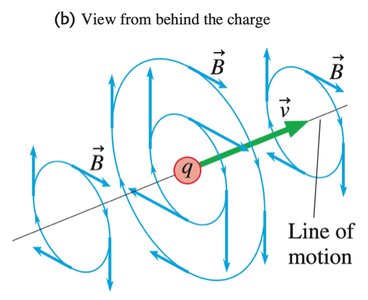
Electric currents generate magnetic fields. The direction of the magnetic field around a straight current-carrying wire can be determined using the right-hand rule: point your thumb in the direction of the current, and your fingers curl in the direction of the magnetic field lines.
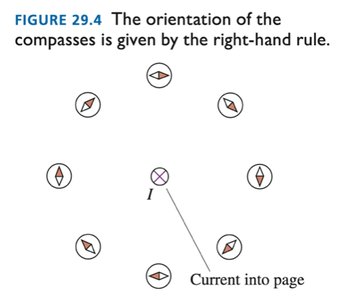
Compass needles placed around a current-carrying wire align tangentially to circles centered on the wire.
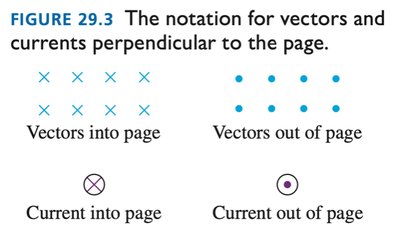
Notation: A dot (•) indicates current or vector out of the page; a cross (×) indicates into the page.
Definition and Properties of the Magnetic Field
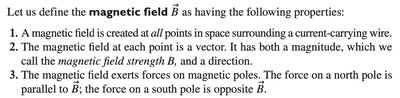
The magnetic field, denoted as , has the following properties:
It is created at all points in space surrounding a current-carrying wire.
It is a vector field, with both magnitude (called the magnetic field strength, ) and direction.
It exerts forces on magnetic poles: the force on a north pole is parallel to , and on a south pole is opposite to $\vec{B}$.
Biot-Savart Law
Magnetic Field from a Moving Point Charge
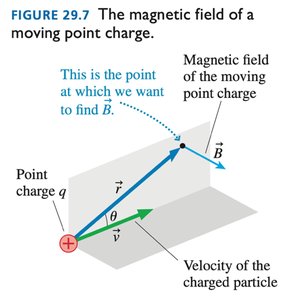
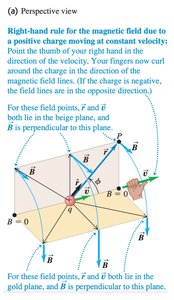
The Biot-Savart Law gives the magnetic field produced by a moving point charge. The direction of the field is given by the right-hand rule, and the magnitude is proportional to the charge, its velocity, and the sine of the angle between the velocity and the position vector from the charge to the point of interest.
Formula:
is the permeability of free space:
is the charge, is the velocity, is the unit vector from the charge to the field point, and is the distance.


Biot-Savart Law for a Current Segment
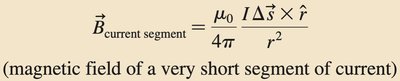
The Biot-Savart Law can also be applied to a small segment of current-carrying wire, giving the magnetic field at a point in space due to that segment:
is the current, is the vector length of the segment, is the unit vector from the segment to the field point, and is the distance.
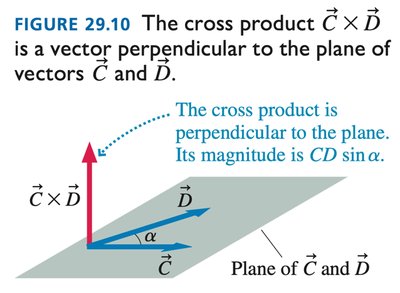
Vector Cross Product in Magnetism
Mathematical Properties
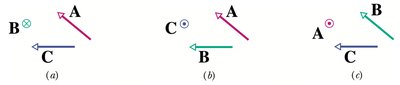
The cross product of two vectors results in a vector perpendicular to both, with magnitude , where is the angle between the vectors. In magnetism, the cross product determines the direction of the magnetic field and the force on charges.
Right-hand rule: Used to determine the direction of the resulting vector.
Antisymmetry:
Magnetic Force on a Moving Charge
Force Law
A charge moving with velocity in a magnetic field experiences a force given by:
The direction of the force is perpendicular to both and (right-hand rule).
If is negative, the force direction is reversed.
Summary Table: Key Laws and Equations
Law/Equation | Mathematical Form | Description |
|---|---|---|
Gauss's Law for Magnetism | No magnetic monopoles; net flux through closed surface is zero | |
Biot-Savart Law (point charge) | Magnetic field from a moving charge | |
Biot-Savart Law (current segment) | Magnetic field from a current element | |
Magnetic Force | Force on a moving charge in a magnetic field |
