 Back
BackMagnetism and the Biot-Savart Law: Fundamentals and Applications
Study Guide - Smart Notes
 Tailored notes based on your materials, expanded with key definitions, examples, and context.
Magnetism: Basic Phenomena
Properties of Magnets and Compass Needles
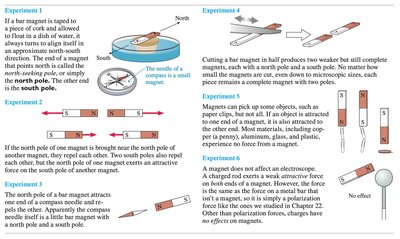
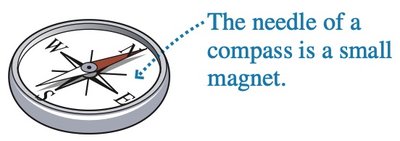
Magnetism is a fundamental property of certain materials, arising from their atomic structure. Magnets possess two distinct poles: the north pole and the south pole. The north pole is defined as the end of a magnet that points toward the geographic north when suspended freely. Compass needles are small magnets that align with Earth's magnetic field, allowing navigation.
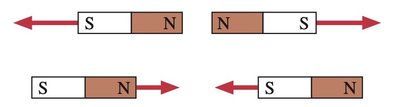
Like poles repel each other; unlike poles attract.
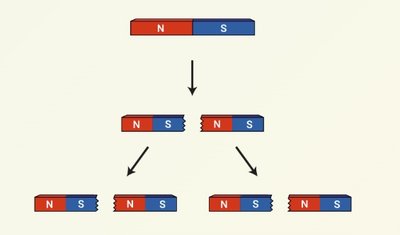
Breaking a magnet results in two smaller magnets, each with both a north and south pole—magnetic monopoles do not exist.
Magnets attract ferromagnetic materials (e.g., iron, nickel) but do not affect non-magnetic objects or electrostatic charges.
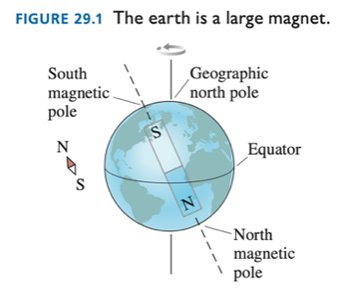
Earth's Magnetic Field
Earth as a Magnet
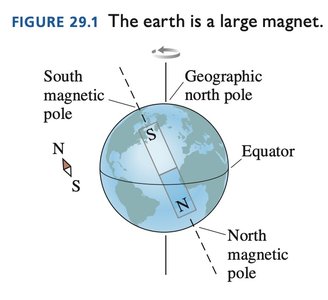
Earth itself acts as a giant magnet, with a magnetic field that extends from its core into space. The geographic north pole corresponds to Earth's magnetic south pole, and vice versa. This field is relatively weak compared to typical bar magnets but is crucial for navigation and protection from solar radiation.
Field strength at Earth's surface: 0.3–0.6 Gauss (30,000–60,000 nT).
Bar magnet field strength: 100–1000 Gauss (0.01–0.1 Tesla).
SI unit for magnetic field: Tesla (T); 1 Tesla = 10,000 Gauss.
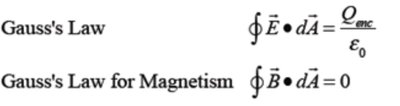
Magnetic Field Lines and Gauss's Law for Magnetism
Visualizing Magnetic Fields
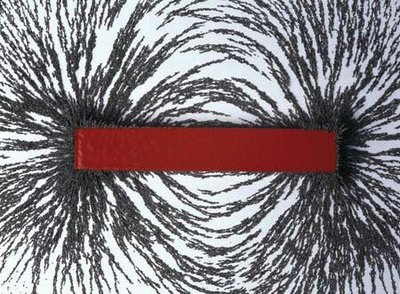
Magnetic field lines provide a visual representation of the direction and strength of magnetic forces. They flow from the north pole to the south pole outside the magnet, and their density indicates field strength. Field lines never intersect, and the pattern can be observed using iron filings.
Field lines are continuous loops—no isolated magnetic monopoles.
Gauss's Law for Magnetism states that the net magnetic flux through any closed surface is zero:
$\oint \vec{B} \cdot d\vec{A} = 0$
Magnetic Fields from Electric Currents
Current-Carrying Wires and Compass Response
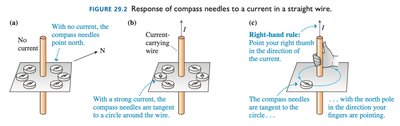
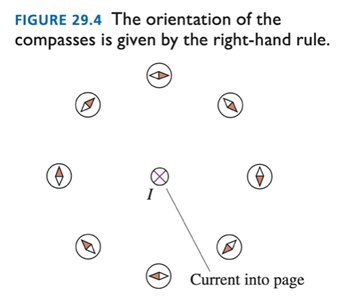
Electric currents generate magnetic fields. The direction of the magnetic field around a straight wire can be determined using the right-hand rule: point your thumb in the direction of the current, and your fingers curl in the direction of the magnetic field lines.
Compass needles placed around a current-carrying wire align tangentially to circles centered on the wire.
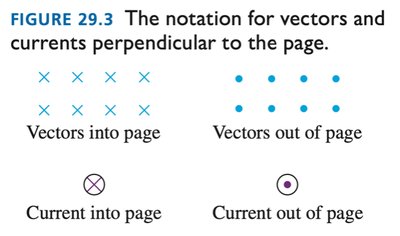
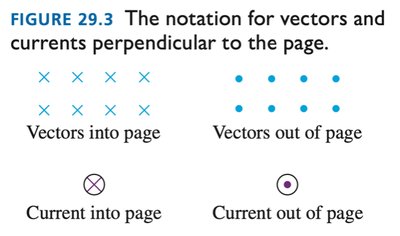
Notation for vectors and currents perpendicular to the page: '×' for into the page, '•' for out of the page.
Properties of the Magnetic Field
Definition and Effects
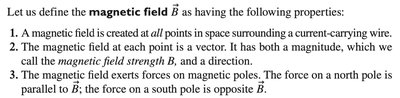
The magnetic field, denoted as $\vec{B}$, has several key properties:
Created at all points in space surrounding a current-carrying wire.
Each point has a vector value: magnitude (magnetic field strength $B$) and direction.
Exerts forces on magnetic poles: force on a north pole is parallel to $\vec{B}$; force on a south pole is opposite $\vec{B}$.
Biot-Savart Law: Magnetic Field from Moving Charges and Currents
Magnetic Field of a Moving Point Charge
The Biot-Savart Law describes the magnetic field generated by a moving point charge. The field's magnitude and direction depend on the charge's velocity, the distance from the charge, and the angle between the velocity and the position vector.
Formula for a moving point charge:
$\vec{B}_{\text{point charge}} = \frac{\mu_0 q v \sin \theta}{4 \pi r^2}$
Direction is given by the right-hand rule.
$\mu_0$ is the permeability of free space: $\mu_0 = 4\pi \times 10^{-7} \text{T} \cdot \text{m/A}$.

Biot-Savart Law for Current Segments
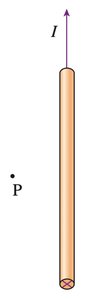
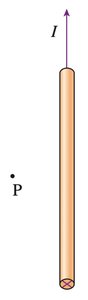
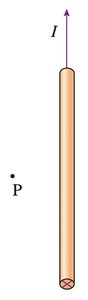
For a very short segment of current, the Biot-Savart Law is:
$\vec{B}_{\text{current segment}} = \frac{\mu_0 I \Delta \vec{s} \times \hat{r}}{4 \pi r^2}$
$I$ is the current, $\Delta \vec{s}$ is the segment vector, $\hat{r}$ is the unit vector from the segment to the observation point.
Cross Product and Magnetic Field Direction
Vector Cross Product
The cross product of two vectors yields a vector perpendicular to the plane formed by the original vectors. In magnetism, this operation determines the direction of the magnetic field and force.
Magnitude: $|\vec{C} \times \vec{D}| = CD \sin \alpha$
Direction: right-hand rule
Properties: $\vec{C} \times \vec{D} = -\vec{D} \times \vec{C}$; zero if vectors are parallel or antiparallel.

Magnetic Force on a Moving Charge
Force Equation and Right-Hand Rule
A charge $q$ moving with velocity $\vec{v}$ in a magnetic field $\vec{B}$ experiences a force:
$\vec{F}_{\text{on } q} = q \vec{v} \times \vec{B}$
Direction: right-hand rule; for negative charges, reverse the direction.
Force is perpendicular to both velocity and magnetic field.

Summary Table: Comparison of Electric and Magnetic Gauss's Laws
Law | Equation | Physical Meaning |
|---|---|---|
Gauss's Law (Electricity) | $\oint \vec{E} \cdot d\vec{A} = \frac{Q_{\text{enc}}}{\epsilon_0}$ | Net electric flux through a closed surface equals enclosed charge divided by permittivity. |
Gauss's Law for Magnetism | $\oint \vec{B} \cdot d\vec{A} = 0$ | No net magnetic flux; no magnetic monopoles exist. |
Notation for Vectors and Currents Perpendicular to the Page
Symbols Used in Diagrams
'×' denotes vectors or currents into the page.
'•' denotes vectors or currents out of the page.
Applications and Examples
Compass Response to Current-Carrying Wire
When a current flows through a straight wire, compass needles placed around the wire align tangentially to circles centered on the wire, demonstrating the circular nature of the magnetic field.
Right-Hand Rule for Current Direction
The right-hand rule is a fundamental tool for determining the direction of magnetic fields and forces in electromagnetism.
Magnetic Field of a Moving Point Charge
The Biot-Savart Law provides the mathematical framework for calculating the magnetic field produced by moving charges and currents.
Summary Table: Key Magnetic Field Formulas
Situation | Formula |
|---|---|
Point charge | $\vec{B}_{\text{point charge}} = \frac{\mu_0 q v \sin \theta}{4 \pi r^2}$ |
Current segment | $\vec{B}_{\text{current segment}} = \frac{\mu_0 I \Delta \vec{s} \times \hat{r}}{4 \pi r^2}$ |
Additional info: Academic context was added to clarify the physical meaning of the Biot-Savart Law, Gauss's Law for Magnetism, and the right-hand rule, as well as to provide definitions and examples for key terms and formulas.
