 Back
BackMomentum and Conservation of Momentum: Collisions and Explosions
Study Guide - Smart Notes
 Tailored notes based on your materials, expanded with key definitions, examples, and context.
Momentum and Conservation of Momentum
Introduction to Momentum
Momentum is a fundamental concept in physics that describes the quantity of motion an object possesses. It is defined as the product of an object's mass and velocity. The principle of conservation of momentum states that in a closed system with no external forces, the total momentum before an event (such as a collision or explosion) is equal to the total momentum after the event.
Momentum (p):
Conservation of Momentum:
Closed System: No net external force acts on the system.
Applications: Collisions (elastic, inelastic, perfect inelastic), explosions, and recoil problems.
Types of Collisions and Explosions
Classification of Collisions
Collisions are classified based on whether kinetic energy is conserved and how the objects behave after the collision. The main types are elastic, inelastic, perfect inelastic, and explosions.
Type | Is Momentum Conserved? | Is Energy Conserved? | Occurs in Real Life? |
|---|---|---|---|
Elastic Collision | Yes | Yes (kinetic energy conserved) | Rarely (idealized) |
Inelastic Collision | Yes | No (some energy lost as heat, sound, deformation) | Common |
Perfect Inelastic Collision | Yes | No (maximum energy loss, objects stick together) | Common (e.g., car crashes) |
Explosion | Yes | No (energy released, objects move apart) | Yes |
Recognizing Conservation of Momentum Problems
Identifying Problem Types
Conservation of momentum problems typically involve collisions or explosions where the system's total momentum is analyzed before and after the event. These are distinct from conservation of energy problems (which focus on energy transformations) and net force/motion problems (which involve acceleration and forces).
Conservation of Momentum: Collisions, explosions, recoil events.
Conservation of Energy: Energy transformations, work, and power.
Net Force/Motion: Problems involving acceleration, Newton's laws.
Worked Examples: Conservation of Momentum
Example 1: Marble Collision
A 0.025 kg marble (cat's eye) is rolled at 0.50 m/s towards a stack of marbles, kicking out a 0.100 kg steel marble. The cat's eye stops after the collision. Find the velocity of the steel marble.
Given: kg, m/s, kg,
Conservation of Momentum:
Since the cat's eye stops:
Calculation:
m/s (rounded to m/s)
Example 2: Conservation of Momentum in Angled Collisions
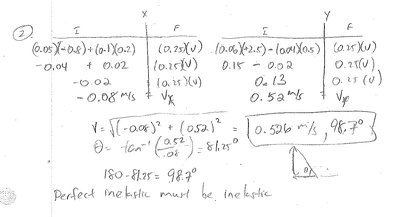
Four velcro-lined air-hockey disks collide in a perfect inelastic collision. The final velocity and direction are determined using vector addition and trigonometry.
Given: Masses and velocities of four disks in different directions.
Method: Resolve each velocity into x and y components, sum the momenta, and use vector addition to find the final velocity and angle.
Formula:
Angle:
Result: m/s,
Type: Perfect inelastic collision (objects stick together)
Example 3: Figure Skating Collision
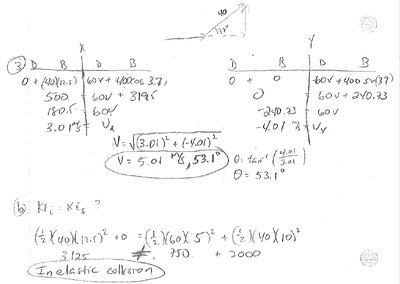
Becka (40.0 kg) collides with Danny (600 N). Becka's velocity changes direction after the collision. The final velocity of Danny is found using conservation of momentum in two dimensions.
Given: Becka's initial and final velocities, Danny's mass.
Method: Resolve velocities into components, apply conservation of momentum in x and y directions.
Calculation: m/s,
Type: Inelastic collision (kinetic energy not conserved)
Example 4: Energy Considerations in Collisions
In inelastic collisions, kinetic energy is not conserved. Some energy is transformed into other forms such as heat, sound, or deformation.
Kinetic Energy Before: (sum for all objects)
Kinetic Energy After: (sum for all objects)
Inelastic Collision:
Example: Figure skating collision shows J, J
Summary Table: Recognizing Conservation Problems
Problem Type | Key Features | Typical Equations |
|---|---|---|
Conservation of Momentum | Collisions, explosions, recoil | |
Conservation of Energy | Energy transformations, work | |
Net Force/Motion | Acceleration, Newton's laws |
Conclusion
Understanding the conservation of momentum is essential for analyzing collisions and explosions in physics. By classifying the type of collision and applying vector addition and conservation laws, students can solve a wide range of problems involving motion and energy.
