 Back
BackMomentum, Collisions, Impulse, and Center of Mass – Step-by-Step Physics Guidance
Study Guide - Smart Notes
 Tailored notes based on your materials, expanded with key definitions, examples, and context.
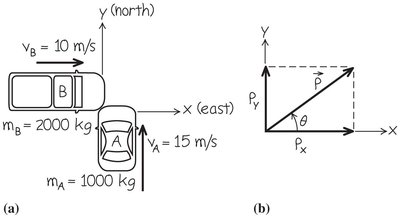
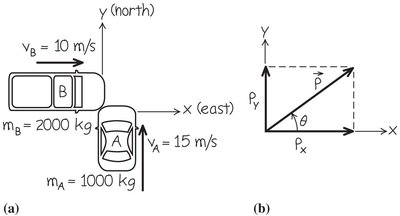
Q1. Calculate the total momentum of two moving objects: A 1000 kg car traveling north at 15 m/s and a 2000 kg truck traveling east at 10 m/s. Find the total momentum (magnitude and direction) just before the collision.
Background
Topic: Conservation of Momentum in Two Dimensions
This question tests your understanding of how to calculate the vector sum of momenta for two objects moving in perpendicular directions. It is a classic application of the momentum vector addition in two dimensions.
Key Terms and Formulas
Momentum ():
Vector Addition: The total momentum is the vector sum of the individual momenta.
Magnitude of a vector:
Direction (angle):
Step-by-Step Guidance
Calculate the momentum of the car (): . The car is moving north, so its momentum is in the direction.
Calculate the momentum of the truck (): . The truck is moving east, so its momentum is in the direction.
Write the momentum components: , ; , .
Add the and components to get the total momentum vector: , .
Set up the formulas for the magnitude and direction of the total momentum, but do not calculate the final values yet.
Try solving on your own before revealing the answer!
Final Answer:
The total momentum vector has a magnitude of kg·m/s and points north of east.
We used the Pythagorean theorem and arctangent to find the magnitude and direction from the and components.
Q2. A 0.300 kg glider moves right at 0.80 m/s on a frictionless track and collides head-on with a stationary 0.150 kg glider. (a) Find the magnitude and direction of the final velocity of each glider if the collision is elastic. (b) Find the final kinetic energy of each glider.
Background
Topic: Elastic Collisions in One Dimension
This question tests your ability to apply conservation of momentum and kinetic energy to solve for final velocities in an elastic collision between two objects.
Key Terms and Formulas
Conservation of Momentum:
Conservation of Kinetic Energy:
Elastic Collision Formulas (for and ):
Step-by-Step Guidance
Identify the masses and initial velocities: kg, m/s; kg, m/s.
Write the conservation of momentum equation for the system.
Write the conservation of kinetic energy equation for the system.
Use the elastic collision formulas to set up expressions for and .
Set up the kinetic energy expressions for each glider after the collision, but do not compute the final values yet.

Try solving on your own before revealing the answer!
Final Answer:
(a) m/s (right), m/s (right)
(b) J, J
We used the elastic collision formulas and plugged in the values for each glider.
Q3. A 270 caliber hunting rifle fires an 8.5 g bullet at 900 m/s. (a) What impulse does the burning gunpowder impart to the bullet? (b) If it takes 2 ms for the bullet to travel the barrel, what is the average force on the bullet? (Express your answer in pounds.)
Background
Topic: Impulse and Average Force
This question tests your understanding of impulse (change in momentum) and how to relate impulse to average force over a time interval.
Key Terms and Formulas
Impulse:
Average Force:
Unit Conversion: $1= 0.225$ lb (for force conversion)
Step-by-Step Guidance
Convert the bullet mass from grams to kilograms.
Calculate the impulse using (assuming the bullet starts from rest).
Convert the time from milliseconds to seconds.
Set up the formula for average force: .
Set up the conversion from Newtons to pounds, but do not compute the final value yet.
Try solving on your own before revealing the answer!
Final Answer:
(a) kg·m/s
(b) N lb
We calculated impulse from the bullet's change in momentum and divided by the time to get the average force, then converted to pounds.
Q4. Calculate the location of the center of mass of the earth–moon system (distance from the earth’s center). What can you say about the position of the center of mass with respect to the earth’s surface?
Background
Topic: Center of Mass for a Two-Body System
This question tests your ability to apply the center of mass formula to a system of two objects (Earth and Moon) and interpret the result physically.
Key Terms and Formulas
Center of Mass (one dimension):
Choose (Earth's center), (distance to Moon's center)
Step-by-Step Guidance
Identify the masses of Earth and Moon, and the distance between their centers (use data from a reference or appendix).
Set up the center of mass formula with and .
Plug in the values for , , and into the formula.
Interpret the result: Is the center of mass inside or outside the Earth?
Try solving on your own before revealing the answer!
Final Answer:
The center of mass is located about 4,700 km from Earth's center, which is inside the Earth but not at its center.
This means the Earth–Moon system's center of mass lies beneath Earth's surface.
