 Back
BackMotion in a Plane and Newton's Laws of Motion: Study Notes
Study Guide - Smart Notes
 Tailored notes based on your materials, expanded with key definitions, examples, and context.
Motion in a Plane
Velocity and Acceleration in a Plane
Motion in a plane involves analyzing the movement of objects in two dimensions, typically using vector quantities for velocity and acceleration. The velocity vector \( \vec{v} \) describes both the speed and direction of motion, while the acceleration vector \( \vec{a} \) indicates how the velocity changes over time.
Velocity (\( \vec{v} \)): The rate of change of displacement with respect to time.
Acceleration (\( \vec{a} \)): The rate of change of velocity with respect to time.
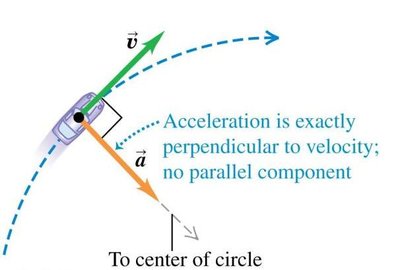
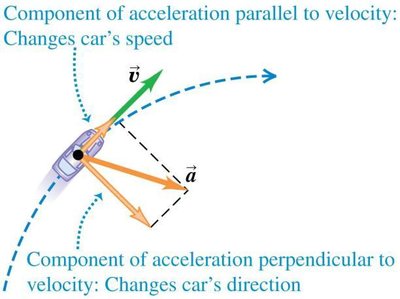
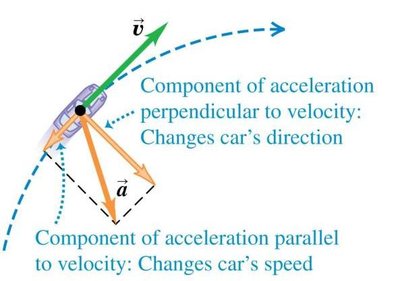
Acceleration can be decomposed into components parallel and perpendicular to the velocity vector.
Uniform Circular Motion
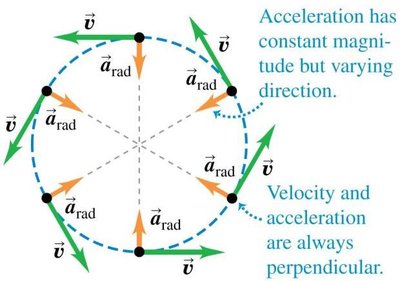
Uniform circular motion occurs when an object moves in a circle at constant speed. Although the speed is constant, the direction of the velocity changes continuously, resulting in a nonzero acceleration called centripetal acceleration.
Centripetal Acceleration (\( a_{\text{rad}} \)): Always points toward the center of the circle and is perpendicular to the velocity.
The magnitude of centripetal acceleration is given by:
Where \( v \) is the speed and \( R \) is the radius of the circle.
The period \( T \) is the time for one complete revolution:
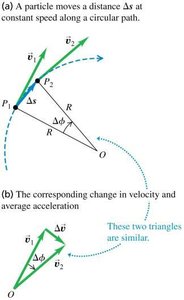

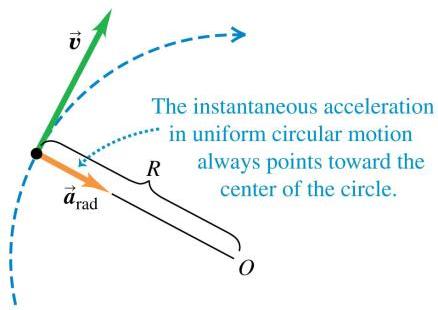
In uniform circular motion, acceleration has constant magnitude but its direction changes continuously, always pointing toward the center.
Example: Carnival Ride
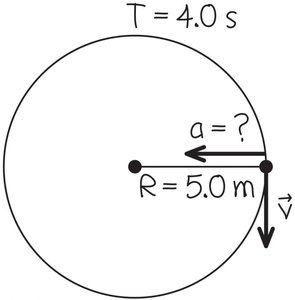
Passengers in a carnival ride travel in a circle of radius 5.0 m, completing one revolution in 4.0 s. The acceleration is calculated as:
Speed:
Centripetal acceleration: or
Projectile Motion
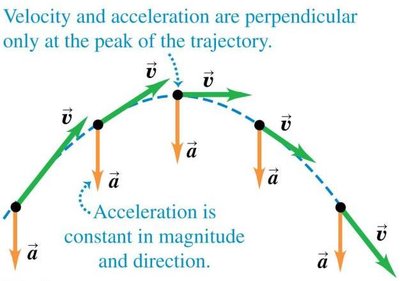
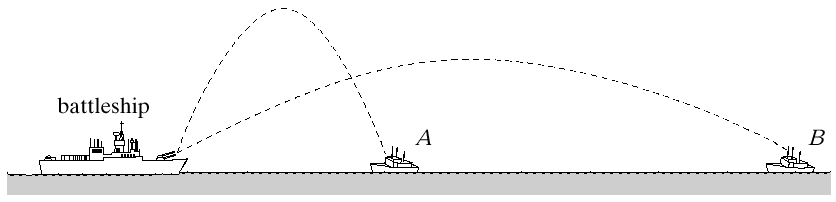
Projectile motion describes the two-dimensional motion of an object under the influence of gravity, following a parabolic trajectory. The horizontal and vertical motions are independent except for the time of flight.
Horizontal velocity remains constant (if air resistance is neglected).
Vertical velocity changes due to constant acceleration from gravity (\( g \)).
At the peak of the trajectory, velocity and acceleration vectors are perpendicular.
Newton's Laws of Motion
Force and Interactions
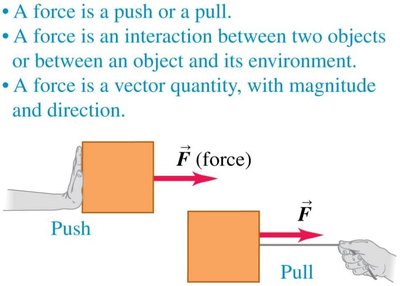
A force is a push or pull acting on an object, resulting from its interaction with another object or its environment. Forces are vector quantities, possessing both magnitude and direction.
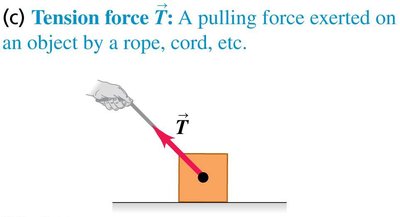
Contact forces: Result from physical contact (e.g., friction, tension, normal force).
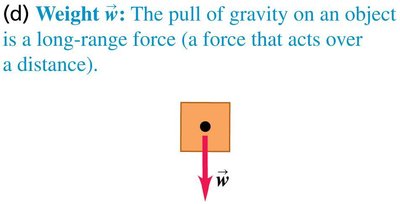
Long-range forces: Act over a distance (e.g., gravitational, magnetic).
Common Types of Forces
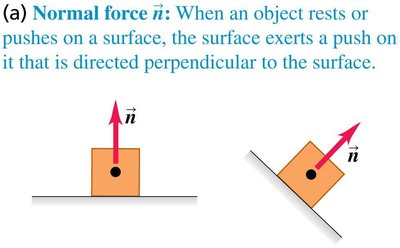
Normal Force (\( \vec{n} \)): Exerted by a surface, acts perpendicular to the surface.
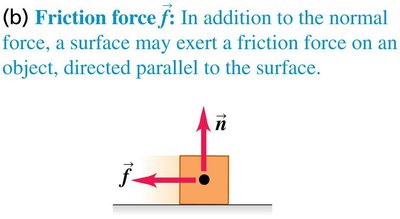
Friction Force (\( \vec{f} \)): Acts parallel to the surface, opposes motion.
Tension Force (\( \vec{T} \)): Pulling force exerted by a rope or cord.
Weight (\( \vec{w} \)): Gravitational force exerted by the Earth, acts downward.
Units and Magnitudes of Force
The SI unit of force is the newton (N):
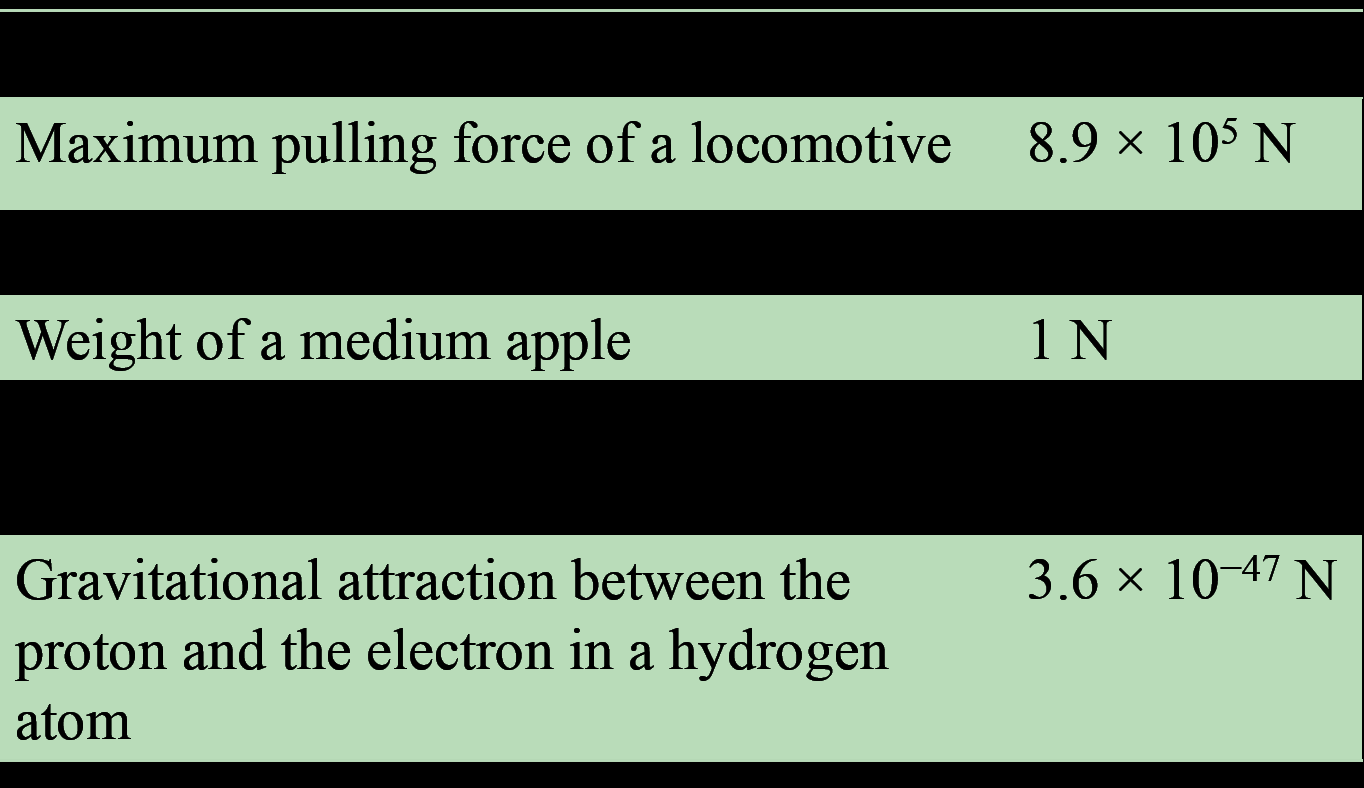
Forces can vary greatly in magnitude, from the pull of a locomotive to the gravitational attraction between subatomic particles.
Force | Magnitude |
|---|---|
Maximum pulling force of a locomotive | N |
Weight of a medium apple | 1 N |
Gravitational attraction between proton and electron in hydrogen atom | N |
Superposition of Forces
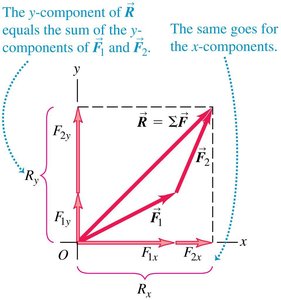
When multiple forces act on an object, their combined effect is the same as a single force equal to their vector sum, called the resultant or net force.
Forces are added using vector addition.
Components along perpendicular axes (x and y) can be summed separately.
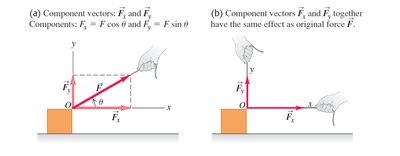
Decomposing Forces into Components
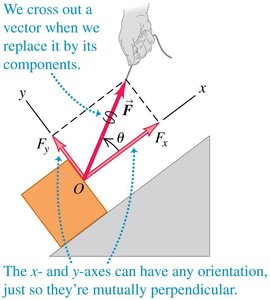
Any force vector can be resolved into perpendicular components, typically along the x- and y-axes. This is useful for analyzing forces acting at angles.
Given a force \( F \) at angle \( \theta \):
Newton's Three Laws of Motion
Newton's First Law (Law of Inertia)
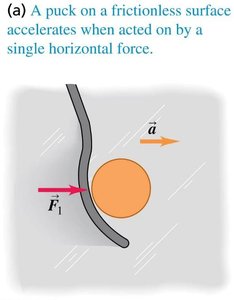
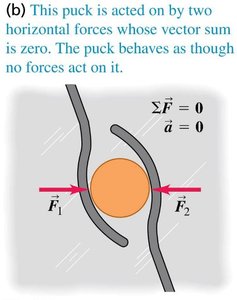
An object at rest remains at rest, and an object in motion continues in motion with constant velocity unless acted upon by a net external force. This property is called inertia.
If the net force on a body is zero, the body is in equilibrium:
Equilibrium means no acceleration occurs.

Newton's Second Law
If a net external force acts on a body, the body accelerates in the direction of the net force. The acceleration is proportional to the net force and inversely proportional to the mass:
Inertial mass: The ratio of net force to acceleration; a measure of an object's resistance to acceleration.
Unit of mass is the kilogram (kg).
Newton's Third Law
For every action, there is an equal and opposite reaction. If body A exerts a force on body B, then body B exerts a force of equal magnitude and opposite direction on body A. These forces act on different bodies.
Mass and Weight
Mass is a measure of an object's inertia, while weight is the gravitational force exerted on the object by the Earth:
Where \( g \) is the acceleration due to gravity (approximately 9.8 m/s2 on Earth).
The value of \( g \) varies with altitude and location.
Additional info: Some explanations and equations were expanded for clarity and completeness, and some table entries were inferred from context.
