 Back
BackMotion in Two or Three Dimensions: Position, Velocity, Acceleration, and Projectile Motion
Study Guide - Smart Notes
 Tailored notes based on your materials, expanded with key definitions, examples, and context.
Motion in Two or Three Dimensions
Introduction
Motion in two or three dimensions extends the concepts of kinematics from straight-line (one-dimensional) motion to more complex paths. This chapter covers the mathematical description of position, velocity, and acceleration as vectors, and applies these concepts to projectile and circular motion, as well as relative velocity in different frames of reference.
Position and Velocity Vectors
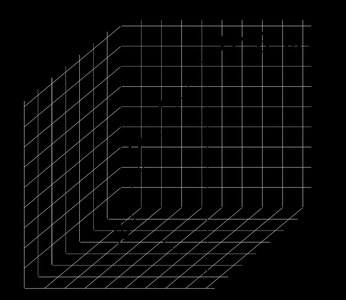
Specifying Position in 2 or 3 Dimensions
To describe the location of an object in space, we use a position vector that points from the origin to the object's location in a coordinate system. In two or three dimensions, this is typically represented as:
Position vector:
Displacement vector:
Displacement and Average Velocity
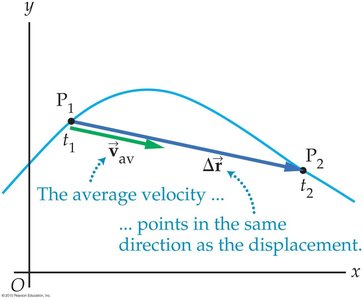
The displacement vector represents the change in position. The average velocity vector is the displacement divided by the time interval:
Average velocity:
Instantaneous Velocity
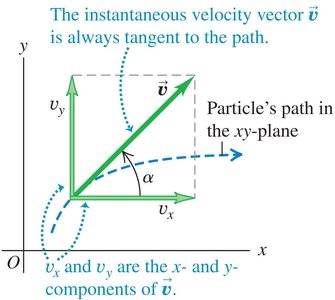
The instantaneous velocity is the rate of change of position at a specific instant and is always tangent to the path of motion:
Instantaneous velocity:
Speed is the magnitude of velocity and is always positive.
The Acceleration Vector
Average and Instantaneous Acceleration
The average acceleration is the change in velocity divided by the time interval, while the instantaneous acceleration is the rate of change of velocity at a specific instant:
Average acceleration:
Instantaneous acceleration:
Components of Acceleration
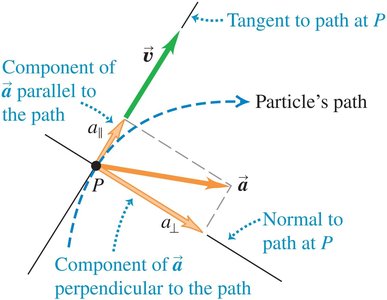
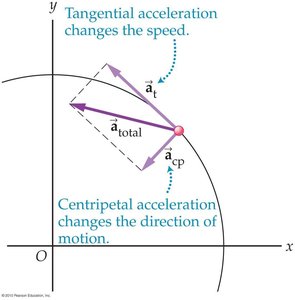
Acceleration can be decomposed into components parallel and perpendicular to the velocity vector. The parallel component changes the speed, while the perpendicular component changes the direction of motion.
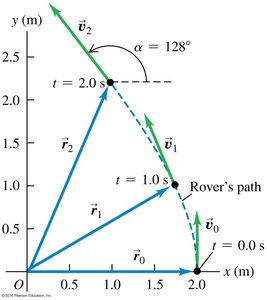
Example: Mars Rover Acceleration
Consider a Mars rover moving along a path. The direction of its average acceleration vector over a time interval is determined by the change in its velocity vector.
Projectile Motion
Definition and Assumptions
Projectile motion describes the motion of an object moving under the influence of gravity alone (assuming air resistance is negligible and gravity is constant). Examples include thrown balls, bullets, and jumping animals.
Gravity acts downward with constant acceleration .
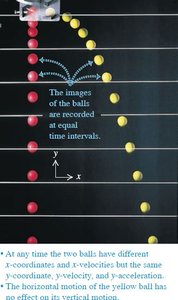
The motion can be separated into independent horizontal (x) and vertical (y) components.

Separation of Motion into Components
Projectile motion problems are solved by analyzing the horizontal and vertical motions separately:
Horizontal motion: (if )
Vertical motion:
Special Cases of Projectile Motion
Zero Launch Angle: The projectile is launched horizontally ().
Launch from Ground: The projectile is launched from and lands at the same height.
In both cases, the trajectory is a parabola described by a quadratic equation in and .
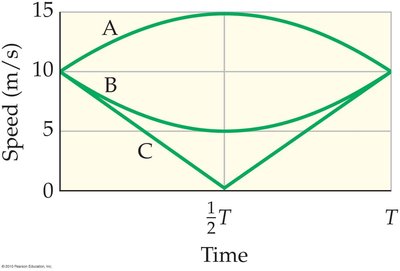
Speed vs. Time in Projectile Motion
The speed of a projectile changes due to gravity. At the peak of its trajectory, the vertical component of velocity is zero, but the horizontal component remains constant.
Range and Maximum Height
The range is the horizontal distance traveled before landing. For a projectile launched at an angle with initial speed :
Range:
Maximum height:
For a given range, two different launch angles (complementary angles) can yield the same range.
Motion in a Circle (Uniform Circular Motion)
Uniform Circular Motion
Uniform circular motion refers to motion along a circular path with constant speed. The direction of the velocity vector changes continuously, resulting in a nonzero acceleration even though the speed is constant.
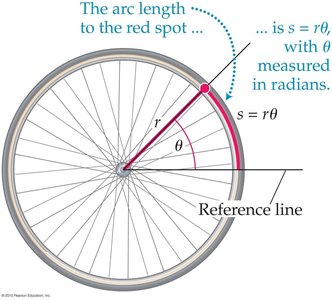
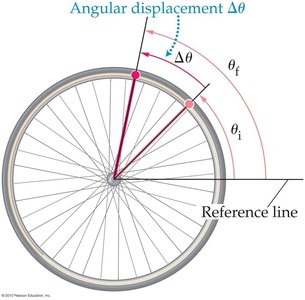
Angular displacement: (measured in radians)
Arc length:

Angular Velocity and Acceleration
Angular velocity: (SI unit: rad/s)
Angular acceleration:
Frequency and Period
Frequency (f): Number of revolutions per second (Hz)
Period (T): Time for one revolution ()
Centripetal Acceleration
In uniform circular motion, the acceleration vector always points toward the center of the circle (centripetal acceleration):
Centripetal acceleration:

Relative Velocity and Frames of Reference
Galilean Relativity
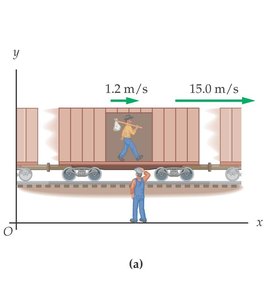
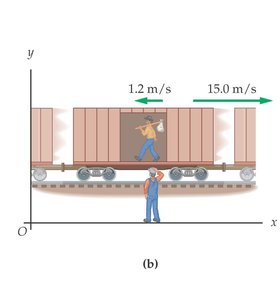
Relative velocity describes how the velocity of an object appears different in different reference frames. The classic example is a person walking inside a moving train:
Where is the velocity of the passenger relative to the ground, is the velocity relative to the train, and is the velocity of the train relative to the ground.

Relative Velocity in Two Dimensions
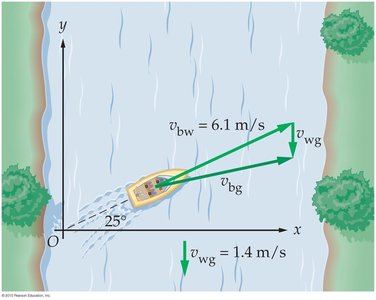
The same principle applies in two dimensions, such as a boat crossing a river with a current:
Vector addition is used to find the resultant velocity.
Worked Examples and Applications
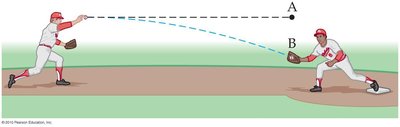
Baseball Throw
A baseball is thrown horizontally and caught at a certain distance. The horizontal distance and vertical drop can be calculated using the equations of projectile motion.
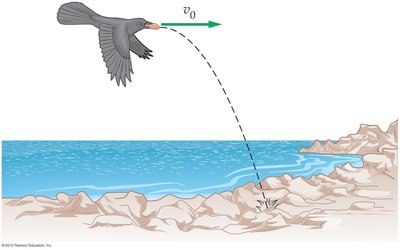
Crow Dropping a Clam
A crow flying horizontally drops a clam. The horizontal velocity remains constant, while the vertical velocity increases due to gravity.
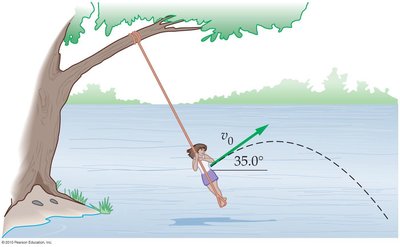
Rope Swing
A girl swings on a rope and lets go at an angle, becoming a projectile. The initial velocity and time of flight determine her height above the water.
Soccer Kick
A soccer ball is kicked at an angle. The velocity components at different times can be found using the kinematic equations for projectile motion.

Summary Table: Kinematic Quantities in Two or Three Dimensions
Quantity | Symbol | Equation | SI Unit |
|---|---|---|---|
Position | m | ||
Displacement | m | ||
Velocity | m/s | ||
Acceleration | m/s^2 | ||
Angular displacement | rad | ||
Angular velocity | rad/s | ||
Centripetal acceleration | m/s^2 |
Additional info: This summary includes expanded academic context and examples to ensure the notes are self-contained and suitable for exam preparation.
