 Back
BackMotion in Two or Three Dimensions: Study Notes
Study Guide - Smart Notes
 Tailored notes based on your materials, expanded with key definitions, examples, and context.
Motion in Two or Three Dimensions
Introduction to Multidimensional Motion
Motion in two or three dimensions extends the concepts of kinematics from straight-line (one-dimensional) motion to more complex paths, such as those followed by projectiles, vehicles, or celestial bodies. Understanding this motion requires the use of vectors to describe position, velocity, and acceleration.
Position, velocity, and acceleration are all vector quantities, meaning they have both magnitude and direction.
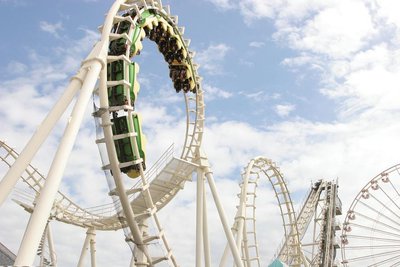
Examples include the flight of a baseball, the path of a roller coaster, or the orbit of a planet.
Vectors in Kinematics
Position Vector
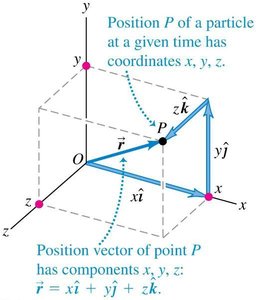
The position vector \( \vec{r} \) locates a particle in space relative to an origin. In three dimensions, it is expressed as:
\( \vec{r} = x \hat{i} + y \hat{j} + z \hat{k} \)
Where x, y, z are the coordinates of the particle at a given time.
Average and Instantaneous Velocity
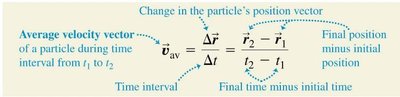
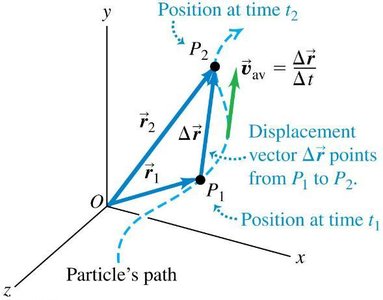
Average velocity is defined as the displacement divided by the time interval:
\( \vec{v}_{\text{av}} = \frac{\Delta \vec{r}}{\Delta t} = \frac{\vec{r}_2 - \vec{r}_1}{t_2 - t_1} \)
It points in the direction of the displacement vector.
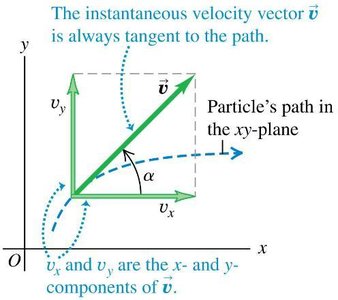
Instantaneous velocity is the rate of change of position with respect to time:
\( \vec{v} = \lim_{\Delta t \to 0} \frac{\Delta \vec{r}}{\Delta t} = \frac{d\vec{r}}{dt} \)
It is always tangent to the particle's path.

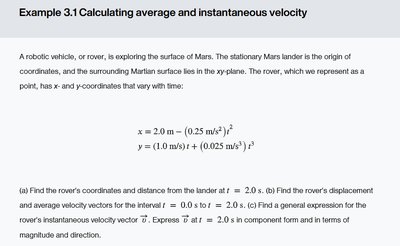
Example: Calculating Average and Instantaneous Velocity
Consider a robotic vehicle on Mars with position functions:
\( x = 2.0\,\text{m} - (0.25\,\text{m/s}^2)t^2 \)
\( y = (1.0\,\text{m/s})t + (0.025\,\text{m/s}^3)t^3 \)
Tasks include finding coordinates, displacement, average velocity, and instantaneous velocity at a given time.
Acceleration in Two or Three Dimensions
Average and Instantaneous Acceleration
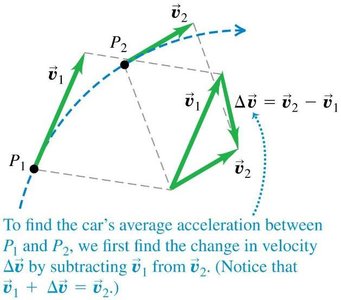
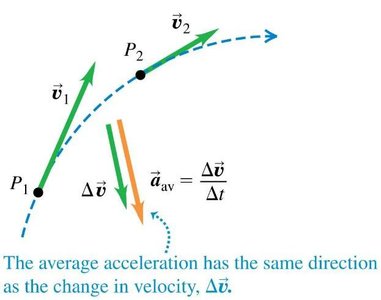
Acceleration describes how velocity changes with time. The average acceleration is:
\( \vec{a}_{\text{av}} = \frac{\Delta \vec{v}}{\Delta t} = \frac{\vec{v}_2 - \vec{v}_1}{t_2 - t_1} \)
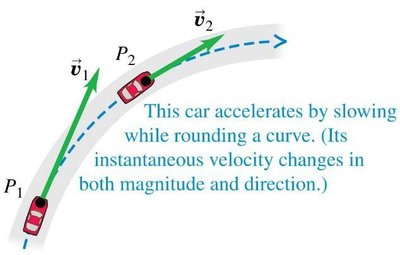
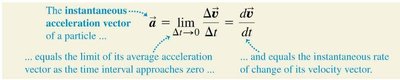
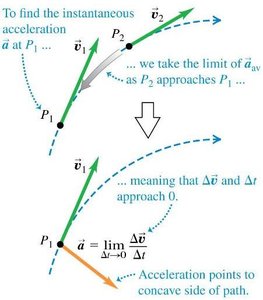
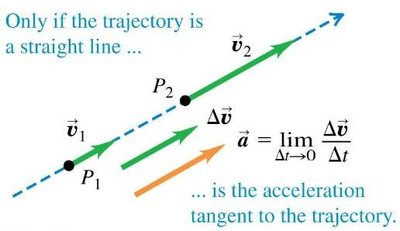
Instantaneous acceleration is the rate of change of velocity with respect to time:
\( \vec{a} = \lim_{\Delta t \to 0} \frac{\Delta \vec{v}}{\Delta t} = \frac{d\vec{v}}{dt} \)
Components of Acceleration
Each component of the acceleration vector is the time derivative of the corresponding velocity component:
\( a_x = \frac{dv_x}{dt} \)
\( a_y = \frac{dv_y}{dt} \)
\( a_z = \frac{dv_z}{dt} \)

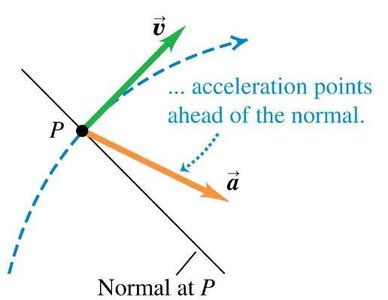
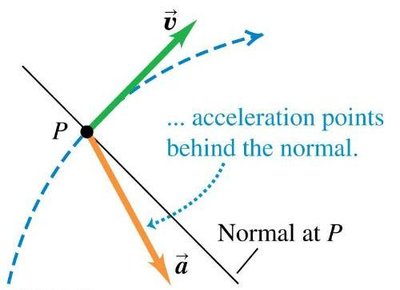
Parallel and Perpendicular Components of Acceleration
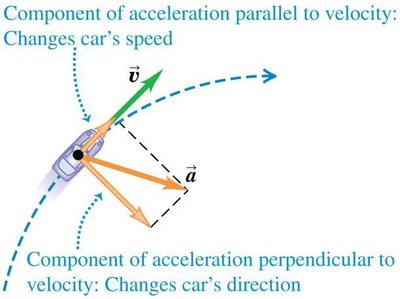
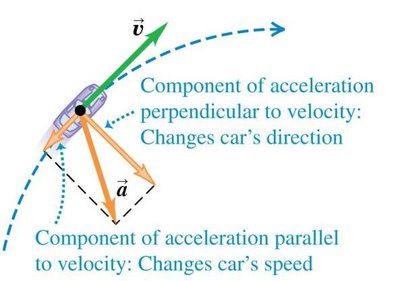
Acceleration can be decomposed into components parallel and perpendicular to the velocity:
The parallel component changes the speed.
The perpendicular component changes the direction of motion.
Projectile Motion
Basic Concepts
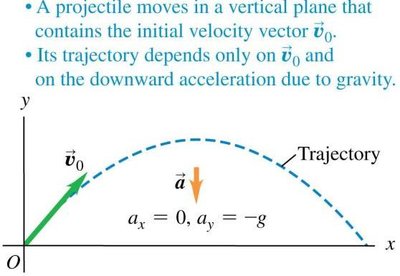
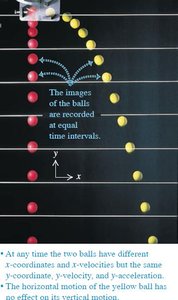
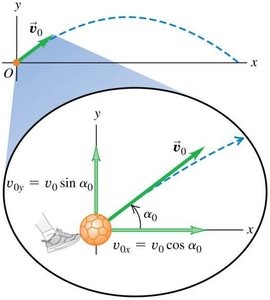
A projectile is any object given an initial velocity and then allowed to move under the influence of gravity (and possibly air resistance). The motion can be analyzed as independent horizontal and vertical components:
Horizontal acceleration: \( a_x = 0 \)
Vertical acceleration: \( a_y = -g \)
Initial Velocity Components
The initial velocity \( \vec{v}_0 \) can be broken into x and y components using the launch angle \( \alpha_0 \):
\( v_{0x} = v_0 \cos \alpha_0 \)
\( v_{0y} = v_0 \sin \alpha_0 \)
Effects of Air Resistance
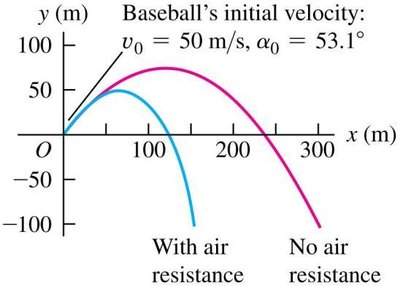
When air resistance is considered:
Acceleration is no longer constant.
Maximum height and range decrease.
The trajectory is no longer a perfect parabola.
Motion in a Circle
Uniform Circular Motion
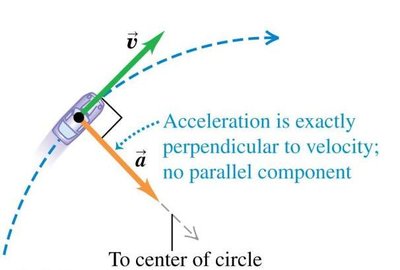
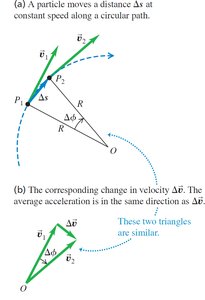
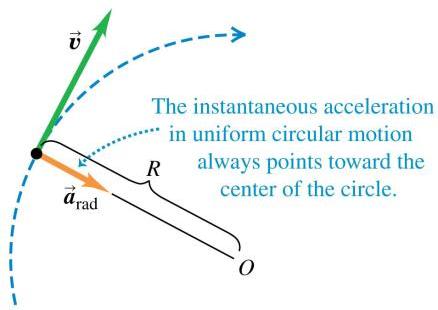
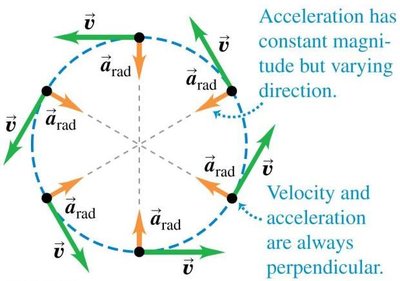
Uniform circular motion occurs when an object moves at constant speed along a circular path. The acceleration is always directed toward the center of the circle (centripetal acceleration):
\( a_{\text{rad}} = \frac{v^2}{R} \)
Velocity and acceleration are always perpendicular.

Nonuniform Circular Motion
If the speed varies, the motion is nonuniform circular motion. The acceleration has both radial (centripetal) and tangential components:
Radial: \( a_{\text{rad}} = \frac{v^2}{R} \)
Tangential: \( a_{\text{tan}} = \frac{dv}{dt} \)
Relative Velocity
Frames of Reference and Relative Velocity
The relative velocity of an object is its velocity as measured in a particular frame of reference. If point P moves relative to frame B, and frame B moves relative to frame A, then:
\( v_{P/A} = v_{P/B} + v_{B/A} \)
This relation extends to two or three dimensions using vector addition.
Example: If a boat moves east at 5 m/s relative to the water, and the water flows north at 3 m/s relative to the ground, the boat's velocity relative to the ground is the vector sum of these two velocities.
*Additional info: The notes above expand on the provided slides by including definitions, equations, and examples for clarity and completeness, as would be expected in a mini-textbook study guide.*
