 Back
BackNewton's Laws, Forces, and Friction – Study Guidance
Study Guide - Smart Notes
 Tailored notes based on your materials, expanded with key definitions, examples, and context.
Q1. Why does a book lying at rest on a table remain at rest?
Background
Topic: Newton's First Law (Law of Inertia)
This question tests your understanding of equilibrium and net force. Newton's First Law states that an object at rest will remain at rest unless acted upon by a net external force.
Key Terms and Formulas:
Net force (): The vector sum of all forces acting on an object.
Normal force (): The upward force exerted by a surface to support the weight of an object.
Weight (): The force of gravity acting downward on the object.
Step-by-Step Guidance
Identify the forces acting on the book: gravity pulls downward (), and the table pushes upward (normal force ).
Write the equation for equilibrium in the vertical direction: .
Since the forces are equal and opposite, the net force is zero (), so the book remains at rest.
Try solving on your own before revealing the answer!
Final Answer: There is no net force on the book.
The upward normal force from the table exactly balances the downward force of gravity, so the book stays at rest.
Q2. What is the net force acting on a hockey puck sliding on ice at constant velocity?
Background
Topic: Newton's First Law (Inertia and Equilibrium)
This question tests your understanding of motion at constant velocity and the concept of net force.
Key Terms and Formulas:
Net force (): The sum of all forces acting on the object.
Constant velocity: Means acceleration () is zero.
Newton's First Law: if .
Step-by-Step Guidance
Recognize that the puck is moving at constant velocity, so there is no acceleration ().
Apply Newton's First Law: If , then .
Conclude that the net force must be zero for the puck to continue moving at constant velocity.
Try solving on your own before revealing the answer!
Final Answer: The net force is zero.
Since the puck is not accelerating, Newton's First Law tells us the net force must be zero.
Q3. Why does a book slide forward off a bus seat when the bus stops suddenly?
Background
Topic: Newton's First Law (Inertia)
This question tests your understanding of inertia and how objects respond to changes in motion.
Key Terms and Formulas:
Inertia: The tendency of an object to resist changes in its state of motion.
Newton's First Law: Objects in motion stay in motion unless acted upon by a net force.
Step-by-Step Guidance
Consider the initial state: The book is moving forward with the bus.
When the bus stops, the book is not attached and continues moving forward due to inertia.
The book slides off because no net force acts to stop its forward motion immediately.
Try solving on your own before revealing the answer!
Final Answer: The book continues moving forward due to inertia.
Newton's First Law explains that the book keeps moving in its original direction when the bus stops.
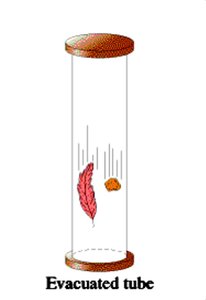
Q4. What can you say about the force of gravity acting on a stone and a feather?
Background
Topic: Gravity and Weight
This question tests your understanding of how gravitational force depends on mass.
Key Terms and Formulas:
Force of gravity ():
Mass (): Amount of matter in an object.
Acceleration due to gravity (): on Earth.
Step-by-Step Guidance
Recall that gravitational force depends on mass: .
Compare the masses: The stone has more mass than the feather.
Therefore, the stone experiences a greater force of gravity than the feather.
Try solving on your own before revealing the answer!
Final Answer: The force of gravity is greater on the stone.
Because the stone has more mass, it experiences a larger gravitational force.
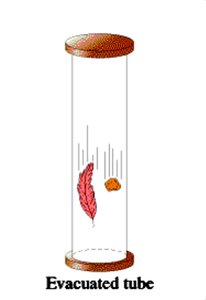
Q5. What can you say about the acceleration of gravity acting on the stone and the feather?
Background
Topic: Acceleration due to Gravity
This question tests your understanding of how gravitational acceleration is independent of mass.
Key Terms and Formulas:
Acceleration due to gravity (): on Earth.
Newton's Second Law:
Weight ():
Step-by-Step Guidance
Write the formula for acceleration: .
Substitute the force of gravity: .
Notice that mass cancels out, so both objects experience the same acceleration due to gravity.
Try solving on your own before revealing the answer!
Final Answer: Both experience the same acceleration due to gravity.
Regardless of mass, all objects fall with the same acceleration in the absence of air resistance.
Q6. An astronaut kicks a bowling ball on Earth and on the Moon with the same force. How does the pain in his foot compare?
Background
Topic: Mass vs. Weight, Newton's Second Law
This question tests your understanding of the difference between mass and weight, and how force relates to acceleration.
Key Terms and Formulas:
Mass (): Amount of matter, does not change with location.
Weight (): Force due to gravity, changes with .
Force (): Causes acceleration, .
Step-by-Step Guidance
Recognize that the mass of the bowling ball and astronaut is the same on Earth and Moon.
The force applied to the ball is the same in both cases.
The resistance felt by the astronaut's foot depends on the mass, not the weight, so the pain is the same.

Try solving on your own before revealing the answer!
Final Answer: The pain is the same.
The mass determines the resistance to acceleration, so the astronaut's foot hurts the same amount on Earth and Moon.
Q7. A block of mass m rests on the floor of an elevator moving upward at constant speed. What is the relationship between the force due to gravity and the normal force?
Background
Topic: Forces in Equilibrium, Newton's Laws
This question tests your understanding of normal force and weight when an object is moving at constant speed.
Key Terms and Formulas:
Normal force (): Upward force from the floor.
Weight (): Downward force due to gravity.
Equilibrium: when acceleration is zero.
Step-by-Step Guidance
Identify the forces: (up) and (down).
Since the elevator moves at constant speed, acceleration is zero.
Apply equilibrium: .
Try solving on your own before revealing the answer!
Final Answer: The normal force equals the weight ().
With no acceleration, the upward and downward forces are balanced.
Q8. A block of mass m rests on the floor of an elevator accelerating upward. What is the relationship between the force due to gravity and the normal force?
Background
Topic: Forces and Acceleration, Newton's Second Law
This question tests your understanding of how acceleration affects the normal force.
Key Terms and Formulas:
Normal force (): Upward force from the floor.
Weight (): Downward force due to gravity.
Newton's Second Law:
Step-by-Step Guidance
Write the force equation: (where is upward acceleration).
Rearrange: .
Since , is greater than .
Try solving on your own before revealing the answer!
Final Answer: The normal force is greater than the weight ().
Upward acceleration increases the normal force.
Q9. Consider two identical blocks, one resting on a flat surface, and the other resting on an incline. For which case is the normal force greater?
Background
Topic: Normal Force and Inclined Planes
This question tests your understanding of how the normal force changes with the angle of the surface.
Key Terms and Formulas:
Normal force (): Perpendicular force from the surface.
Weight (): Downward force due to gravity.
Inclined plane:
Step-by-Step Guidance
For the flat surface, .
For the incline, , where is the angle.
Since for , the normal force is less on the incline.
Try solving on your own before revealing the answer!
Final Answer: The normal force is greater for the block on the flat surface.
On the incline, the normal force is reduced by the cosine of the angle.
Q10. Why does a box slide off the back of a frictionless truck bed when the truck accelerates forward?
Background
Topic: Friction and Inertia
This question tests your understanding of how friction affects motion and why objects remain at rest when no force acts on them.
Key Terms and Formulas:
Friction: Force that opposes relative motion between surfaces.
Inertia: Tendency to resist changes in motion.
Step-by-Step Guidance
Recognize that the box is initially at rest relative to the truck.
When the truck accelerates, friction would normally push the box forward.
With no friction, there is no force to accelerate the box, so it stays at rest as the truck moves away.
Try solving on your own before revealing the answer!
Final Answer: The box remains at rest due to lack of friction.
Without friction, the box does not accelerate with the truck and slides off the back.
