 Back
BackNewton's Laws of Motion and Forces: Structured Study Notes
Study Guide - Smart Notes
 Tailored notes based on your materials, expanded with key definitions, examples, and context.
Newton's Laws of Motion and Forces
Fundamental Forces and Types of Forces
The study of dynamics in physics involves understanding the forces that govern the motion of objects. Forces can be categorized as contact forces or action-at-a-distance forces, and four fundamental forces exist in nature.
Contact Forces: These include collisions, pushing or pulling, friction, and tension. They require physical interaction between objects.
Action-at-a-Distance Forces: These are mediated by fields and include gravity and electromagnetism.
Four Fundamental Forces:
Gravity: Responsible for attraction between masses.
Electromagnetism: Governs electric and magnetic interactions.
Weak Nuclear Force: Responsible for certain types of radioactive decay.
Strong Nuclear Force: Binds protons and neutrons in the nucleus.
Force: An influence that can change an object's motion or shape. The SI unit is the Newton (N), defined as .
Vector Nature: Forces are vectors, meaning they have both magnitude and direction.
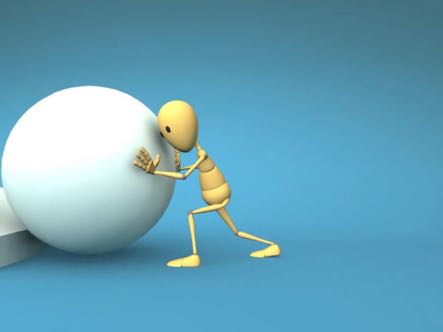
Example: Everyday forces such as pushing, pulling, and friction are manifestations of electromagnetic forces at the atomic level.
Superposition Principle and Net Force
The net force acting on an object is the vector sum of all individual forces. This is known as the superposition principle.
Net Force Equation:
Component Form:
Magnitude:
Direction:
Newton's Laws of Motion
Newton's First Law: Law of Inertia
Newton's First Law states that an object at rest remains at rest, and an object in motion continues in motion at a constant speed in a straight line unless acted upon by a nonzero net force.
Inertia: The tendency of an object to resist changes in its motion. It is a property of matter and does not depend on the object's position or location.
Mass (Inertial): Quantitative measure of inertia. SI unit: kilogram (kg).

Example: A passenger in a car continues moving forward when the car suddenly stops due to inertia.
Newton's Second Law: Law of Acceleration
Newton's Second Law relates the net force acting on an object to its acceleration and mass.
Equation:
Acceleration: Directly proportional to net force and inversely proportional to mass.
Multiple Objects: For a system,
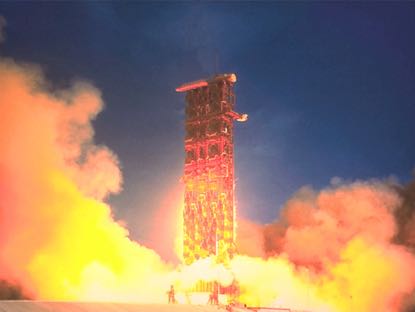
Example: The acceleration of a rocket is determined by the net force (thrust minus gravity and air resistance) and its mass.
Newton's Third Law: Law of Interaction
Newton's Third Law states that for every action, there is an equal and opposite reaction. When object A exerts a force on object B, object B exerts an equal and opposite force on object A.
Action-Reaction Pair: Forces always come in pairs, acting on different objects.
Forces do not cancel: Action and reaction forces do not cancel because they act on different objects.
Equation:
Example: When you push against a wall, the wall pushes back with an equal and opposite force.
Equilibrium
An object is in equilibrium when the net force acting on it is zero. This can occur when the object is at rest or moving at constant velocity.
Condition:
All forces must be balanced: Forces add up to zero.
Incorrect assumption: Zero net force does not mean no forces are acting; it means forces are balanced.
Tension in Ropes
When objects are connected by a rope or string, the tension force is transmitted along the rope. The mass of the rope is often neglected, and the tension is the same at all points.
Tension: Force exerted along the rope.
Equation: (for massless rope)
Equilibrium:
Weight and Normal Force
Weight is the force exerted by gravity on an object. The normal force is the reaction force exerted by a surface perpendicular to the object.
Weight:
On Earth:
On other planets: (where is the acceleration due to gravity on that planet)
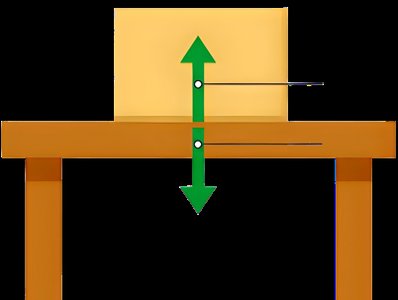
Normal Force: Always perpendicular to the surface. Balances the weight in equilibrium.
Equation: (on a flat surface)

Example: A box resting on a table experiences a downward force (weight) and an upward force (normal force).
Frictional Forces
Nature of Friction
Friction is a force that opposes the motion of objects. It arises due to surface roughness and chemical bonding at the microscopic level.
Sliding Friction: Occurs when objects slide over each other.
Coulomb's Law of Friction: Frictional force is proportional to the normal force.
Direction: Opposite to motion and parallel to the surface.
Coefficient of Friction (): Depends on the materials in contact.
Equation:

Example: The friction between a box and the floor depends on the normal force and the nature of the surfaces.
Static and Kinetic Friction
Frictional forces can be classified as static or kinetic. Static friction prevents motion, while kinetic friction acts during motion.
Static Friction: Can take any value up to a maximum ().
Kinetic Friction: Has a constant value ().
Coefficients:

Example: A box remains stationary until the applied force exceeds the maximum static friction. Once moving, kinetic friction takes over.
Summary Table: Static vs. Kinetic Friction
Type of Friction | Equation | Condition |
|---|---|---|
Static Friction | Object at rest | |
Kinetic Friction | Object in motion |
Additional info: The values of and depend on the materials and surface conditions.
